TL;DR
As an FCA-authorised expert broker that has helped arrange over 900,000 policies, WeCovr understands the UK private medical insurance market inside and out. This guide explains exactly what PMI is, who needs it, and what it costs in 2025, helping you make an informed decision for your health. How PMI works, who its for, and how much it costs in 2025 Private Medical Insurance (PMI), often called private health cover, is a type of insurance policy designed to cover the costs of private medical treatment for acute conditions.
Key takeaways
- You feel unwell. Your first port of call is usually your NHS GP. They will assess your symptoms.
- You receive a referral. If your GP believes you need to see a specialist, they will provide an 'open referral' letter.
- You contact your insurer. You call your PMI provider's claims line, explain the situation, and provide your referral details.
- Your claim is authorised. The insurer checks that your policy covers the condition and proposed treatment. They will then authorise the claim and may provide a list of approved specialists or hospitals.
- You book your appointment. You can now book your consultation and any subsequent tests or treatment at a private hospital or clinic at a time that suits you.
As an FCA-authorised expert broker that has helped arrange over 900,000 policies, WeCovr understands the UK private medical insurance market inside and out. This guide explains exactly what PMI is, who needs it, and what it costs in 2025, helping you make an informed decision for your health.
How PMI works, who its for, and how much it costs in 2025
Private Medical Insurance (PMI), often called private health cover, is a type of insurance policy designed to cover the costs of private medical treatment for acute conditions. It runs alongside the NHS, offering you more choice, flexibility, and faster access to specialist care when you need it most.
Think of it as a way to bypass potential waiting lists for eligible treatments, giving you peace of mind and control over your healthcare journey.
What is Private Medical Insurance (PMI)? A Simple Definition
At its core, PMI is a contract between you and an insurer. You pay a regular fee, called a premium, and in return, the insurer agrees to pay for private medical costs for specific conditions that arise after you take out your policy.
Its primary purpose is to diagnose and treat acute conditions – illnesses or injuries that are likely to respond quickly to treatment and return you to your previous state of health. This includes things like joint replacements, cataract surgery, or treatment for a newly diagnosed hernia.
PMI is a complement to the National Health Service (NHS), not a replacement. You will still use the NHS for accidents and emergencies, GP visits, and the management of long-term, chronic conditions.
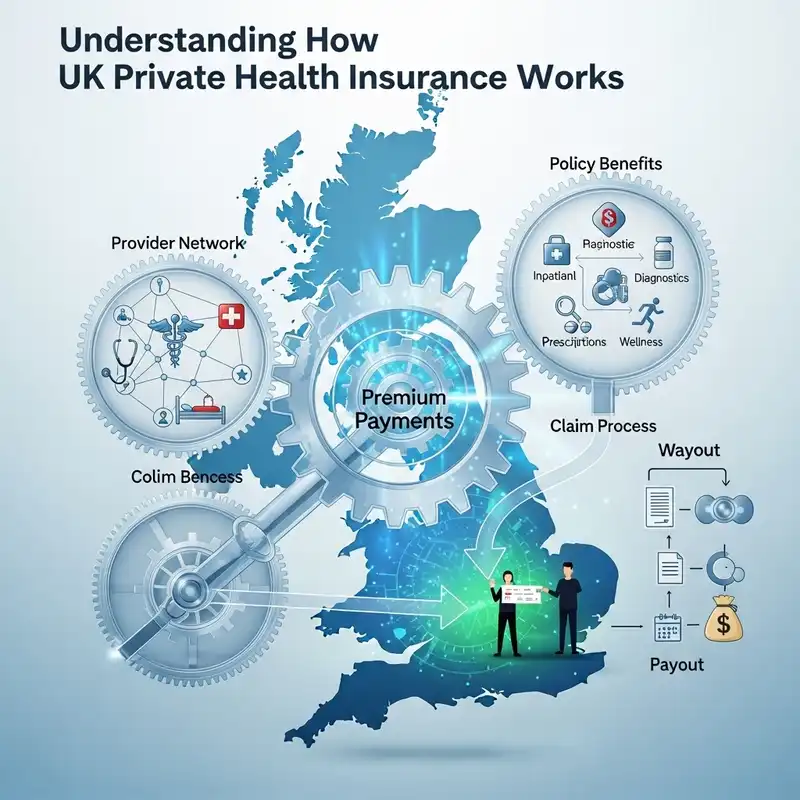
How Does Private Health Insurance Work in the UK?
Navigating the process is simpler than you might think. Here’s a typical journey:
- You feel unwell. Your first port of call is usually your NHS GP. They will assess your symptoms.
- You receive a referral. If your GP believes you need to see a specialist, they will provide an 'open referral' letter.
- You contact your insurer. You call your PMI provider's claims line, explain the situation, and provide your referral details.
- Your claim is authorised. The insurer checks that your policy covers the condition and proposed treatment. They will then authorise the claim and may provide a list of approved specialists or hospitals.
- You book your appointment. You can now book your consultation and any subsequent tests or treatment at a private hospital or clinic at a time that suits you.
- The insurer settles the bill. In most cases, the hospital will bill your insurance provider directly, so you don't have to worry about payments, apart from any excess you've agreed to pay.
Who is Private Medical Insurance For?
PMI can be valuable for a wide range of people in the UK.
- The Self-Employed and Business Owners: For those who run their own business, long waiting times can mean significant loss of income. PMI helps you get treated and back to work faster.
- Families: Parents often choose PMI to ensure their children can be seen by specialists quickly, avoiding the anxiety of long waits for diagnosis or treatment.
- Employees: Many companies offer private medical insurance UK as a highly valued employee benefit. This is known as a 'group scheme' and can often be more cost-effective than an individual policy.
- Retirees: While premiums are higher for older individuals, many retirees value the speed and comfort of private care, particularly for common age-related procedures like cataract surgery or hip replacements.
Essentially, if you want more control over when, where, and by whom you are treated for eligible conditions, PMI is worth considering.
What Does Private Health Insurance Typically Cover?
Policies are built around a core level of cover, with the option to add extra benefits. Understanding what's included is key.
| Typically Covered (Core) | Often Excluded or Requires an Add-on |
|---|---|
| In-patient and day-patient treatment: Costs for surgery and hospital stays where you need a bed, even for just a day. | Pre-existing conditions: Any illness or injury you had symptoms of or treatment for before your policy started. |
| Specialist consultations: Fees for seeing a consultant privately following a GP referral. | Chronic conditions: Long-term, incurable conditions like diabetes, asthma, or high blood pressure. PMI is for acute conditions. |
| Advanced diagnostics: Scans like MRI, CT, and PET to help diagnose your condition quickly. | Accident & Emergency: A&E services remain the responsibility of the NHS. |
| Cancer care: Most policies offer extensive cancer cover, including chemotherapy, radiotherapy, and surgery. This is often a cornerstone of PMI. | Routine GP services: You will continue to use your regular NHS GP. Some policies offer access to a private virtual GP service. |
| Hospital accommodation and nursing care: The cost of a private room in a private hospital. | Normal pregnancy and childbirth: Uncomplicated pregnancies are not covered, but complications may be. |
| Optional Add-ons: Policies can be enhanced with out-patient cover (for tests and consultations that don't require a hospital bed), dental and optical care, mental health support, and therapies. | Cosmetic surgery: Procedures that are not medically necessary. |
Understanding Underwriting: A Critical Choice
When you apply for PMI, the insurer needs to understand your medical history. This process is called 'underwriting', and it determines what will be excluded from your cover. There are two main types:
1. Moratorium Underwriting
This is the most common type. It's simpler and quicker because you don't have to fill out a detailed medical questionnaire.
- How it works: The policy automatically excludes any medical conditions for which you have had symptoms, medication, advice, or treatment in the 5 years before your policy start date.
- The '2-year rule': However, if you go for 2 continuous years on the policy without needing any treatment, advice, or medication for that specific condition, it may become eligible for cover.
2. Full Medical Underwriting (FMU)
This involves completing a comprehensive health questionnaire about your medical history.
- How it works: The insurer assesses your application and informs you upfront of any specific conditions that will be permanently excluded from your policy.
- The benefit: You have complete clarity from day one about what is and isn't covered. There are no grey areas.
| Feature | Moratorium Underwriting | Full Medical Underwriting (FMU) |
|---|---|---|
| Application Process | Quick and simple, no initial health forms. | Requires a detailed medical questionnaire. |
| Initial Exclusions | General exclusion for conditions from the last 5 years. | Specific, named exclusions based on your history. |
| Clarity | Less clarity at the start; claims can be slower. | Full clarity from day one; claims process is faster. |
| Covering Old Issues | Conditions can become eligible for cover after 2 years. | Exclusions are typically permanent. |
| Best For | People with a clean bill of health seeking a fast start. | People with a known medical history who want certainty. |
A Clear Warning: What PMI Does NOT Cover
It is absolutely vital to understand the limitations of private medical insurance in the UK. Misunderstanding this can lead to disappointment at the point of claim.
Standard PMI policies are designed to cover new, acute medical conditions that arise after you join.
They are not designed to cover:
- Pre-existing Conditions: Any disease, illness, or injury for which you have experienced symptoms, received medication, sought advice, or had treatment before your policy began. If you had investigations for back pain before taking out a policy, for example, treatment for that back pain will be excluded.
- Chronic Conditions: Long-term conditions that can be managed but not cured. This includes conditions like diabetes, asthma, high blood pressure, arthritis, and Crohn's disease. The day-to-day management of these conditions will remain with your NHS GP. While a policy might cover an acute flare-up of a chronic condition, the ongoing monitoring and treatment is not covered.
Always be honest and thorough when discussing your medical history. This ensures you have a clear understanding of your cover from the outset.
How Much Does Private Medical Insurance Cost in 2025?
The cost of a PMI policy, your premium, is highly personal. It depends on several factors:
- Age: Premiums increase as you get older, as the likelihood of needing treatment rises.
- Location: Treatment costs vary across the UK. London and the South East are typically more expensive.
- Cover Level: A comprehensive policy with full out-patient, dental, and therapy cover will cost more than a basic in-patient-only plan.
- Excess (illustrative): This is the amount you agree to pay towards a claim. A higher excess (£500 or £1,000) will lower your monthly premium.
- Hospital List: Insurers have different tiers of hospitals. Choosing a more limited list of local hospitals is cheaper than a list that includes prime central London facilities.
- Lifestyle: Smokers will pay significantly more than non-smokers.
To give you an idea, below are some illustrative monthly premium estimates for a non-smoker with a £250 excess on a mid-range policy in 2025.
| Age Group | Estimated Monthly Premium (Mid-Range Cover) |
|---|---|
| 20-29 | £35 - £50 |
| 30-39 | £45 - £70 |
| 40-49 | £60 - £95 |
| 50-59 | £85 - £140 |
| 60-69 | £130 - £220 |
Disclaimer: These are illustrative figures only. Your actual quote will depend on your individual circumstances and the insurer you choose. The best way to get an accurate price is to get a personalised quote.
How to Reduce Your Private Health Cover Premiums
Worried about the cost? There are several effective ways to make your policy more affordable:
- Increase Your Excess: Choosing a higher excess is one of the quickest ways to lower your premium.
- Opt for a 6-Week Wait: This option means your PMI will only kick in if the NHS waiting list for the eligible in-patient treatment you need is longer than six weeks. If you can be seen on the NHS within that time, you use the NHS. This can reduce premiums by up to 30%.
- Review Your Hospital List: Do you really need access to every hospital in the country, including the most expensive ones in London? Choosing a more restricted, local network can offer significant savings.
- Pay Annually: Most insurers offer a discount if you pay your premium for the full year upfront.
- Use an Expert Broker: A specialist PMI broker like WeCovr can be invaluable. We compare the market for you, finding the policy that best fits your needs and budget. Our service is free to you, as we are paid by the insurer.
Beyond Treatment: The Rise of Wellness Benefits
Modern private health cover is no longer just about being ill. The best PMI providers now include a wealth of wellness benefits designed to keep you healthy. These can include:
- Virtual GP Services: 24/7 access to a GP via phone or video call, often with the ability to get prescriptions delivered.
- Mental Health Support: Access to counselling sessions, talking therapies, and mental wellbeing apps.
- Health and Wellness Discounts: Reduced prices on gym memberships, fitness trackers, and health screenings.
- Rewards for Healthy Living: Some providers, like Vitality, have programmes that reward you with things like free coffee or cinema tickets for being active.
At WeCovr, we enhance this further. All our PMI clients receive complimentary access to our AI-powered calorie and nutrition tracking app, CalorieHero, to support their health goals. Furthermore, customers who purchase PMI or Life Insurance through us are eligible for discounts on other types of cover, adding even more value.
Choosing the Best PMI Provider in the UK
The UK market is home to several excellent, established insurers. The main players include:
- Aviva
- AXA Health
- Bupa
- The Exeter
- Vitality
- WPA (Western Provident Association)
There is no single "best" provider. The right choice for you depends entirely on your priorities. Are you looking for the most comprehensive cancer cover? The best mental health support? The lowest price? Or the most engaging wellness programme?
This is where an independent broker adds real value. We know the strengths and weaknesses of each provider and can match their products to your specific requirements, saving you hours of research and potential confusion.
Frequently Asked Questions (FAQs)
Is private health insurance worth it in the UK?
Can I get private health insurance if I have a pre-existing condition?
Do I still need the NHS if I have private medical insurance?
Ready to Find the Right Cover?
Navigating the world of private medical insurance can feel complex, but it doesn't have to be. Understanding your needs and comparing your options is the key to finding a policy that offers both value and peace of mind.
The expert, friendly team at WeCovr is here to help. We provide independent advice, compare policies from leading UK insurers, and find the right cover for your needs and budget — all at no cost to you.
Get your free, no-obligation quote today and take the first step towards faster healthcare.
Sources
- Office for National Statistics (ONS): Mortality, earnings, and household statistics.
- Financial Conduct Authority (FCA): Insurance and consumer protection guidance.
- Association of British Insurers (ABI): Life insurance and protection market publications.
- HMRC: Tax treatment guidance for relevant protection and benefits products.