TL;DR
UK 2025 Shock New Data Reveals Over 1 in 3 Working Britons Will Be Forced Into Early Retirement Due to Illness or Injury, Fueling a Staggering £4 Million+ Lifetime Income & Pension Gap – Is Your LCIIP Shield Your Unseen Retirement Plan & Legacy Preserver? The dream of a golden retirement, meticulously planned and eagerly anticipated, is a cornerstone of the British working life. We save, we invest, and we count down the years until we can swap the daily commute for hobbies, travel, and time with loved ones.
Key takeaways
- David (illustrative): An IT Manager earning £70,000 per year.
- Emily (illustrative): A Marketing Director earning £80,000 per year.
- Combined Income (illustrative): £150,000 per year.
- Planned Retirement Age: 67.
- Illustrative estimate: Combined annual income: £150,000
UK 2025 Shock New Data Reveals Over 1 in 3 Working Britons Will Be Forced Into Early Retirement Due to Illness or Injury, Fueling a Staggering £4 Million+ Lifetime Income & Pension Gap – Is Your LCIIP Shield Your Unseen Retirement Plan & Legacy Preserver?
The dream of a golden retirement, meticulously planned and eagerly anticipated, is a cornerstone of the British working life. We save, we invest, and we count down the years until we can swap the daily commute for hobbies, travel, and time with loved ones.
But a startling new projection for 2025 reveals a harsh reality lurking beneath the surface of these plans. Based on escalating trends in long-term sickness and economic inactivity, new analysis indicates that more than one in three (over 33%) of today’s working Britons will face an early, involuntary retirement due to a significant illness or injury.
This isn't a planned downshift in your late 50s. This is a sudden, health-driven halt to your career, potentially decades before your State Pension age. The financial consequences are nothing short of catastrophic. For a professional couple, this health shock can create a lifetime income and pension gap exceeding £4.5 million, wiping out decades of financial planning and jeopardising the future of your family and your legacy. (illustrative estimate)
The question is no longer if you should plan for this, but how. In this definitive guide, we will unpack this looming crisis and reveal how a robust Life, Critical Illness, and Income Protection (LCIIP) shield is no longer a "nice-to-have," but an essential component of your retirement and legacy planning.
The Ticking Time Bomb: Unpacking the 2025 UK Early Retirement Crisis
The headline figure—one in three forced into early retirement—may seem shocking, but it's a projection grounded in alarming, real-world data. The UK is currently grappling with a public health crisis that is silently dismantling its workforce.
According to the latest Office for National Statistics (ONS) figures, the number of people economically inactive due to long-term sickness has surged to a record high of over 2.8 million. This represents a staggering increase of nearly 700,000 people since the start of the decade. This isn't just an issue for those nearing retirement; the sharpest increases are being seen in younger age groups, particularly those aged 25-34.
What is driving this trend? It’s a combination of factors, including an ageing population, NHS waiting lists, and a notable rise in specific health conditions.
Leading Causes of Long-Term Work Absence in the UK:
| Rank | Condition Category | Primary Examples | Key Statistics & Trends (2024/2025 Projections) |
|---|---|---|---|
| 1 | Mental Health Conditions | Depression, Stress, Anxiety Disorders | Now the single biggest cause of work-related illness. The Centre for Mental Health estimates the economic cost of mental ill health in England alone to be over £117.9 billion annually. |
| 2 | Musculoskeletal (MSK) Issues | Back Pain, Neck/Upper Limb Problems, Arthritis | Responsible for over 22% of long-term sickness absence. ONS data shows over 5 million people reporting chronic back pain. |
| 3 | Cancer | Breast, Prostate, Lung, Bowel Cancer | Macmillan Cancer Support estimates that over 1 million people of working age are living with cancer in the UK. Many face long-term side effects impacting their ability to work. |
| 4 | Cardiovascular Diseases | Heart Attack, Stroke, Heart Failure | The British Heart Foundation states there are 7.6 million people living with heart and circulatory diseases in the UK, causing thousands to leave work prematurely each year. |
| 5 | Neurological Conditions | Multiple Sclerosis, Parkinson's Disease, Motor Neurone Disease | The Neurological Alliance reports that 1 in 6 people live with a neurological condition, many of which are progressive and impact working capacity over time. |
The dream of working until 67 is becoming a statistical improbability for a huge portion of the population. Relying on hope as a strategy is no longer viable.
The £4.5 Million Chasm: Calculating the True Cost of a Health-Forced Retirement
The term "income gap" doesn't do justice to the financial abyss created by a premature, health-forced retirement. Let's quantify it to understand the sheer scale of the risk.
Consider a hypothetical professional couple, David and Emily, both aged 40.
- David (illustrative): An IT Manager earning £70,000 per year.
- Emily (illustrative): A Marketing Director earning £80,000 per year.
- Combined Income (illustrative): £150,000 per year.
- Planned Retirement Age: 67.
At age 40, David is diagnosed with Multiple Sclerosis, and a year later, Emily suffers a severe stroke. While they may be able to work in a reduced capacity for a short time, their consultants advise that full-time, high-pressure work is no longer possible. They are forced into retirement 26 years ahead of schedule.
Let's break down their financial devastation:
1. The Colossal Loss of Future Earnings: This is the most immediate and largest part of the financial gap.
- Illustrative estimate: Combined annual income: £150,000
- Years of lost work until age 67: 26 years
- Illustrative estimate: Total Lost Gross Income (pre-tax, no pay rises): £150,000 x 26 = £3,900,000
This figure doesn't even account for the probable salary increases, bonuses, and promotions they would have received over the next two and a half decades.
2. The Evaporation of the Pension Pot: The loss isn't just the contributions; it's the magical effect of compound growth over 26 years.
- Annual Pension Contributions: Let's assume a standard 5% employee and 3% employer contribution (8% total).
- Illustrative estimate: Annual contribution amount: 8% of £150,000 = £12,000
- Illustrative estimate: Total raw contributions lost: £12,000 x 26 = £312,000
- The Real Loss (illustrative): That £312,000 isn't the true figure. We need to calculate the lost investment growth. If that £12,000 per year was invested for 26 years with an average annual growth of 5%, the final pension pot would have been worth approximately £613,000. This is the growth they have lost.
3. The Decimation of State Benefits:
- State Pension (illustrative): To receive the full State Pension, you need around 35 qualifying years of National Insurance (NI) contributions. By stopping work at 41, both David and Emily will have a significant shortfall, leading to a permanently reduced State Pension for the rest of their lives. This could easily equate to a loss of over £100,000 each in retirement income over a 20-year retirement.
- Employment and Support Allowance (ESA) (illustrative): The "safety net" many believe will catch them provides a maximum of around £138.20 per week (as of 2024/25 rates) for those in the support group. This is a tiny fraction of their previous income.
The Staggering Total Financial Gap:
| Financial Component | Estimated Loss for David & Emily |
|---|---|
| Lost Future Gross Earnings | £3,900,000 |
| Lost Future Pension Pot Value (with growth) | £613,000+ |
| Reduced State Pension (combined) | £200,000+ |
| Total Estimated Financial Chasm | £4,713,000+ |
This £4 Million+ figure doesn't even include additional costs like private medical treatments, home adaptations, or potential long-term care needs. It is a legacy-destroying, life-altering financial black hole.
Your Financial First Responders: A Deep Dive into the LCIIP Shield
Faced with such a daunting risk, it's easy to feel powerless. But you are not. A powerful suite of financial protection products, which we call the LCIIP Shield, is specifically designed to step in when a health crisis strikes.
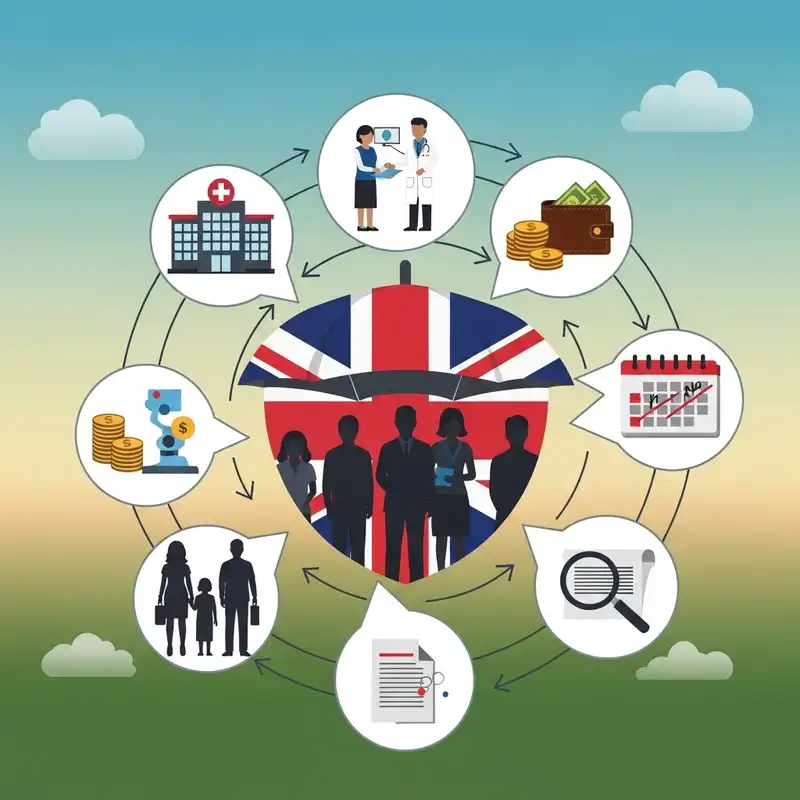
LCIIP stands for Life Insurance, Critical Illness Cover, and Income Protection. They work together to form a comprehensive financial fortress around you and your family.
1. Income Protection (IP): Your Monthly Salary Replacement
Often considered the most crucial part of the shield for working adults, Income Protection is your financial lifeline.
- What it is: A policy that pays you a regular, tax-free monthly income if you are unable to work due to any illness or injury that prevents you from doing your job.
- How it works: After a pre-agreed waiting period (known as the 'deferred period', typically 1, 3, 6, or 12 months), the policy starts paying out. You can typically cover up to 60-70% of your gross salary.
- The crucial feature: You can choose a payment period that lasts right up until your planned retirement age (e.g., 67). In the case of David and Emily, a robust IP policy would have replaced a significant portion of their monthly income for the next 26 years, allowing them to cover bills, mortgage payments, and living expenses.
2. Critical Illness Cover (CIC): Your Lump Sum Financial Reset
While IP replaces your income, Critical Illness Cover provides a significant capital injection at a time of immense stress.
- What it is: A policy that pays out a one-off, tax-free lump sum upon diagnosis of one of a list of specified serious conditions (e.g., heart attack, stroke, cancer, multiple sclerosis).
- How it works: The list of conditions covered is extensive and defined in the policy. Upon a qualifying diagnosis, the insurer pays the sum assured directly to you.
- How it helps: This lump sum is incredibly flexible. It could be used to:
- Clear your entire mortgage, instantly removing your largest monthly outgoing.
- Adapt your home for new mobility needs.
- Pay for private medical treatment or specialist therapies to aid recovery.
- Create an investment fund to generate a future income.
- Simply provide a financial cushion to reduce stress and allow you to focus on your health.
3. Life Insurance: Your Legacy Preserver
Life Insurance is the final, fundamental layer of the shield, ensuring your family's future is secure if the worst should happen.
- What it is: A policy that pays out a tax-free lump sum to your beneficiaries upon your death.
- How it works: You choose a level of cover and a term (e.g., until your children are independent or the mortgage is paid off). If you pass away during the term, the policy pays out.
- Its role in the shield: It ensures that even if your health crisis ultimately shortens your life, your financial commitments are met, and your family's future is not compromised. It can pay off any remaining debts and provide a substantial inheritance, preserving the legacy you worked so hard to build.
The LCIIP Shield at a Glance:
| Protection Type | What It Does | How It Pays | Key Purpose |
|---|---|---|---|
| Income Protection | Replaces lost earnings if you can't work. | Monthly Tax-Free Income | Covers ongoing living costs. |
| Critical Illness Cover | Provides capital on diagnosis of a serious illness. | One-Off Tax-Free Lump Sum | Clears debt, funds big-ticket costs. |
| Life Insurance | Provides for dependents upon your death. | One-Off Tax-Free Lump Sum | Secures your family's legacy. |
Beyond the Payout: The Hidden Value-Adds of Modern Protection Policies
A common misconception is that insurance policies just sit there until you claim. Today, the best policies are active partners in your health and wellbeing from day one. Insurers know that keeping you healthy is good for everyone.
This is why most leading UK protection policies now come bundled with a suite of incredibly valuable support services, often available to you and your immediate family at no extra cost. These can include:
- 24/7 Virtual GP: Skip the NHS waiting times and get a video consultation with a UK-based GP anytime, from anywhere in the world. Get prescriptions, referrals, and peace of mind in minutes.
- Mental Health Support: Access to a specified number of therapy or counselling sessions with accredited professionals to help with stress, anxiety, or depression.
- Second Medical Opinion Services: If you receive a serious diagnosis, you can have your case reviewed by a world-leading expert to confirm the diagnosis and explore all available treatment options.
- Physiotherapy & Rehabilitation: Get access to early intervention for musculoskeletal issues to prevent them from becoming long-term problems.
- Nutritional Support & Health MOTs: Proactive services to help you manage your health and lifestyle.
Here at WeCovr, we passionately believe in this holistic approach to wellbeing. It's why, in addition to finding you the most comprehensive policy, we also provide our clients with complimentary access to CalorieHero, our proprietary AI-powered calorie and nutrition tracking app. We see it as our duty to not only provide a financial safety net but also to empower our clients with tools to live healthier lives.
Case Study: The Tale of Two Retirements - Sarah vs. Mark
To see the profound impact of the LCIIP shield, let's compare two individuals facing the same health shock.
Mark, 48, a Graphic Designer - Unprotected
Mark was self-employed and earned a good income of £55,000. He considered income protection but felt it was an expense he could put off. At 48, a sudden, severe back injury from a fall left him with chronic pain and unable to sit at a desk for long periods. His career was over. (illustrative estimate)
- The Aftermath: Mark's income stopped overnight. His savings were depleted within 18 months covering his mortgage and bills. He and his wife had to sell their family home to downsize and release equity. The stress put an immense strain on his marriage and his mental health. He applied for state benefits but the amount was barely enough to survive on. His pension pot, which he'd been diligently building, was now frozen, its potential growth stunted. His dream of leaving a comfortable inheritance for his children vanished.
Sarah, 48, an Architect - Protected
Sarah, earning a similar £60,000, had worked with an adviser a few years earlier to put a robust LCIIP shield in place. At 48, she was diagnosed with breast cancer. The treatment was gruelling and meant she had to stop working for at least two years, with an uncertain long-term prognosis. (illustrative estimate)
- The Aftermath:
- Critical Illness Payout (illustrative): Her £150,000 critical illness policy paid out within weeks of diagnosis. She used £120,000 to clear the remaining balance on her mortgage, eliminating her biggest worry. The remaining £30,000 was set aside for any additional costs or a well-deserved family holiday after her treatment.
- Income Protection Kicks In (illustrative): After her three-month deferred period, her income protection policy began paying her £3,000 tax-free each month. This replaced the majority of her take-home pay.
- The Result: Sarah could focus 100% on her recovery. There was no financial pressure, no arguments about money, and no need to touch her pension or savings. Her family's standard of living was maintained. Her life insurance policy remained in place, giving her peace of mind that her family's future was secure no matter what. She had control, dignity, and security when she needed them most.
Navigating the Maze: How to Build Your Personal LCIIP Fortress
Building the right protection shield isn't about buying a one-size-fits-all product off the shelf. It requires a thoughtful assessment of your unique circumstances.
1. Assess Your Needs (The Big Questions):
- Income: How much of your monthly income would you need to maintain your lifestyle? (Cover bills, mortgage, food, etc.).
- Debts: What is your outstanding mortgage? Do you have car loans or credit card debts that would need clearing?
- Dependents: How long do your children need financial support? Do you care for elderly parents?
- Existing Cover: What protection do you have through your employer? Is it sufficient? Crucially, is it portable if you leave your job?
2. Understand the Jargon:
- 'Own Occupation' Cover: This is the gold standard for Income Protection. It means the policy will pay out if you are unable to do your specific job. Less comprehensive definitions like 'Suited Occupation' or 'Any Occupation' can make it much harder to claim.
- Guaranteed vs. Reviewable Premiums: Guaranteed premiums are fixed for the life of the policy, providing certainty. Reviewable premiums may be cheaper initially but can increase over time, potentially becoming unaffordable when you need the cover most.
- Deferred Period: This is the waiting period for Income Protection. A longer deferred period (e.g., 6 months) means a lower premium, but you'll need sufficient savings to bridge the gap.
3. The Golden Rule: Full Disclosure When applying for insurance, you must be completely honest about your medical history, lifestyle (smoking, drinking), and occupation. Withholding information can give an insurer grounds to void your policy at the point of claim, which would be a devastating outcome.
4. Why Use an Expert Broker like WeCovr? The protection market is complex, with dozens of insurers and hundreds of policy variations. An expert, independent broker is your indispensable guide.
At WeCovr, we don't work for an insurance company; we work for you.
- We search the entire market from leading providers like Aviva, Legal & General, Royal London, and Zurich to find the policy with the best definitions and value for your specific needs.
- We help you with the application, ensuring it's completed correctly to avoid any issues down the line.
- We place your policy 'in trust', which can help the payout fall outside of your estate for inheritance tax purposes and ensures the money gets to your loved ones faster.
- We are your advocate at claim time, providing support and guidance when you need it most.
Common Questions & Misconceptions about Protection Insurance
Scepticism is natural, but much of it is based on outdated myths. Let's set the record straight.
| Myth | The Reality |
|---|---|
| "Insurers never pay out." | Fact: This is the biggest myth. The Association of British Insurers (ABI) reports that in 2022, the industry paid out over 97.3% of all protection claims, totalling over £6.8 billion. That's over £18.6 million paid to families every single day. |
| "It's too expensive." | Fact: The cost of not having cover is infinitely higher (see the £4.5M gap). A comprehensive policy for a healthy 35-year-old can cost less than a daily coffee or a monthly streaming subscription. The peace of mind is priceless. |
| "I'm young and healthy." | Fact: Illness and injury do not discriminate by age. As the ONS data shows, long-term sickness is rising fastest among younger people. Getting cover when you are young and healthy means lower premiums for life. |
| "I have cover through work." | Fact: While a great perk, 'death-in-service' or group income protection is often limited. It's rarely enough to cover all your needs, it's not portable if you change jobs, and it ceases the moment you are made redundant or leave. It's a temporary safety net, not a personal fortress. |
| "The state will look after me." | Fact: State benefits like Employment and Support Allowance (ESA) or Universal Credit provide a subsistence-level income, not a lifestyle-maintaining one. They are a safety net of last resort and will not protect your home, pension, or legacy. |
Your Retirement: Don't Leave It to Chance
The data is clear. The risk of your carefully laid retirement plans being derailed by a health shock is significant and growing. While we cannot always control our health, we can absolutely control how we prepare for the financial consequences.
Your ability to earn an income is your most valuable asset, worth millions over your career. Leaving it uninsured is a gamble that a shocking number of people are statistically destined to lose.
A robust LCIIP shield is not an expense. It is a fundamental investment in your financial security. It’s the unseen pillar that supports your retirement plan. It’s the guardian of your family’s future. It is the mechanism that ensures one piece of bad luck—a diagnosis or an accident—does not unravel a lifetime of hard work.
Take a moment to look at your own financial plan. If it doesn't account for the possibility of having to stop work early, it's incomplete.
Don't wait for a health crisis to reveal the cracks in your financial foundations. Speak with an expert at WeCovr today. Let us help you build a personalised, affordable, and robust shield that protects your income, your retirement, and the legacy you deserve.
Sources
- Department for Transport (DfT): Road safety and transport statistics.
- DVLA / DVSA: UK vehicle and driving regulatory guidance.
- Association of British Insurers (ABI): Motor insurance market and claims publications.
- Financial Conduct Authority (FCA): Insurance conduct and consumer information guidance.