TL;DR
By 2025, over 1 in 8 Britons face critical NHS waiting lists, delaying vital care, worsening conditions, and risking financial strain. Discover how private medical insurance provides immediate access to specialist treatment and safeguards your health. The National Health Service (NHS) is a cornerstone of British life, a cherished institution providing care to millions.
Key takeaways
- Worsening Medical Conditions: An acute issue that could be resolved quickly can become a chronic, life-altering problem.
- Increased Pain and Suffering: Living with a treatable condition for months, or even years, takes a significant physical and mental toll.
- Financial Hardship: The inability to work while waiting for treatment can lead to lost income, depleted savings, and immense financial stress.
- Total Waiting List (Referral to Treatment - RTT): The overall list for people waiting to start treatment is expected to exceed 8 million. This represents a significant portion of the population waiting for procedures like hip replacements, hernia operations, and gynaecological surgery.
- The Longest Waits: The most concerning figures are the number of people waiting for extended periods. By 2025, it's projected that over 400,000 people will have been waiting for more than a year (52 weeks) for treatment. Tens of thousands are already waiting over 18 months.
By 2025, over 1 in 8 Britons face critical NHS waiting lists, delaying vital care, worsening conditions, and risking financial strain. Discover how private medical insurance provides immediate access to specialist treatment and safeguards your health.
The National Health Service (NHS) is a cornerstone of British life, a cherished institution providing care to millions. Yet, the pressures it faces are unprecedented. The stark reality is that the queues for treatment are growing longer, and the wait is having a profound impact on the nation's health and financial wellbeing.
By 2025, the situation is projected to reach a critical point. More than 8 million people in England alone—equivalent to over 1 in 8 of the UK population—are expected to be on an NHS waiting list for routine consultant-led treatment. This isn't just a number; it's millions of lives on hold. It's the self-employed professional unable to work due to debilitating hip pain. It's the parent anxiously awaiting a diagnostic scan for a worrying symptom. It's the retiree whose quality of life is diminishing while waiting for cataract surgery.
These delays aren't mere inconveniences. They can lead to:
- Worsening Medical Conditions: An acute issue that could be resolved quickly can become a chronic, life-altering problem.
- Increased Pain and Suffering: Living with a treatable condition for months, or even years, takes a significant physical and mental toll.
- Financial Hardship: The inability to work while waiting for treatment can lead to lost income, depleted savings, and immense financial stress.
In this challenging landscape, taking proactive control of your health has never been more vital. Private Medical Insurance (PMI) is emerging not as a luxury, but as a practical solution for a growing number of people. It provides a parallel path to rapid diagnosis and treatment, offering peace of mind and acting as a crucial safety net.
This comprehensive guide will demystify the world of UK private health insurance. We will explore the reality of NHS waiting times, explain precisely how PMI works, detail its costs and benefits, and empower you to decide if it's the right choice for safeguarding you and your family's future.
The NHS Waiting List Crisis: A 2025 Deep Dive
To understand the value of private healthcare, we must first grasp the scale of the challenge within the NHS. The "1 in 8" figure is more than a headline; it's a reflection of deep, systemic pressures that affect real people every single day.
The Numbers Behind the Wait
According to projections based on data from NHS England and analysis by leading health think tanks like The King's Fund and the Nuffield Trust, the waiting list for elective care in England is set to surpass 8 million by early 2025. When accounting for the rest of the UK, this figure paints a picture of a health service stretched to its absolute limit.
Let's break down the key statistics as of late 2024 and their projections for 2025:
- Total Waiting List (Referral to Treatment - RTT): The overall list for people waiting to start treatment is expected to exceed 8 million. This represents a significant portion of the population waiting for procedures like hip replacements, hernia operations, and gynaecological surgery.
- The Longest Waits: The most concerning figures are the number of people waiting for extended periods. By 2025, it's projected that over 400,000 people will have been waiting for more than a year (52 weeks) for treatment. Tens of thousands are already waiting over 18 months.
- Diagnostic Delays: Before treatment can even be planned, a diagnosis is needed. The waiting list for key diagnostic tests (like MRI scans, CT scans, and endoscopies) stands at over 1.6 million people. A quarter of these individuals have been waiting longer than the six-week target.
- Cancer Treatment Breaches: While the NHS rightly prioritises cancer care, even here, targets are being missed. In 2024, the target for starting treatment within 62 days of an urgent GP referral was consistently missed, with only around 60% of patients being treated in time.
The Human Cost of a Long Wait
Behind every statistic is a personal story of anxiety, pain, and disruption. The consequences of these delays ripple through every aspect of a person's life.
1. Deteriorating Physical Health A delay is rarely static. A knee problem that requires a straightforward arthroscopy can develop into severe arthritis if left untreated, eventually necessitating a full joint replacement—a far more complex and costly procedure. A small hernia can become strangulated, turning a routine operation into a medical emergency. The wait itself can cause a patient's condition to deteriorate, making treatment more difficult and recovery longer.
2. The Mental and Emotional Strain Living in a state of uncertainty is incredibly stressful. The anxiety of not knowing what's wrong, coupled with persistent pain, can lead to depression, sleep deprivation, and a significant decline in mental wellbeing. For many, the mental anguish of the wait is as debilitating as the physical condition itself.
3. The Financial Impact For those of working age, the financial consequences can be devastating.
- Loss of Income (illustrative): If your condition prevents you from working, Statutory Sick Pay (£116.75 per week as of 2024/25) is often insufficient to cover household bills.
- Risk to Self-Employment: For freelancers and business owners, time off is time without pay. A long wait can jeopardise contracts, client relationships, and the very viability of their business.
- Career Stagnation: Being unable to perform at your best or taking extended sick leave can harm career progression and future earning potential.
Consider the example of a self-employed builder in his 50s. He develops severe shoulder pain, making his job impossible. His GP refers him to an NHS specialist. He faces a 40-week wait for an initial consultation, followed by another potential 52-week wait for surgery. That's nearly two years of being unable to earn a proper living. The financial strain on his family is immense. This is the reality for thousands across the country.
What is Private Medical Insurance (PMI) and How Does It Work?
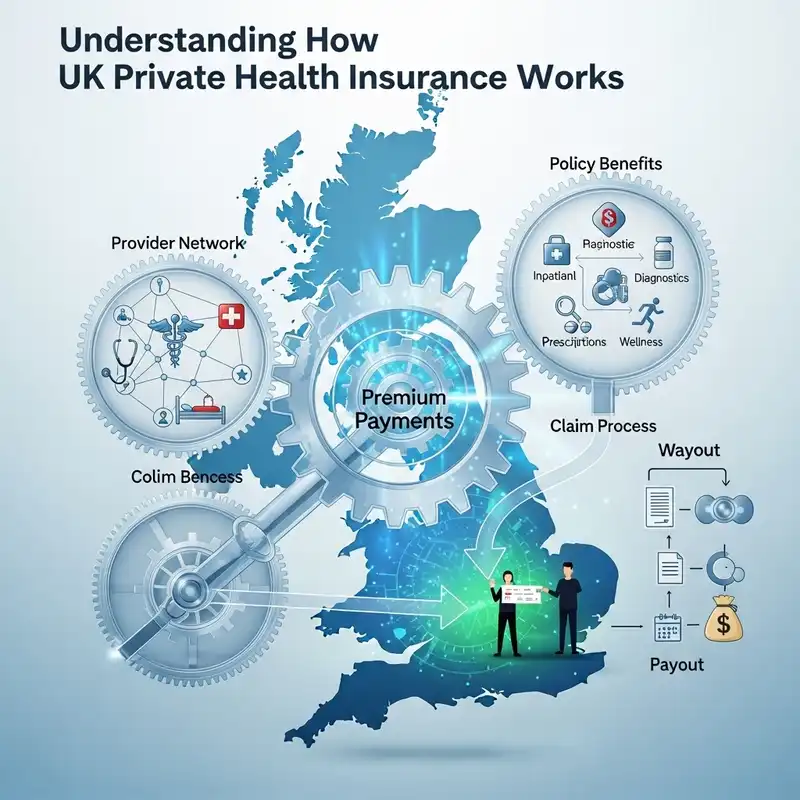
Private Medical Insurance is a policy you pay for that covers the costs of private healthcare. In essence, you pay a monthly or annual premium, and in return, the insurer covers the expense of eligible medical treatments at a private hospital or facility.
It's designed to work alongside the NHS, not replace it. You will still use your NHS GP for initial consultations and rely on the NHS for emergency services (A&E) and the management of long-term chronic illnesses. PMI's core purpose is to bypass the long waiting lists for specialist consultations, diagnostic tests, and elective surgery for acute conditions.
The Golden Rule: Acute vs. Chronic Conditions
This is the most important concept to understand in private health insurance. Failure to grasp this distinction is the source of most customer confusion.
-
An Acute Condition: A disease, illness, or injury that is likely to respond quickly to treatment and lead to a full recovery. It has a clear start and a foreseeable end.
- Examples: Cataracts, joint replacements (hip, knee), hernia repair, gallstone removal, most cancer treatments, bone fractures.
-
A Chronic Condition: A disease, illness, or injury that has one or more of the following characteristics: it needs ongoing or long-term monitoring, requires palliative care, has no known cure, or is likely to recur.
- Examples: Diabetes, hypertension (high blood pressure), asthma, Crohn's disease, arthritis, multiple sclerosis.
Standard UK private medical insurance policies are designed to cover acute conditions that arise after your policy has started. They do not cover the ongoing management of chronic conditions.
The Pre-Existing Condition Clause
Alongside the chronic condition rule, insurers also have rules about conditions you already have when you take out a policy. A pre-existing condition is any illness, disease, or injury for which you have experienced symptoms, sought advice, or received treatment in the years before your policy began (typically the last 5 years).
Insurers handle this through a process called underwriting. There are two main types:
| Underwriting Type | How It Works | Pros | Cons |
|---|---|---|---|
| Moratorium (Most Common) | You don't declare your full medical history upfront. The insurer automatically excludes any condition you've had in the last 5 years. | Quicker to set up. | Potential uncertainty about cover until a claim is made. |
| Full Medical Underwriting (FMU) | You complete a detailed health questionnaire. The insurer reviews it and explicitly states what is and isn't covered from the start. | Provides complete clarity on cover from day one. | Slower application process; may have permanent exclusions. |
Under a moratorium, if you go for a set period (usually 2 years) without any symptoms, treatment, or advice for a pre-existing condition after your policy starts, it may then become eligible for cover.
The Patient Journey: NHS vs. Private Care
The difference in experience becomes crystal clear when you compare the typical journey from symptom to treatment.
| Stage | NHS Pathway | Private Pathway (with PMI) |
|---|---|---|
| 1. Initial Symptom | Visit your NHS GP (or use a Digital GP service if included in your policy). | Visit your NHS GP (most policies require a GP referral). |
| 2. GP Referral | GP refers you to an NHS hospital specialist. | GP provides an 'open referral' for private care. |
| 3. Specialist Consultation | Wait: Weeks or often many months (e.g., 20-40 weeks). | Wait: Days or 1-2 weeks. You choose the specialist from the insurer's list. |
| 4. Diagnostic Tests | Wait: Placed on another list for scans (e.g., MRI, CT). Can be 6+ weeks. | Wait: Tests are often done within a few days of the consultation. |
| 5. Diagnosis & Treatment Plan | Follow-up appointment with the NHS specialist. | The private specialist provides results and a plan quickly. |
| 6. Surgery/Treatment | Wait: Placed on the main surgical waiting list. This can be over a year. | Wait: Surgery scheduled at your convenience, often within 2-4 weeks. |
| 7. Hospital Stay | On a general ward, often with multiple other patients. | Private en-suite room, flexible visiting, à la carte menu. |
| 8. Post-Op Physio | May face another wait for limited NHS physiotherapy sessions. | Private physiotherapy sessions usually begin immediately. |
This side-by-side comparison highlights the core value of PMI: speed, choice, and convenience.
The Core Benefits of Private Health Insurance
While bypassing queues is the headline benefit, a good PMI policy offers a range of advantages that contribute to better health outcomes and greater peace of mind.
- Rapid Access to Specialists: The ability to see a consultant within days rather than months is transformative. It means faster diagnosis, faster treatment, and less time spent in pain and anxiety.
- Choice and Control: You are in the driver's seat. You can choose the consultant you want to see and the hospital where you want to be treated from your insurer's approved list. You can also schedule treatment at a time that suits you, minimising disruption to your work and family life.
- Comfort and Privacy: A private hospital stay is a world away from a busy NHS ward. You can expect a private room with an en-suite bathroom, a TV, Wi-Fi, and a better quality menu. This comfortable environment is more conducive to rest and recovery.
- Access to Breakthrough Treatments: The NHS is guided by the National Institute for Health and Care Excellence (NICE) on which drugs and treatments it can fund. This process can be slow. PMI policies often provide access to newer, more advanced drugs, treatments, or surgical techniques that are not yet available on the NHS, particularly in cancer care.
- Comprehensive Mental Health Support: Recognising the growing mental health crisis, many modern PMI plans offer extensive support. This can include fast access to counsellors, therapists, and psychiatrists, bypassing long NHS waiting lists for services like CBT (Cognitive Behavioural Therapy).
- Value-Added Services: Insurers are increasingly competing on wellness perks. These often include:
- 24/7 Digital GP services
- Health and wellbeing apps
- Discounts on gym memberships and fitness trackers
- Mental health support lines
At WeCovr, we believe in promoting our customers' long-term health, not just insuring them against illness. That's why, in addition to finding you the perfect policy, we provide our customers with complimentary access to CalorieHero, our proprietary AI-powered calorie and nutrition tracking app. It's our way of going the extra mile, helping you build healthy habits that last a lifetime.
Demystifying the Costs: What Do You Actually Pay?
The cost of private medical insurance is not one-size-fits-all. It's a highly personalised product, with premiums depending on a range of factors.
Factors Influencing Your Premium
- Age: This is the biggest determinant. Premiums increase as you get older because the statistical likelihood of needing treatment rises.
- Location: Treatment costs vary across the UK. Living in or near London, where hospital costs are highest, will result in higher premiums.
- Level of Cover: A basic, no-frills policy will be much cheaper than a fully comprehensive one with all the bells and whistles.
- Excess (illustrative): This is the amount you agree to pay towards a claim (e.g., the first £250). Choosing a higher excess will lower your monthly premium.
- Hospital List: Insurers offer different tiers of hospitals. A policy that only covers local private hospitals will be cheaper than one that includes premium central London facilities.
- No-Claims Discount (NCD): Similar to car insurance, you build up a discount for every year you don't make a claim, which can significantly reduce your premium over time.
- Personal Health: Your smoker status and, to a lesser extent, your BMI can influence the price.
Indicative Monthly Premiums (2025 Estimates)
To give you a clearer idea, here are some estimated monthly costs. Please note these are for illustrative purposes only and can vary significantly between insurers and based on the factors above.
| Age | Basic Cover (In-patient only, £500 excess) | Mid-Range Cover (Out-patient included, £250 excess) | Comprehensive Cover (Full cover, therapies, £100 excess) |
|---|---|---|---|
| 30s | £35 - £50 | £60 - £85 | £90 - £130 |
| 40s | £45 - £65 | £75 - £110 | £110 - £160 |
| 50s | £60 - £90 | £100 - £150 | £150 - £220 |
| 60s | £90 - £140 | £150 - £230 | £230 - £350+ |
Is It Worth the Cost?
Whether PMI is "worth it" is a personal calculation of value versus risk.
Consider the monthly premium for a 45-year-old—perhaps £80 for a solid mid-range policy. This is comparable to a premium gym membership, a family mobile phone contract, or a few weekly takeaways.
Now, weigh that against the alternative. If that same 45-year-old needed a hip replacement and couldn't work for the 12-18 months they were on an NHS waiting list, the loss of income could run into tens of thousands of pounds. In that context, the £960 annual premium for PMI looks like an exceptionally sound investment in both their physical and financial health.
How to Choose the Right Health Insurance Policy
Navigating the market can be daunting, with dozens of policies and options available. Breaking it down into a step-by-step process makes it manageable.
Step 1: Understand the Levels of Cover
Policies are generally structured in three tiers:
- Basic (or Core) Cover: This is the entry-level option. It typically covers the most expensive part of private treatment: costs associated with being an in-patient or day-patient. This includes surgery fees, anaesthetist fees, hospital accommodation, and nursing care. It usually excludes the initial consultations and diagnostic tests.
- Mid-Range Cover: The most popular choice. It includes everything in the Core Cover, but adds a set amount of out-patient cover. This is crucial as it pays for the initial specialist consultations and diagnostic scans (MRI, CT) that pinpoint the problem.
- Comprehensive Cover: This top-tier option includes extensive in-patient and out-patient cover, and often adds extra benefits like cover for mental health, physiotherapy, osteopathy, and sometimes even routine dental and optical care.
Step 2: Key Policy Options to Customise Your Plan
Once you've chosen a level of cover, you can tailor it further with key options:
- The 'Six-Week' Option: This is a fantastic way to reduce your premium by 20-30%. With this option, you agree to use the NHS if the waiting list for the in-patient treatment you need is less than six weeks. If the NHS wait is longer, your private cover kicks in. It's a pragmatic compromise that protects you from the very long delays while saving you money.
- Cancer Cover: This is arguably the most valued part of any PMI policy. It's usually included as standard, but the level of cover can vary. Check if it includes access to experimental drugs not funded by the NHS, palliative care, and cover for chemotherapy and radiotherapy.
- Hospital List: Insurers have tiered lists. Choosing a list that excludes the most expensive hospitals (usually in central London) can significantly lower your premium without compromising on quality, as there are excellent private hospitals all over the UK.
- Therapies: Cover for physiotherapy, chiropractic, and osteopathy is often an optional add-on. If you have a history of musculoskeletal issues or play a lot of sport, this might be a valuable addition.
Step 3: Use an Expert Broker
Trying to compare all these variables across multiple insurers like Aviva, Bupa, AXA Health, and Vitality is complex and time-consuming. This is where an independent broker is invaluable.
A specialist broker like WeCovr doesn't just sell you a policy; we provide expert guidance.
- We listen to your needs: We take the time to understand your specific requirements, health concerns, and budget.
- We search the whole market: We compare plans from all the UK's leading insurers to find the one that offers the best value and the right cover for you.
- We explain the jargon: We cut through the complex terminology to ensure you understand exactly what you are and are not covered for.
- We help you save money: We know all the ways to tailor a policy (like the six-week option or hospital lists) to make it more affordable without sacrificing the cover you need.
- We're here for you at claim time: If you need to use your policy, we can help guide you through the process.
Our service is provided at no extra cost to you. Let us do the hard work of finding the perfect health insurance safety net for you and your family.
Common Misconceptions & FAQs
Let's address some of the most common questions and myths surrounding private health insurance.
"Does PMI replace the NHS?" No, absolutely not. It works in partnership with the NHS. You will always need the NHS for emergencies (A&E), GP services (unless you have a Digital GP add-on), and the management of chronic conditions.
"I'm young and healthy, so I don't need it." This is the best time to get it. Premiums are at their lowest when you are young and healthy. Insurance is about protecting against the unexpected—an accident, a sports injury, or a sudden diagnosis. Getting cover in place early means you are protected before any conditions arise that might be excluded in the future.
"What isn't covered by a standard PMI policy?" It's crucial to be aware of the standard exclusions:
- Pre-existing conditions (as defined by your underwriting)
- Chronic conditions (like diabetes, asthma)
- Emergency treatment (go to A&E)
- Normal pregnancy and childbirth
- Cosmetic surgery (unless medically required, e.g., reconstruction after an accident)
- Treatments for drug and alcohol addiction
- Organ transplants
"Can I add my family to my policy?" Yes. You can usually add your partner and children to your policy. Insurers often provide discounts for family or couple plans, which can be more cost-effective than individual policies.
"What happens to my policy if I have to claim?" If you make a claim, you will likely lose some or all of your No-Claims Discount at your next renewal, meaning your premium will increase. However, this is the very reason you have insurance—to be able to access treatment when you need it most. The cost of the treatment will almost always far outweigh the increase in your premium.
A Tale of Two Knees: Sarah's Story
To see the real-world impact, let's consider a relatable scenario.
Sarah is a 48-year-old self-employed marketing consultant. She loves hiking but starts to experience persistent pain and clicking in her right knee.
The NHS Pathway:
- Month 1: Sarah sees her GP, who suspects a torn meniscus and refers her to an NHS orthopaedic specialist.
- Month 7: After a six-month wait, Sarah has her appointment. The specialist agrees a scan is needed.
- Month 9: Two months later, Sarah has her MRI scan.
- Month 10: She has a follow-up appointment. The scan confirms a significant tear requiring arthroscopic surgery. She is placed on the surgical waiting list. The estimated wait is 45 weeks.
- Total Time to Treatment: Approximately 19-20 months. Throughout this period, Sarah is in constant pain. She can no longer hike, struggles to sleep, and her work suffers as she can't concentrate. The financial and mental toll is enormous.
The Private Pathway (with PMI):
- Week 1: Sarah sees her GP, who provides an open referral. She calls her insurer, who gives her a choice of three local orthopaedic specialists. She books an appointment for the following week.
- Week 2: The specialist sees her and arranges an MRI at the same private hospital for two days later.
- Week 3: At her follow-up, the specialist confirms the tear and discusses surgery. Sarah books the operation for two weeks' time, on a day that fits her work schedule.
- Week 5: Sarah has her surgery in a private hospital. She begins physiotherapy the next day.
- Total Time to Treatment: Five weeks. Sarah is on the road to a full recovery, with minimal disruption to her life and business.
Sarah's story is a powerful illustration of how PMI acts as a bridge over the chasm of NHS waiting lists, preserving not just physical health, but also financial stability and mental wellbeing.
Conclusion: Take Control of Your Health Future
The pressures on our beloved NHS are immense and set to continue. While it will always be there for us in an emergency, the long waits for routine yet life-altering treatments are a new reality we must all confront. The prospect of being 1 in 8 Britons on a waiting list by 2025 is a call to action.
Private Medical Insurance is not about turning your back on the NHS. It is about empowering yourself with an alternative. It's a pragmatic tool that provides rapid access to diagnosis and treatment for acute conditions, giving you control over your health, your finances, and your future. It is a safety net that protects you from the pain, anxiety, and financial hardship of a long wait.
By understanding how PMI works, what it covers, and how to tailor it to your budget, you can make an informed decision. It's about weighing a manageable monthly cost against the potentially devastating impact of being unable to get the medical care you need when you need it most.
Don't leave your health to chance. Take the first step towards peace of mind today.
Talk to an expert advisor at WeCovr. We can provide a free, no-obligation quote and help you compare plans from across the market, ensuring you find the perfect cover to safeguard what matters most: your health.
Sources
- Department for Transport (DfT): Road safety and transport statistics.
- DVLA / DVSA: UK vehicle and driving regulatory guidance.
- Association of British Insurers (ABI): Motor insurance market and claims publications.
- Financial Conduct Authority (FCA): Insurance conduct and consumer information guidance.