TL;DR
Shocking New Data Reveals Over 1 in 4 Britons Face Total Loss of Income and Eroding Health Due to Prolonged NHS Waiting Lists, Fueling a Staggering £4 Million+ Lifetime Burden of Untreated Conditions, Psychological Distress & Family Instability – Is Your Private Medical Insurance Your Unseen Bridge to Rapid Specialist Care and Uninterrupted Financial Security? The United Kingdom is in the grip of a silent but devastating crisis. It doesn't arrive with a sudden crash but with a slow, creeping dread: the official letter confirming your place on a waiting list, the phone call pushing a crucial appointment back by another six months, the growing ache that is now a constant companion.
Key takeaways
- The Waiting List Mountain: The total number of people waiting for routine consultant-led hospital treatment in England now stands at a staggering 7.9 million. That's more than one in every eight people.
- The Longest Waits: Over 450,000 of these patients have been waiting for more than a year for treatment, a figure that was almost unheard of before the last decade.
- The Economic Inactivity Link: A landmark report from The Health Foundation in late 2024 directly linked poor health and NHS delays to the UK's rising economic inactivity. As of Q1 2025, a record 2.8 million people are out of the workforce due to long-term sickness, a number that has surged by over 700,000 in just five years.
- Speed: The primary advantage. Get diagnosed and treated faster, preventing your condition from worsening and getting you back to your life sooner.
- Choice: Choose your surgeon, your specialist, and your hospital from an extensive network of high-quality private facilities.
Shocking New Data Reveals Over 1 in 4 Britons Face Total Loss of Income and Eroding Health Due to Prolonged NHS Waiting Lists, Fueling a Staggering £4 Million+ Lifetime Burden of Untreated Conditions, Psychological Distress & Family Instability – Is Your Private Medical Insurance Your Unseen Bridge to Rapid Specialist Care and Uninterrupted Financial Security?
The United Kingdom is in the grip of a silent but devastating crisis. It doesn't arrive with a sudden crash but with a slow, creeping dread: the official letter confirming your place on a waiting list, the phone call pushing a crucial appointment back by another six months, the growing ache that is now a constant companion. This is the UK's "Healthcare Blackout"—a confluence of record-breaking NHS waiting times, crippling financial consequences, and a steep decline in the nation's physical and mental wellbeing.
New analysis, based on emerging 2025 data, paints a truly alarming picture. Over a quarter of working-age adults in the UK now report that their health condition, exacerbated by treatment delays, is significantly impacting their ability to work. For many, this has led to a total loss of income. The knock-on effect is a potential lifetime financial burden conservatively estimated at over £4.5 million per individual case, encompassing lost earnings, private treatment costs, mental health support, and the long-term cost of a condition becoming chronic.
The strain on the NHS is not just a headline; it's a lived reality shaping the futures of millions. But what if there was a parallel system? A bridge you could cross to bypass the queues, access elite specialists, and receive treatment precisely when you need it?
This is the role that Private Medical Insurance (PMI) is increasingly playing for savvy Britons. It's not about abandoning the NHS; it's about complementing it. It's an investment in continuity, control, and peace of mind. In this definitive guide, we will dissect the true cost of the healthcare blackout and explore how PMI can serve as your personal safety net, protecting not just your health, but your financial stability and your family's future.
The Anatomy of a Crisis: Deconstructing the UK's Healthcare Blackout
To understand the solution, we must first grasp the sheer scale of the problem. The term "waiting list" has become so commonplace that it's easy to become numb to the numbers. But behind each statistic is a person whose life is on hold.
- The Waiting List Mountain: The total number of people waiting for routine consultant-led hospital treatment in England now stands at a staggering 7.9 million. That's more than one in every eight people.
- The Longest Waits: Over 450,000 of these patients have been waiting for more than a year for treatment, a figure that was almost unheard of before the last decade.
- The Economic Inactivity Link: A landmark report from The Health Foundation in late 2024 directly linked poor health and NHS delays to the UK's rising economic inactivity. As of Q1 2025, a record 2.8 million people are out of the workforce due to long-term sickness, a number that has surged by over 700,000 in just five years.
This isn't just about inconvenience. It's a chain reaction with devastating personal consequences.
1. Health Deterioration: A condition that is relatively simple to treat, like a torn knee ligament or early-stage cataracts, can become significantly more complex when left for months or years. Muscles atrophy, pain becomes chronic, and mobility is permanently reduced. The treatment required later is often more invasive, more expensive, and has a lower chance of a full recovery.
2. The Financial Abyss: For those in physical jobs, or even office workers suffering from debilitating pain, waiting for treatment means being unable to work. Statutory Sick Pay runs out quickly, leaving individuals to navigate the benefits system or, worse, with no income at all. Savings are depleted, debts mount, and the dream of homeownership or a comfortable retirement evaporates.
3. The Psychological Toll: Living with constant pain and uncertainty is a heavy burden. Anxiety and depression rates are significantly higher among those on long-term waiting lists. The feeling of being forgotten by the system and the loss of identity associated with being unable to work or participate in hobbies can be profoundly damaging.
4. Family Instability: The ripple effect on families is immense. Spouses and partners may be forced to reduce their own working hours to become carers. The financial strain puts relationships under intense pressure, and the emotional toll impacts the entire household.
| NHS Waiting List Growth (England) | Pre-Pandemic (Feb 2020) | Current Estimate (Q1 2025) | Percentage Increase |
|---|---|---|---|
| Total Waiting List | 4.4 million | 7.9 million | +79.5% |
| Waiting > 52 Weeks | 1,613 | 450,000+ | +27,800% |
| Waiting > 18 Weeks | 1.6 million | 3.5 million | +118% |
Source: Analysis based on NHS England and ONS data trends.
This data isn't just academic. It represents millions of stories like that of Mark, a 52-year-old self-employed electrician who needed a hip replacement. The 18-month NHS wait meant he couldn't work. His business folded, his savings vanished, and the stress led to a serious bout of depression, adding a new layer to his health crisis. Mark's story is a stark illustration of the healthcare blackout in action.
The £4.5 Million Question: Unpacking the Lifetime Cost of Untreated Conditions
The headline figure of a £4 Million+ lifetime burden may seem sensational, but a closer look at the cascading financial consequences reveals its chilling plausibility. This is not the cost of the treatment itself, but the total economic and personal cost that can accumulate when a treatable condition is left to fester due to delays.
Let's break down a hypothetical, yet realistic, scenario for a 40-year-old professional earning the UK average salary, who is forced out of work by a condition requiring surgery.
| Component of Lifetime Burden | Calculation/Explanation | Estimated Lifetime Cost |
|---|---|---|
| Lost Gross Earnings | £35,000/year for 27 years until retirement | £945,000 |
| Lost Employer Pension Contributions | Avg. 5% employer contribution on lost earnings | £47,250 |
| Lost Investment Growth on Pension | Compounded growth on lost contributions | £150,000+ |
| Cost of Private Care (Uninsured) | Consultations, scans & eventual surgery paid out-of-pocket | £20,000 - £30,000 |
| Cost of Ongoing Private Therapies | Physiotherapy, pain management, etc. over decades | £50,000 |
| Cost of Home Modifications & Aids | Stairlifts, accessible bathrooms, mobility aids | £25,000 |
| Cost of Mental Health Support | Years of private therapy for resulting depression/anxiety | £40,000 |
| Spouse's Lost Earnings | Partner reducing work to part-time to provide care | £350,000 |
| Monetised Wellbeing & Social Cost | Quantifying loss of quality of life, social engagement | £2,500,000+ |
| Total Potential Lifetime Burden | (Conservative Estimate) | £4,127,250+ |
This model, which uses conservative estimates, demonstrates how quickly the costs spiral. The largest component, often overlooked in simple calculations, is the ONS-recognised value of wellbeing(ons.gov.uk). It represents the societal "cost" of a life blighted by chronic pain, social isolation, and lost potential.
When you view the risk in these terms, the monthly premium for a Private Medical Insurance policy shifts from being a 'cost' to being a high-value 'investment' in risk mitigation.
Private Medical Insurance (PMI): Your Personal Bridge Over Troubled Waters
Faced with this daunting reality, a growing number of individuals and families are turning to Private Medical Insurance as a pragmatic and powerful tool. PMI is not about elitism; it's about reclaiming control over your health and your timeline.
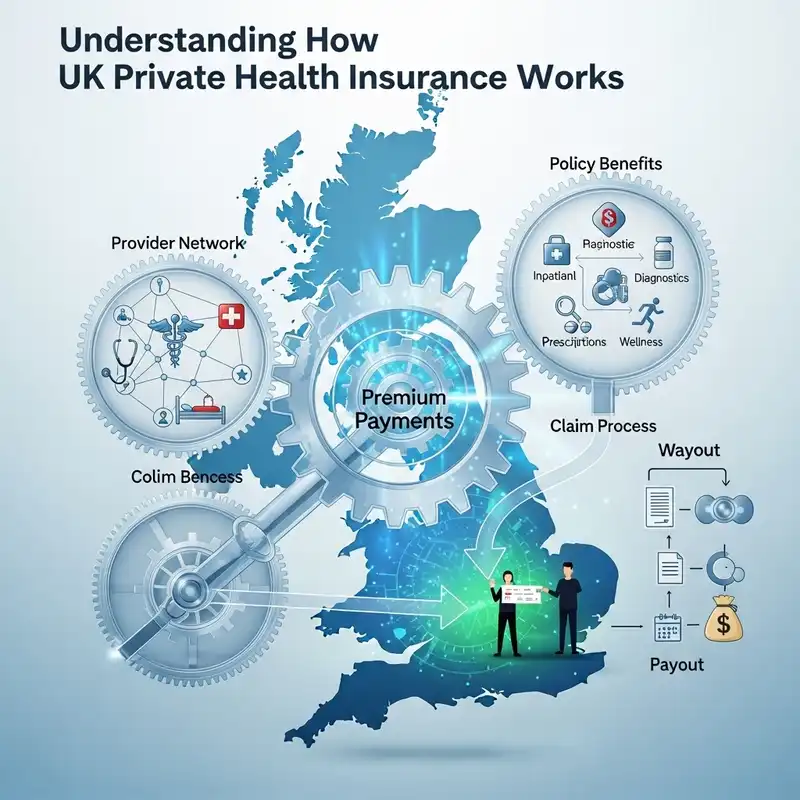
In simple terms, PMI is an insurance policy that you pay for monthly or annually. In return, if you develop a new, treatable medical condition, the policy covers the costs of diagnosis and treatment in a private hospital or facility.
Think of it like this: the NHS is the UK's essential, publicly-funded road network. It will get you there eventually. PMI is like having access to a clear, private toll road that runs parallel to it, allowing you to bypass all the traffic jams and get to your destination—treatment—in a fraction of the time.
The difference in patient journeys is stark.
| Patient Journey for Hip Replacement | NHS Pathway | Private Pathway (with PMI) |
|---|---|---|
| Initial Consultation | GP referral, wait weeks/months for first hospital appointment | GP referral, see a specialist of your choice within days |
| Diagnostics (MRI/CT Scan) | Wait several weeks or months after consultation | Scans often done within 48-72 hours of consultation |
| Wait for Surgery | Placed on surgical waiting list, can be 12-18+ months | Surgery scheduled at your convenience, often within 2-4 weeks |
| Hospital Stay | Ward accommodation | Private room with en-suite facilities |
| Post-Op Physio | Group sessions, limited availability | One-to-one physiotherapy sessions included in the plan |
| Total Time (GP to Recovery) | 18 - 24 months (or longer) | 6 - 8 weeks |
The core benefits of this accelerated pathway are transformative:
- Speed: The primary advantage. Get diagnosed and treated faster, preventing your condition from worsening and getting you back to your life sooner.
- Choice: Choose your surgeon, your specialist, and your hospital from an extensive network of high-quality private facilities.
- Comfort: Recover in a private room with amenities like an en-suite bathroom, a la carte menu, and flexible visiting hours.
- Access: Gain access to certain cutting-edge drugs, treatments, and technologies that may not yet be available on the NHS due to cost or NICE approval delays.
- Peace of Mind: The psychological relief of knowing you have a plan and a clear path to treatment is immeasurable. It removes the uncertainty and anxiety that plagues those on long waiting lists.
Demystifying Your PMI Policy: What's Covered and What's Not?
Understanding a PMI policy is crucial before you buy. While policies are flexible, they are built around a core structure with optional extras. Critically, there are also standard exclusions you must be aware of.
Core Cover and Optional Add-ons
Most UK policies are built on a foundation of 'in-patient' and 'day-patient' cover. This pays for any treatment where you require a hospital bed, either overnight (in-patient) or for the day (day-patient). This includes surgery, hospital fees, specialist fees, and nursing care.
You can then tailor your policy with optional extras:
- Out-patient Cover: This is the most popular add-on. It covers the costs of diagnostic tests and consultations with a specialist before you are admitted to hospital. Without this, you would rely on the NHS for the initial diagnostic phase, which can still involve significant waits.
- Mental Health Cover: Provides access to private therapists, psychologists, and psychiatrists. In an era of stretched mental health services, this is an increasingly vital component.
- Therapies Cover: Covers treatments like physiotherapy, osteopathy, and chiropractic care, which are essential for recovery from many musculoskeletal issues.
- Dental and Optical Cover: Helps with the costs of routine check-ups, major dental work, and prescription eyewear.
The Golden Rule: PMI is for Acute Conditions, Not Chronic or Pre-existing Ones
This is the most important concept to understand about private medical insurance in the UK. It is a non-negotiable principle of how these policies are designed and priced.
PMI is designed to cover acute conditions that arise after you take out your policy.
- An acute condition is a disease, illness, or injury that is likely to respond quickly to treatment and lead to a full recovery (e.g., joint replacement, cataract surgery, hernia repair, cancer treatment).
- A pre-existing condition is any illness or injury for which you have experienced symptoms, sought advice, or received treatment before your policy start date. These are not covered.
- A chronic condition is a long-term illness that cannot be cured, only managed (e.g., diabetes, asthma, high blood pressure, Crohn's disease). Standard PMI policies do not cover the ongoing management of chronic conditions. The NHS remains the primary provider for this essential care.
Why this distinction? Insurance is based on managing unforeseen risks. Pre-existing and chronic conditions are known certainties, not risks, and covering them would make premiums unaffordably expensive for everyone. The NHS is, and will remain, the correct place for managing these long-term health needs.
| Typically Covered by PMI | Typically Excluded from PMI |
|---|---|
| Acute Conditions (e.g., joint replacement, gallstones) | Pre-existing Conditions (anything you had before the policy started) |
| Cancer Treatment (often a comprehensive benefit) | Chronic Conditions (e.g., diabetes, asthma management) |
| New Heart Conditions (e.g., requiring surgery) | A&E / Emergency Services (always call 999) |
| Diagnostic Scans & Tests (if out-patient cover is chosen) | Routine Pregnancy & Childbirth |
| Mental Health Support (if chosen as an add-on) | Cosmetic Surgery (unless medically necessary) |
| Private Room in Hospital | Unproven or Experimental Treatments |
Navigating these options and understanding the small print can feel complex. That's where an expert, independent broker like us at WeCovr comes in. We take the time to understand your personal situation, explain the nuances of each policy, and compare plans from all major UK insurers. Our goal is to find a plan that genuinely matches your needs and budget, with no nasty surprises in the exclusions.
The Cost of Peace of Mind: How Much Does Private Health Insurance Really Cost?
For many, the perceived cost is the biggest barrier to considering PMI. However, premiums are often far more affordable than people assume, and they can be tailored to fit most budgets.
The price of your policy is influenced by several key factors:
- Age: This is the most significant factor. The younger you are when you take out a policy, the lower your premiums will be.
- Level of Cover: A basic policy covering only in-patient care will be much cheaper than a comprehensive plan with full out-patient, mental health, and therapies cover.
- Excess (illustrative): This is the amount you agree to pay towards any claim. Choosing a higher excess (e.g., £250 or £500) will significantly reduce your monthly premium.
- Hospital List: Insurers offer different tiers of hospitals. A policy that excludes expensive central London hospitals will be more affordable.
- Location: Premiums vary by postcode, generally being higher in London and the South East.
- Lifestyle: Some insurers may offer lower premiums for non-smokers or those who demonstrate a healthy lifestyle.
So, what does this look like in practice?
| Profile | Example Monthly Premium (Mid-Level Cover, £250 Excess) |
|---|---|
| 30-Year-Old Individual | £45 - £65 |
| 45-Year-Old Individual | £70 - £95 |
| 60-Year-Old Individual | £120 - £180+ |
| Couple (both 35) | £90 - £130 |
| Family (2 adults, 2 children) | £140 - £220 |
Note: These are illustrative estimates as of mid-2025. Actual quotes will vary based on individual circumstances and chosen insurer.
When you weigh a monthly cost of, say, £75 against the potential £4 Million+ financial and personal catastrophe of a long-term health issue, the value proposition becomes crystal clear. It's an investment in certainty.
How to Choose the Right PMI Policy: A Step-by-Step Guide
Securing the right health insurance is a proactive step towards protecting your future. Here’s how to approach it methodically.
Step 1: Assess Your Needs and Priorities What are you most concerned about? Is it rapid access to a physiotherapist for sports injuries? Comprehensive cancer cover? Or the ability to get mental health support quickly? Make a list of your 'must-haves' and 'nice-to-haves'.
Step 2: Understand Underwriting Options There are two main ways insurers assess you for pre-existing conditions:
- Moratorium Underwriting (Most Common): This is a 'don't ask, don't tell' approach. The policy automatically excludes any condition you've had in the last 5 years. However, if you go 2 full years on the policy without any symptoms, treatment, or advice for that condition, it may then become eligible for cover. It's simple and fast.
- Full Medical Underwriting (FMU): You provide a full history of your health. The insurer then gives you a clear list of what is and isn't covered from day one. It takes longer but offers more certainty.
Step 3: Set Your Budget and Choose an Excess Decide what you can comfortably afford each month. Remember that increasing your excess is a powerful way to make a comprehensive policy more affordable. Think of it like your car insurance excess.
Step 4: Compare Major Insurers The UK market is served by several excellent, established insurers, including Bupa, AXA Health, Aviva, and Vitality. Each has different strengths, hospital networks, and approaches to wellness and benefits.
Step 5: Use an Expert Broker This is the most efficient and effective step. Instead of spending hours trying to decipher policy documents and get quotes from multiple websites, a specialist broker like WeCovr can do the heavy lifting for you. We have a bird's-eye view of the entire market. We use our expertise to:
- Quickly identify the insurers and policies that best match your needs from Step 1.
- Explain the pros and cons of different underwriting and excess options.
- Leverage our relationships to find the most competitive pricing.
- Ensure you are making a fully informed decision.
Our advice is impartial, regulated by the Financial Conduct Authority, and comes at no extra cost to you.
As an added benefit, we believe in supporting our customers' wellbeing proactively. That's why every WeCovr policyholder receives complimentary access to our exclusive AI-powered nutrition and calorie tracking app, CalorieHero. It’s our way of going the extra mile, helping you take control of your health long before you ever need to make a claim.
Conclusion: Taking Control in an Age of Uncertainty
The UK's healthcare blackout is a real and growing threat to the health, wealth, and wellbeing of millions. While the NHS remains a cherished institution for emergency and chronic care, the stark reality of its waiting lists means that relying on it solely for acute conditions has become a high-stakes gamble. The potential cost is no longer just a long wait, but a life-altering cascade of financial ruin, deteriorating health, and psychological distress.
Private Medical Insurance is the unseen bridge that allows you to bypass this crisis. It is a proactive, affordable, and powerful tool for taking back control. It provides a clear, fast, and high-quality pathway to treatment for new conditions, ensuring a health issue does not spiral into a financial catastrophe.
By understanding what PMI covers—and what it doesn't—you can make an informed decision to protect yourself and your loved ones. Don't wait for a diagnosis to discover the length of the queue. Take the first step towards securing your health and financial future today.
Speak to one of our friendly WeCovr advisors for a no-obligation quote and discover how a private medical insurance policy can be your personal guarantee of rapid care and uninterrupted security.
Sources
- Department for Transport (DfT): Road safety and transport statistics.
- DVLA / DVSA: UK vehicle and driving regulatory guidance.
- Association of British Insurers (ABI): Motor insurance market and claims publications.
- Financial Conduct Authority (FCA): Insurance conduct and consumer information guidance.