Whether you already own an electric vehicle, or are planning to get one, you've probably noticed that electric cars are just about everywhere these days. In fact, in the UK today there are approximately 1.1 million Electric Vehicles (EVs) on the road, and they have over 1.2 million cousins in the form of Plug-In Hybrid Vehicles (PHEVs). Suffice to say, Electric Vehicles are getting faster, with better range, and are being sold in numbers greater than ever before. As petrol prices rise and Electric Vehicles become better and better, you might be thinking that now is as good a time as any to buy an EV.
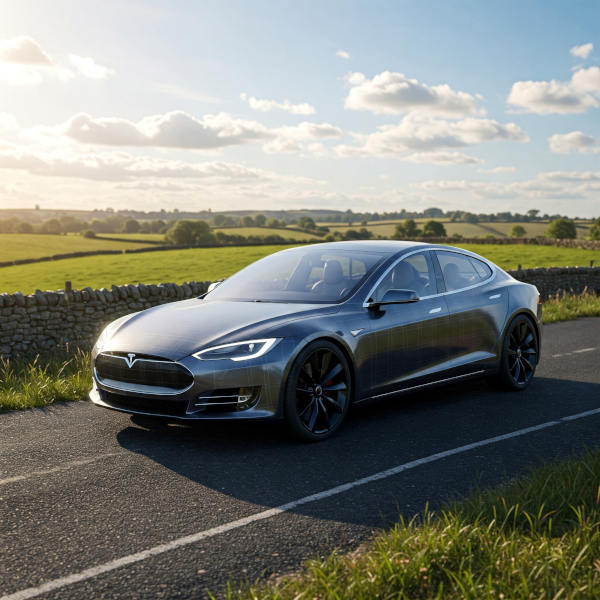
It's no suprise that Tesla holds a top spot for electric vehicles sales in the UK, with their Model Y and Model 3 maintaining a standard for beauty and performance, but there are many offerings out there in the market, each occupying an interesting niche within this fast-growing industry. So in the interests of saving you time, see below for the top 10 selling electric cars in the UK.
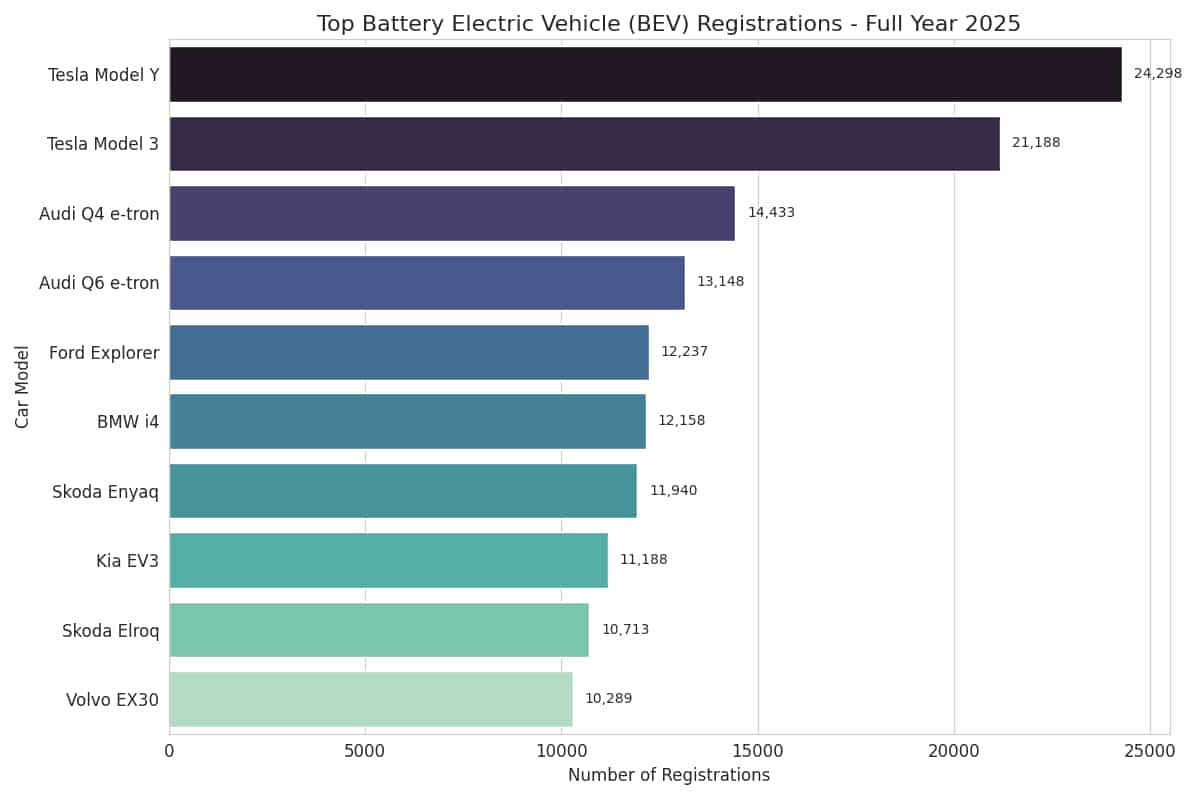
Here are the top 10 best selling Electric Cars this year. As you can see from the graph below, Tesla models reign above many other EVs with by far the most sales, but the runners up are relevant in their own right.
1. Tesla Model 3

With over 45,000 sales in the UK so far this year, the Model 3 is one of the most popular EVs available. The UK has fully embraced the sales bandwagon that has seen this car reach over a million global sales several years ago. Despite its competitive price, it offers great performance, with its Rear-wheel drive trim offering a range of over 300 miles. This can be pushed further in the Long Range model which can go up to 370 miles between charges, a great performance benchmark. While these numbers are still a way off the 1,100+ Miles of the most efficient petrol cars, the battery technology used to power them is still incredibly impressive for the performance of the vehicle.
2. Kia Niro EV

With over 20,000 Niro EVs being sold this year, Kia have shown that it's possible to create a functional, decent-range SUV at an affordable price. When you couple the spacious interior, solid handling and smooth ride with Kia's proprietary technology, you get a car that will give you as much as you can take. While it may not have the range of a long-range Tesla, its spaciousness, and decent 285 mile range more than makes up for it - especially considering the price starts around £35,000.
3. Volkswagen ID 3

At over 18,000 sales, the Volkswagen ID 3 is the electric equivalent of the highly popular Volkswagen Golf. Its slightly blocky but futuristic design may not be for everyone, but if you take two different ID 3s, they won't necessarily be the same under the bonnet. This is due to a number of motor and battery options, depending on whether you want a lower price or higher range. Starting around £35,000, the Volkswagen ID 3 is reasonably priced, whilst the top models can reach a range further than 330 Miles. As one of the best selling electric family hatchbacks this year, the ID 3 is one to look out for.
4. Nissan Leaf

One of the longest-running electric vehicles on the road today, the Nissan Leaf has consistently sold well not only in the UK, but across the world as well, with over 15,000 sales this year. A new and improved second-generation update to the Leaf, which received a major update in 2017, has a focus on affordability. For those looking for a new EV that won't break the bank, the Nissan Leaf's starting price of around £28,000 will look like an appealing offering. Of course, the range is only 168 miles for this model, but if you live in a city, this is unlikely to be an issue, especially as you can charge it at home. Simple, comfortable, and with a smooth ride, this family hatchback is practical and great value-for-money.
5. Audi Q8 e-tron

At more than 12,000 sales, this large family SUV, now known as the Audi Q8 e-tron, holds a highly regarded spot in the electric vehicle industry. Despite its high price of over £70,000, the Audi name and the sleek, classy styling make this car one of the more premium vehicles on the market. With sporty performance and a clean, angular design, the Audi e-tron range appeals to buyers seeking quality over saving money, with a rapid charging time and a 0-62 mph speed of under 6 seconds.
6. Hyundai Kona Electric

Making a good dent in the EV market at more than 11,500 sales is the Hyundai's hatchback crossover the Kona Electric, which is the electric version of their standard Kona. With prices beginning around £35,000 and a new model offering more than 300 miles of range, the Hyundai Kona Electric is an electric car with great value for money. Coming with all the standard hatchback crossover traits like comfort and ease-of-driving, Hyundai have created a very strong contender for the EV market.
7. Mini Electric

The electric version of the iconic Mini, the Mini Electric hops on the success bandwagon of Mini, selling more than 10,000 times this year. More intriguingly, it marks the start of a new era for Mini, as they have decided to make their entire future car ranges comprising solely of electric-only vehicles. With the same hatchback body and a panopoly of tech, the Mini Electric is comfortably priced from £30,000, although this price comes with a small pitfall, which is a 145-mile range. On the flipside, that makes it faster to charge, and a good vehicle for urban living, especially as a second car.
8. Renault Zoe

With around 8,000 sales and a range of 245 miles, the sleek but compact and affordable Renault Zoe is a great budget option for those wishing to get a hatchback with range. Coming in at under £30,000 it's also a brilliant vehicle for those transitioning from traditional combustion-engine cars, as it has a similar driving feel. Unfortunately, the little Zoe was stamped with a poor Euro NCAP safety test several years ago, making it a worrisome purchase for some.
9. Vauxhall Corsa-e

Designed after its popular cousin, the Vauxhall Corsa, the electric version comes through with similar value for money and a great number of standard features, including low running cost, comfortable seats, space and a decently sized boot, all within a reasonably compact frame. Coming in at over £32,000, it might be considered a little pricey for an electric hatchback, but given its hearty 222 mile range and efficient batteries, the Vauxhall Corsa-e is a solid choice with few complications, with over 9,500 sales to boot.
10. MG ZS EV

With over 9,000 sales, the MG ZS is a family-sized SUV that offers great practicality – and has an electric supermini-sized asking price.
Starting from around £30,000 the MG might not be the fanciest electric car you can buy, but it offers great value for money. It is very well equipped, the interior has a surprisingly classy feel thanks to plenty of soft touch materials, and it’s spacious for its size.
The standard 198 mile range isn’t the best, but the Long Range model boosts this to 273 miles, making it a trade-off many will accept for its comparatively low price and its other strengths.

Here are the top 10 Electric Cars for Range in the UK in 2026.
Topping the list of Electric Cars with longest range is, unsurprisingly, a premium saloon like the long range Tesla Model S or Mercedes EQS. But there are other competitors fighting for a close second, so check out the comparison list of the range of cars vs. their prices below. As you'll find out, range often comes at a premium, although there are some exceptions, with the 315 mile range Hyundai Kona Electric coming in at under £40,000.
| Rank | Make | Range (miles) | Price (£) |
|---|---|---|---|
| 1 | Tesla Model S | 415 | 85,000 |
| 2 | BMW iX | 260-390 | 75,000-120,000 |
| 3 | Ford Mustang Mach-E (long-range RWD) | 380 | 52,000 |
| 4 | Tesla Model 3 | 310-380 | 45,000-55,000 |
| 5 | Tesla Model X | 355 | 95,000 |
| 6 | Volkswagen ID.3 | 340 | 44,000 |
| 7 | Skoda Enyaq iV | 340 | 42,000 |
| 8 | Porsche Taycan | 315 | 80,000 |
| 9 | Hyundai Kona Electric | 315 | 39,000 |
| 10 | Audi E-tron GT | 290 | 80,000-110,000 |

It's one thing knowing that you can charge your vehicle at home, but it's another thing knowing where you can charge your vehicle when you're out and about. Furthermore, some vehicles require much more charge than others, with certain public chargers only supplying 3-5kW, while others can supply up to 350kW. From CCS Combo to Tesla Superchargers, and from Mennekes to Yazaki plugs, electric charging solutions are far from homogenised, so it pays to have an all in one solution. Fortunately, ZapMap has you covered. Just plug in your vehicle type and it will allow you to see every charger you can use, how much it will cost, and even whether or not the charger is vacant.

Unfortunately not. Electric cars of a similar price point will cost more than their petrol or diesel equivalent because of the expensive-to-replace batteries. As supply chains get better, and car batteries become standardised, this will inevitably decrease, but until that point, insuring an electric car will be more expensive. Electric cars are also more expensive in general, and the more expensive the car, the more expensive the insurance.

The most efficient petrol cars are able to cover over 1,100 miles on a full tank. On the flipside, the record-breaking Mercedes EQS 450+ has a range of over 450 miles on a single charge and costs nearly 5 times as much as a standard family saloon. So yes, it's true that most electric cars can't travel as far as petrol cars on a single 'fill-up'.

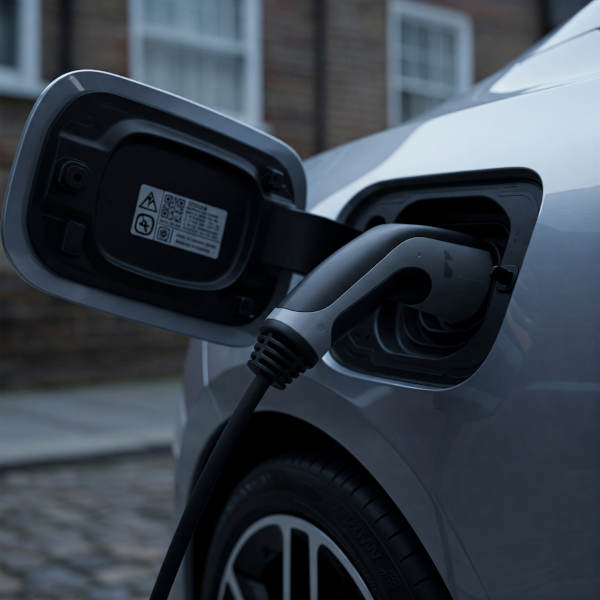
Electric cars are like any other battery powered device in that they're charged via the mains, either through your own house's electricity system, or in custom charging stations. If you're going to charge your electric car via the mains from the 110/240v dc system in your house, you'll need what is known as a "trickle charger", which is called that because it takes a very long time to charge up your vehicle, because the electrical system in your house cannot provide enough power to charge your EV quickly.
Fortunately, there are other available charging systems. Some charging systems are higher powered, and are often used as short-term charging solutions to quickly increase your vehicle charge. An example of this would be a Tesla Supercharger. Others have middling voltages, and are used to charge your EV moderately while it's parked, for example, while you're at work or while you're shopping. Different cars use different charging systems, so it's worth doing your research before deciding to charge your EV at a random EV Charger. Types of charger include CCS Combo and Tesla Superchargers, and types of plugs include Mennekes and Yazaki. Different cars come with different adapters, and not all chargers are available to use, so an app like ZapMap could allow you to see which charger you can use, how much it will cost, and whether or not the charger is vacant.
Unless you purchased a Tesla prior to 2017 (which gives you access to free charging at any Tesla Supercharger), you're going to have to pay for the electricity you use. After all, it takes resources and manpower to produce energy for the mains. Regardless, there are multiple ways you can pay, from an app to a contactless or RFID card.
It's estimated that the majority of charging of a vehicle is done at home, with about 60% of the average EV battery charge coming from "trickle chargers". Workplace charging accounts for a further 30%, with only 7% of a battery being charged at a destination. The final 3% is made up of those rare times you'll need to charge en route to a destination. In these cases, high power rapid chargers (43-350kW) will be used, but due to their increased power supply rates, you'll need to pay a lot more, so it's best to avoid these unless absolutely necessary.
Tesla has 3 main electric cars on offer: the Model S, the Model 3 and the Model Y, but while Tesla seems to hold the most sway when it comes to prestige and publicity, there are other, similar offerings from different car manufacturers.
1. Tesla Model S vs. Audi e-tron GT

| Tesla Model S Standard | Audi e-tron GT Base model | |
|---|---|---|
| Starting Price | £95,000+ | £83,000+ |
| Range | 415 Miles | 305 miles |
The Tesla Model S is undoubtedly a great vehicle although it comes in at a premium, with a price of £95,000 for the standard vehicle, going up to over £115,000 for the 'Plaid' version. At the lower end of the price range you have the Standard Model S, which could be compared to the Audi e-tron GT, a car which starts at around £83,000.
2. Tesla Model 3 vs. Polestar 2

| Tesla Model 3 | Polestar 2 | |
|---|---|---|
| Starting Price | £45,000+ | £51,000+ |
| Range | 320 Miles | 300-355 Miles |
The Tesla Model 3 is Tesla's most affordable model, and is considered by many to be a class leader, however as Tesla has open-sourced their patents, many other companies have access to their battery designs, making the electric vehicle industry a place rife for competition. One such competitor is Polestar, whose Polestar 2 is by many accounts an excellent option for those wishing to purchase a mid-range EV. Unfortunately, with a weight of 2,123kg, it is a little less efficient than the Model 3, which shows up in its reduced range.
3. Tesla Model Y Long Range vs. Ford Mustang Mach-E ER RWD

| Tesla Model Y Long Range | Ford Mustang Mach-E ER RWD | |
|---|---|---|
| Starting Price | £56,000 | £54,000 |
| Range | 335 Miles | 310 Miles |
While there are a few electric crossovers in the market, most are still a small way off the Tesla Model Y, especially in the range department. The Ford Mustang Mach-E Extended Range Rear Wheel Drive is probably the closest competitor to the Tesla Model Y, with a range of 310 Miles (EPA rated), but cars like the Hyundai Ioniq 5 and Kia EV6 have a similar range. Unfortunately, this is about 7% less far than the Tesla, but at a slightly lower price, making the Model Y a better choice for maximum range. The Model Y is also certified to tow a trailer/caravan, unlike some other electric vehicles on the market.

What's better, an Electric Car or a Hybrid Car? Curiously, the answer depends on the timescale that you want to use your car over. With the UK set to ban all new petrol and diesel car sales by 2030, more and more people are looking to hybrid vehicles to reduce their reliance on petrol (and for the fuel efficiency). With petrol/diesel cars likely to reduce in number leading up to the 2030 cut-off point, the cost of petrol will eventually rise as demand slowly decreases. Of course, depending on the level of future fuel reserves, it may be viable to keep running petrol/diesel cars for several decades after the cut-off, but it is likely that demand for electric vehicles will outstrip demand for petrol vehicles, making petrol stations less and less viable as businesses.
So which is better? For now, it's better to go for a hybrid car. As the cut-off point for sales of new hybrid vehicles will last until 2035, most hybrid vehicles will be relevant well into the future, even when petrol/diesel cars are becoming less viable. In fact, they may even be easier to convert to fully plug-in electric vehicles, making them the perfect option to buy right now.

Until December 2025, Fully Electric Vehicles were exempt from the London Congestion Charge. However, as of 26th December 2025, this exemption has ended, and all vehicles, including EVs, are now required to pay the charge unless they qualify for other specific discounts or exemptions. EVs do, however, remain exempt from the Ultra Low Emission Zone (ULEZ) charge, provided they meet the minimum emission standards (which all fully electric cars do). This applies to both private and company vehicles.

Any car purchased for a business can have its cost partly offset against the business's corporation tax bill. Usually this deduction will be applied over an extended period of time, but in the case of electric cars, a full tax deduction can be claimed in the same year of purchase.
Obviously, if you purchase an electric car with your own cash, your income will have already been subjected to income and corporation tax.
In the event that you are using a personal car for business journeys, you can claim 45p per mile for the first 10,000 miles, after which you can only claim 25p per mile. As electric vehicles are often more cost efficient, this may be a beneficial tax arrangement.

Experts estimate that by 2055, more than 95% of vehicles on the road will be electric, a calculation which takes into account the likely possibility that 100% of cars produced by 2040 will be electric.
A few years ago, electric vehicle sales in Europe overtook diesel car sales for the first time in recent history, signalling the beginning of the end for petrol purchasers and the start of the electric era. With the UK government planning to ban the sale of new petrol and diesel cars by the year 2030, the stage looks set for electric vehicles to take over.
While many vehicles manufacturers are also looking to switch out the production of their petrol cars for electric vehicles, the reality is that it will take some time before the entire world runs on electric vehicles.
Around 2.2 million litres of water is needed to create just one ton of lithium, and it's poorer countries who rely on farming who are paying the price. As a result, many people are looking at different ways to using lithium in a battery, and while there are some alternatives, the reality is that most are not yet economically viable. From seawater to sodium, and hemp to magnesium, there are many ways to make a battery, however many of these are simply not as light or efficient. So the answer is yes, it's theoretically possible to have an electric car without a lithium battery, but one will need to wait some time before seeing any change, and it's too early to tell.

The short answer? Yes. Electric cars CAN be manual. The long answer? You're very unlikely to see it. Here's why:
Given the way that electric cars are designed, they are often most suited to being automatic vehicles. An EV battery can provide varying degrees of power to move a car, up until a certain limit. Given that this power supply can be increased to give the average electric car an RPM of up to 20,000, there is no need to shift gears, as the battery can continue to comfortably supply power beyond the average 6,000rpm range of a typical diesel or petrol car. In a petrol or diesel car, there is a requirement for gear-shifting because an engine can only spin so many RPM to turn the wheels before the wheels reach a speed beyond what the engine is capable of turning.
As the speed of the manual engine increases, it begins to reach its RPM limit, requiring a gear-shift, as it becomes less and less efficient to supply power to the wheels. A change in gears is required to change the gear ratio, which allows the engine to turn the wheels faster. Thus, each upwards change in gear allows the engine to supply power to the wheels within an acceptable and increased speed range, with each gear being efficient only within a certain range (usually between 1000 - 2500 RPM). Modern EV batteries, on the other hand, have just one gear because their RPM range can go much higher, and so they are able to sustain power to the wheels, even at high RPMs. But is it possible for an electric car to have more than one gear? Almost certainly.
One reason that most electric vehicles do not have gears is because it's simply cheaper to manufacture them without a full driveline system. In fact, many electric cars could benefit from having a driveline system, and some are even manufactured with two speed transitions (e.g. the Porsche Taycan), although even these cars are still automatically shifted, they simply use a gear change to maintain efficiency at higher speeds, so that the battery doesn't get overworked.
While all of these workarounds are still automatic, there are examples of manual gear-shifting in very high-level performance race cars in Formula E, where they can have between 3 and 4 different gears to maintain efficiency and performance.
In general, electric cars with one gear are more natural to use, more efficient, and much much cheaper to service, as the usual wear and tear that happens to the clutch system is non-existent in a one-gear electric vehicle.

While it was once rare, a growing number of electric cars can now legally tow a caravan. Previously, options were limited, but now models from various manufacturers are type-approved for towing. For example, the Tesla Model X and Model Y, Kia EV6, Hyundai Ioniq 5, and Audi Q8 e-tron all have significant towing capacities.
However, you shouldn't expect the same kind of range while towing a caravan as you would normally. Towing can reduce an EV's range by 30-50%, making long journeys require more frequent charging stops. This is a key reason why it's important to check the specific towing capacity and consider the impact on range before purchasing an EV for towing purposes.
Plug-in Hybrid Electric Vehicles (PHEVs) also remain a popular choice for towing, often offering substantial towing capacities, with examples like the Mitsubishi Outlander PHEV, Volvo XC90 T8, and BMW X5 50e being capable towers.
The Electric vs. Petrol Cars debate has been going back and forth since electric vehicles have started to make their way back into the mainstream automobile industry, but many are starting to believe that electric cars are the future, and are patently better than petrol vehicles. This isn't necessarily true, but there are some pros and cons of both.
1. They're more environmentally friendly (sort of).

Electric cars don't produce any of their own emissions, and instead are as environmentally friendly as the grid that supplies them. This means that for a country like Norway, with 98% of its energy coming form green sources, Electric cars charged on the grid are 98% green. On the flipside, the production cost of a battery is very high, and often produces high levels of CO2 especially for higher kWh vehicles.
This means that for an electric vehicle to become more environmentally friendly than a regular petrol car, it needs to be used for longer in order to offset the CO2 production costs associated with its production. For the Tesla Model 3, for example, you will have to travel 13,500 miles to offset the carbon footprint of its production. As production becomes more powered by green energy and batteries become more efficient, this associate carbon footprint should decrease, and there's no doubt that an electric vehicle when used regularly for more than a year is significantly better than a petrol vehicle in terms of environmental impact.
2. They're cheaper to run

The Electric Volkswagen ID.3 has a running cost of around £0.08/mile compared to a diesel-powered Ford Focus which has a running cost of around £0.15/mile, which is nearly double the cost. In the long run, petrol costs will be driven higher by lowered supply, while energy grids will increasingly become more and more based around renewable energy. In an ideal world, that should lead to decreases in the cost per mile to run an electric vehicle.
3. They're cheaper to maintain

The typical petrol car has a number of expensive-to-replace parts like crankshafts and other engine parts, and has a tendancy to break down at some point, due to the metal-on-metal wear-and-tear that inevitably occurs. An electric vehicle has way fewer moving parts, having no gearbox, exhaust pipe or even clutches. Furthermore, the key part of every electric vehicle, the battery, is often insured with an extended warranty by manufacturers, giving EV drivers peace of mind.
4. They're the future

Energy must become renewable or we will simply run out of energy sources and civilisation will grind to a halt. In our international and interconnected age, travel will always be a necessity, and so it stands to reason that the only future for personal transport will lie in electric (or at least renewable) vehicles. Eventually, this will lead to lower consumer costs and will benefit everyone involved.

While many tout Electric vehicles as an eco-friendly alternative to evil, petrol guzzling combustion-engine cars, the reality is that there are more downsides to the production and running of an electric car than you might first think. To start with:
1. They use Lithium in their batteries. A lot of it.

Lithium is a rare earth metal, and this huge hike in demand for it due to the electric vehicle industry has forced many countries (Argentina, China, Bolivia, Chile) to begin unsustainable mining practices that can harm the environment. On top of this, mining produces more CO2 than drilling for oil, adding to the CO2 production cost of a battery.
2. Electric car productions creates tonnes of CO2

While the production of a standard petrol vehicle creates between 7 and 10 tonnes of CO2, the CO2 emissions caused by producing an electric car goes up substantially due to the batteries. In our modern capitalistic society, car manufacturers have been trying as hard as they can for decades to increase range and power in all of their vehicles so they can beat their competition. As 150kg of CO2 are released for every 1 kiloWatt hour (kWh) of battery capacity, cars like Tesla's Model S 100D caused emissions of 15 additional Tonnes of CO2 in the production of the batteries alone. In fact, most electric cars often cause emmisions of CO2 between 2 and 3 times more than standard petrol cars.
3. Electricity isn't clean, and so neither are Electric Vehicles.

While there are some companies who focus on providing 100% clean energy to the grid, the reality is that the majority of energy provided to the grid comes from non-renewable energy sources. In the UK, for example, the grid is becoming progressively cleaner, but a significant portion of energy (around 40%) still comes from non-renewable sources. Of course, as countries lean further and further into relying on green technology, this percentage will decrease. In recent years, the amount of sustainable energy produced for the mains in the UK has grown significantly, and this trend is set to continue. So while your electric vehicle might not produce its own emissions, the power sources behind it certainly do.
4. They're expensive to buy.

Although the cost of electric vehicles is going down, the reliance on expensive battery technology is still a major sticking point for most manufacturers. As a result, low price-range electric cars may suffer from decreased performance in the realms of range or charging speed, but as battery technology improves, this is set to become less of a barrier to entry. Furthermore, they're less expensive to service, and to charge, and the batteries are often very well built, with extended warranties. All in all, this decreases running costs, so electric vehicles should be viewed as a longer term investment.
5. More range? Higher Price The average petrol car has a range of over 400 miles, while most electric cars have a range of 200-300 miles. At the higher end of electric vehicle range comes a much greater cost, with the premium Mercedes EQS 450+ with a range of over 450 miles coming in at a staggering £100,000+. To put that into comparison, a diesel-powered Jaguar XF can have a range of over 700 miles and costs significantly less. Of course, with time, the cost of petrol will rise and the efficiency of batteries will increase, leading to more fuel efficiency for electric vehicles.
6. Where can I charge? Unlike petrol stations which are a dime a dozen, many places in the UK are simply devoid of charging stations. This looks set to be the case across rural areas for the forseeable future, however, in urban centres, there are growing numbers of charging spaces. Given the different outlet and power types, it can be tough to know where to charge your vehicles but fortunately, ZapMap allows you to see every charger you can use, how much it will cost, and even whether or not the charger is vacant.

You cannot drive an electric car without a license, but there may be a loophole if what you're driving isn't technically a car. For example, the Citroën Ami is designed to be a quadricycle, and has a range of 46 miles and a top speed of 28mph, allowing it to fall under the vehicle designation bracket of "Quadricycle", meaning that people in certain European countries can drive it without a license. Unfortunately for Brits, this license-free courtesy has not been extended to people wanting to drive it in the UK. So unfortunately you'll have to stick to electric scooters if you want to go license free.

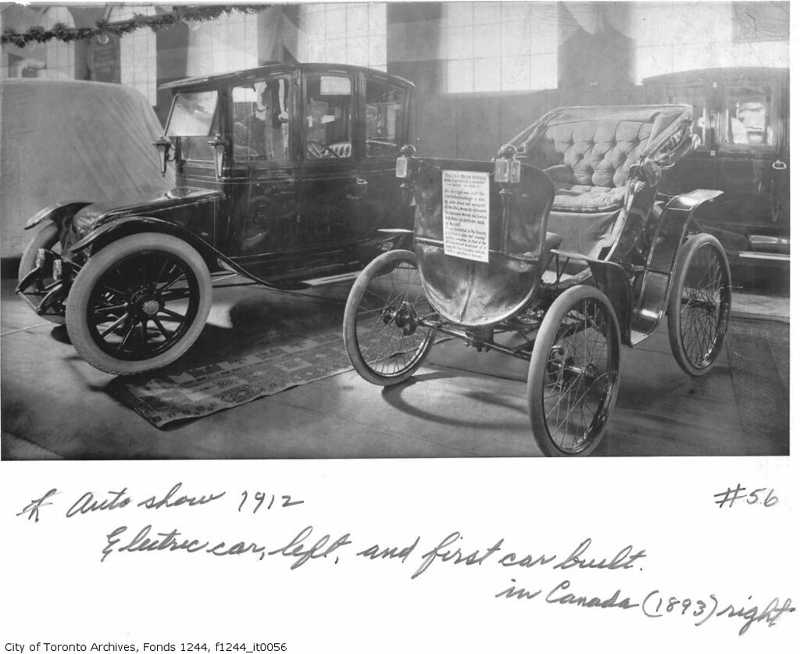
In 1832, the first electric car was made by Robert Anderson, predating the first gasoline powered car, which was the catchily titled "Vehicle Powered by a Gas Engine" (created in 1886 by Carl Benz, who's company later went on to become Mercedes Benz). This electric vehicle by Robert Anderson was fairly rudimentary in design though, and lacked practicality, and it was only until the 1870s that electric cars began to have any utility.
In 1884, Thomas Parker invented the first electric car available in the UK, in a design that was created to avoid the negative effects of coal-powered vehicles in terms of pollution. Thomas Parker was a prolific inventor who made huge developments in dynamos, lead acid batteries and four wheel drive in his vehicles.
In 1887, a chemist named William Morrison created the first practical self-powered four-wheeled electric carriage. 12 were sold at 110,000 in today's money. In fact, towards the end of the 19th century approximately one third of all cars were electric. Eventually, gasoline-powered vehicles became more popular, and it's only now in the 21st century that we are beginning to see a resurgence in electric vehicles.