TL;DR
In the United Kingdom, the National Health Service (NHS) stands as a fundamental pillar of public health, offering essential medical services to millions. However, recent findings from the British Social Attitudes survey paint a concerning picture. Public satisfaction with the NHS has reached its lowest recorded level, reflecting growing concerns over waiting times, staff shortages, and overall service quality.
Key takeaways
- Top 5 reasons for NHS dissatisfaction: survey by Nuffield Trust and King's Fund
- According to the British Social Attitudes survey conducted in 2023, only 24% of respondents expressed satisfaction with the NHS, marking a five-percentage-point drop from the previous year.
- This figure starkly contrasts with the peak satisfaction rate of 70% recorded in 2010.
- The survey, conducted by the National Centre for Social Research across England, Wales, and Scotland, polled over 3,000 individuals, providing valuable insights into public sentiment towards the healthcare system.
- In this article, we delve into the key findings of the survey, explore the reasons behind the decline in satisfaction, and discuss potential avenues for improvement.
Decline in Public Satisfaction with the NHS
In the United Kingdom, the National Health Service (NHS) stands as a fundamental pillar of public health, offering essential medical services to millions. However, recent findings from the British Social Attitudes survey paint a concerning picture. Public satisfaction with the NHS has reached its lowest recorded level, reflecting growing concerns over waiting times, staff shortages, and overall service quality. In this article, we delve into the key findings of the survey, explore the reasons behind the decline in satisfaction, and discuss potential avenues for improvement.
The Survey Results
According to the British Social Attitudes survey conducted in 2023, only 24% of respondents expressed satisfaction with the NHS, marking a five-percentage-point drop from the previous year. This figure starkly contrasts with the peak satisfaction rate of 70% recorded in 2010. The survey, conducted by the National Centre for Social Research across England, Wales, and Scotland, polled over 3,000 individuals, providing valuable insights into public sentiment towards the healthcare system.
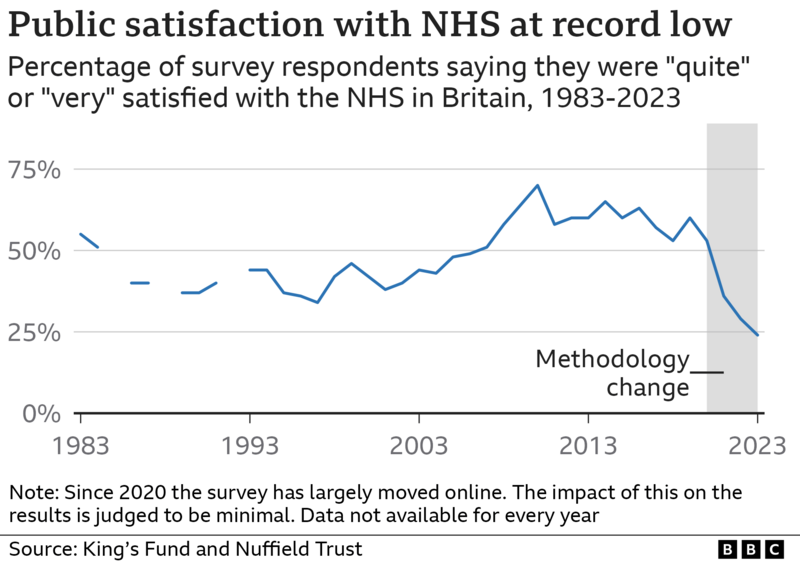
*source: Nuffield Trust and King's Fund, BBC(bbc.co.uk)
Key Concerns
Several factors contribute to the declining satisfaction levels among the public:
-
Waiting Times: Long waiting times for medical appointments and procedures remain a significant source of frustration for patients.
-
Staff Shortages: The NHS faces persistent challenges in recruiting and retaining healthcare professionals, leading to understaffed facilities and overworked staff.
-
Funding and Resources: Insufficient funding and resources strain the healthcare system, impacting service quality and patient outcomes.
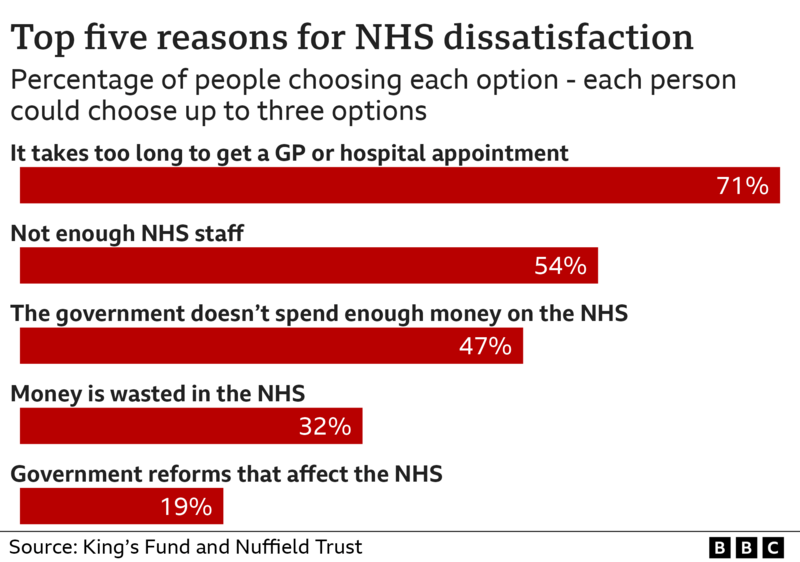
*source: Nuffield Trust and King's Fund, BBC(bbc.co.uk)
Impact on Core Services
The survey highlights specific areas of dissatisfaction within the NHS:
-
Accident & Emergency (A&E): Public satisfaction with A&E services remains low, reflecting concerns over overcrowding and lengthy waiting times.
-
Dentistry: Dental services also receive low satisfaction ratings, indicating potential issues with accessibility and quality of care.
Social Care
In addition to healthcare services, public satisfaction with social care has plummeted to 13%, the lowest since the survey's inception. Similar to healthcare, long waiting times, staffing shortages, and funding constraints contribute to dissatisfaction in the social care sector.
Public Opinion on Government Action
When asked about government interventions, nearly half of respondents (48%) supported increased taxes and spending on the NHS. However, a significant portion (42%) preferred maintaining current levels of taxation and spending. These divergent views underscore the complexity of addressing healthcare challenges through policy measures.
Industry Perspectives
Rory Deighton, the NHS Confederation's acute network director, acknowledges the challenges faced by both patients and healthcare professionals. He emphasises the need for concerted efforts to improve access to primary care and reduce waiting lists. Increased investment in hospitals, GP surgeries, and social care is deemed essential for addressing systemic issues.
Call for Action
Healthcare organisations, such as the Nuffield Trust and the Royal College of Nursing, stress the urgency of addressing the NHS's shortcomings. Political parties are urged to prioritise healthcare reform, focusing on enhancing service quality, reducing waiting times, and ensuring equitable access to care.
Government Response
While acknowledging the survey findings, the Department of Health and Social Care in England highlights ongoing efforts to improve NHS performance. Investment in key areas like GP services demonstrates a commitment to addressing systemic challenges. Similarly, the Scottish and Welsh governments emphasise their dedication to enhancing healthcare despite budgetary constraints.
Conclusion
The decline in public satisfaction with the NHS reflects deep-rooted challenges facing the healthcare system. Addressing these issues requires a multifaceted approach, involving increased investment, workforce development, and policy reforms. By listening to patient experiences, collaborating with healthcare professionals, and prioritising public health, stakeholders can work towards rebuilding trust and ensuring the NHS delivers on its promise of quality care for all.
Private Medical Insurance as a Solution
While systemic issues within the NHS are being addressed, increasing numbers of individuals are exploring alternatives like Private Medical Insurance to alleviate immediate concerns. PMI offers access to private healthcare services, reducing wait times and providing additional health choices for patients.
Sources
- NHS England: Waiting times and referral-to-treatment statistics.
- Office for National Statistics (ONS): Health, mortality, and workforce data.
- NICE: Clinical guidance and technology appraisals.
- Care Quality Commission (CQC): Provider quality and inspection reports.
- UK Health Security Agency (UKHSA): Public health surveillance reports.
- Association of British Insurers (ABI): Health and protection market publications.
Important Information and Risks
No advice: This article is for general information only. It is not financial, legal, insurance, or tax advice, and it is not a personal recommendation. WeCovr does not assess your individual circumstances or recommend a specific product through this article.
Policy exclusions and underwriting: Insurance policies, including life insurance, private medical insurance, critical illness cover, and income protection, are subject to insurer underwriting, eligibility, acceptance criteria, terms, conditions, limits, and exclusions. Pre-existing medical conditions may be excluded, restricted, or accepted on special terms unless an insurer confirms otherwise in writing.
Tax treatment: References to tax treatment, HMRC rules, or business reliefs are based on current UK legislation and guidance, which can change. Tax treatment depends on your personal or business circumstances and may differ from examples in this article.
Before you buy: Always read the Insurance Product Information Document (IPID), policy summary, and full policy terms before buying, renewing, changing, or keeping cover. If you are unsure whether a policy is suitable for you, speak to an insurance adviser.
Start with your Protection Score, then decide whether private health cover is the right fit
Check where health access sits in your overall protection picture before deciding whether to compare private health cover.
Spot whether NHS access risk is the real issue
See if PMI is the gap to fix first
Get health insurance help only if it makes sense for you
Get your score
Start with your protection score
Check your current position first, then get health insurance help if you need it.
Check your current resilience
Score your income, health access and family protection position in a few minutes.
See where private cover helps
Understand whether faster diagnosis and treatment is a priority gap.
Continue to tailored PMI help
If health access is the issue, continue to tailored PMI help.
What you get
A quick view of your current protection position
A clearer idea of where the biggest gaps may be
A direct route to tailored help if you want it