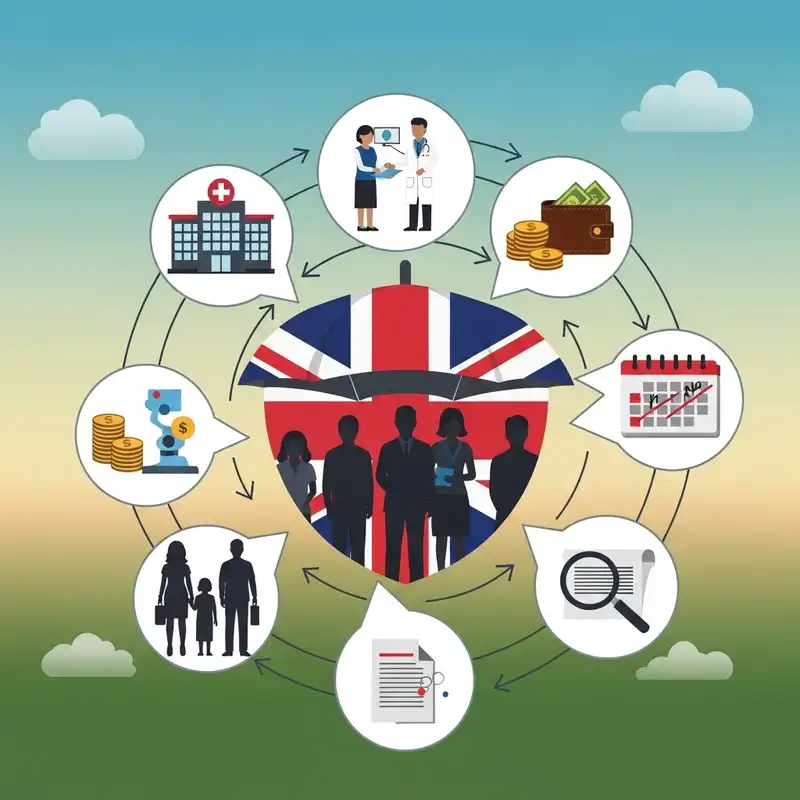
TL;DR
In our relentless pursuit of growth, we meticulously plan our careers, sculpt our bodies in the gym, and cultivate our minds with endless content. Yet, we often overlook the most critical element of a truly optimised life: resilience. Not just the mental grit to push through a tough day, but the foundational, structural resilience that can withstand lifes most powerful shocks.
Key takeaways
- Audit Your Reality: Sit down and take a clear-eyed look at your situation. What protection do you already have through work? What are your monthly outgoings? What debts do you have (mortgage, loans)? Who depends on your income?
- Identify Your Vulnerabilities: What are your biggest personal risks? Are you self-employed with no sick pay? Is your job physically demanding? Do you have a family history of a particular illness?
- Quantify Your Needs: Don't guess. Calculate the exact income you would need to replace each month. Work out the lump sum required to clear your major debts. Use online calculators or speak to an adviser to get a realistic figure.
- Explore the Solutions: Using the information in this guide, familiarise yourself with the different types of cover. Understand the difference between Income Protection and Critical Illness Cover, or Level Term and Family Income Benefit.
- Seek Expert, Impartial Advice: This is the most important step. An independent protection adviser can translate your needs into a tangible plan. They can navigate the market, understand the nuances of different insurer's underwriting, and ensure your policies are set up correctly (e.g., placed in trust).
Future Proofing Your Purpose the Resilience Revolution
In our relentless pursuit of growth, we meticulously plan our careers, sculpt our bodies in the gym, and cultivate our minds with endless content. We optimise, we bio-hack, we hustle. Yet, we often overlook the most critical element of a truly optimised life: resilience. Not just the mental grit to push through a tough day, but the foundational, structural resilience that can withstand life’s most powerful shocks.
The stark reality, highlighted by research from organisations like Cancer Research UK, is that one in two people born in the UK after 1960 will be diagnosed with cancer in their lifetime. This is not a distant, abstract threat; it is a statistical probability that touches almost every family. And it’s just one of many potential health crises that can emerge without warning.
When a serious illness or injury strikes, it doesn’t just attack your health. It attacks your ability to earn, your financial stability, and the future you’ve worked so hard to build. Suddenly, the focus shifts from personal growth to pure survival. This is where the Resilience Revolution begins: a paradigm shift from surface-level wellness to creating a life that is not just successful, but secure. It's about building a financial fortress that protects you and your loved ones, allowing you to face the future with confidence, not fear.
The Unseen Cracks: A Look at the UK's Health and Financial Landscape
To understand why financial resilience is no longer a 'nice-to-have' but an absolute necessity, we must look at the converging trends shaping modern British life. The ground beneath our feet is shifting, and ignoring the tremors is a risk we can ill afford.
The Health Challenge:
The "1 in 2" cancer statistic is a powerful headline, but the picture is broader. According to the Office for National Statistics (ONS), long-term sickness is a growing concern. In 2024, millions of working-age people are economically inactive due to long-term health conditions, a figure that has risen significantly in recent years. Mental health conditions are a major contributing factor, alongside musculoskeletal problems and other chronic illnesses.
These aren't just numbers; they represent careers paused, incomes lost, and dreams deferred. The average period of sickness absence is climbing, meaning a temporary setback can easily become a prolonged financial crisis without the right support.
The Evolving World of Work:
The traditional model of a 'job for life' with a generous sick pay package and death-in-service benefits is fading. The UK workforce is more dynamic and fragmented than ever before.
- The Rise of the Self-Employed: Millions of people in the UK are now self-employed, working as freelancers, contractors, or running their own small businesses. This entrepreneurial spirit is vital to our economy, but it comes with a trade-off: there is no employer safety net. No statutory sick pay beyond the bare minimum, no company pension, and no group insurance policies.
- The Gig Economy: A growing segment of the workforce operates in the gig economy, with fluctuating incomes and a lack of traditional employment rights.
- Portfolio Careers: Many professionals now juggle multiple roles and income streams. While this offers flexibility, it also complicates financial planning and exposes them to risk if one income source dries up due to illness.
This new world of work demands a new way of thinking about personal protection. The responsibility has shifted squarely onto the individual's shoulders.
Beyond Green Juice: True Resilience vs. Surface Wellness
The wellness industry is booming, offering an endless array of products and services promising a better life. From meditation apps and boutique fitness classes to organic meal plans and wellness retreats, we are encouraged to invest heavily in our immediate well-being.
While these practices are undoubtedly beneficial, they represent only one side of the coin. They help us thrive when life is good. True resilience, however, is about what happens when life is not good.
Imagine building a magnificent house. You spend a fortune on the interior design, the smart home technology, and the landscaped gardens. But you build it on a foundation of sand. The first storm that rolls in will wash it all away.
Financial protection is the concrete foundation of your life.
- Wellness optimises the present. It helps you feel good today.
- Resilience secures the future. It ensures that a crisis today doesn't destroy all your tomorrows.
A critical illness diagnosis or a debilitating injury can render your gym membership and mindfulness subscription useless if you can no longer afford your mortgage. True life optimisation means preparing for adversity with the same vigour we apply to pursuing success. It’s the least glamorous part of personal development, but it is, without question, the most important.
Your Financial First Aid Kit: Core Protection Explained
Building this foundation isn't complex, but it requires understanding the key tools at your disposal. Think of these policies as your personal financial first aid kit, each designed to address a specific type of emergency. At WeCovr, we specialise in helping you assemble the perfect kit for your unique circumstances, ensuring there are no gaps in your protection.
Income Protection: Your Monthly Salary Lifeline
This is arguably the most crucial policy for anyone who relies on their income to live.
- What is it? Income Protection (IP) is an insurance policy that pays you a regular, tax-free monthly income if you are unable to work due to any illness or injury. It continues to pay out until you can return to work, reach retirement age, or the policy term ends, whichever comes first.
- Who needs it? Every single working adult. If you lost your salary tomorrow, how long could you pay your bills? For the self-employed, IP is not just important; it's a lifeline.
- Key Concept: The 'Own Occupation' Definition. This is the gold standard. It means the policy will pay out if you are unable to do your specific job. Other definitions, like 'suited occupation' or 'any occupation', are less comprehensive and may not pay out if the insurer believes you could do a different type of work.
Let's consider a real-world example:
Sarah, a 35-year-old freelance marketing consultant, develops severe repetitive strain injury (RSI) and is unable to use a computer for extended periods. Her 'own occupation' Income Protection policy kicks in after her chosen 3-month deferment period. It pays her £2,500 a month, covering her mortgage, bills, and living expenses. This gives her the financial space to undergo physiotherapy and retrain in voice-activated software, allowing her to eventually return to her career without having drained her life savings or gone into debt. (illustrative estimate)
Income Protection: Key Features at a Glance
| Feature | Description | What to Consider |
|---|---|---|
| Cover Amount | Typically 50-70% of your gross pre-tax income. | How much do you need to cover essential outgoings? |
| Deferment Period | The waiting period before payments start (e.g., 4, 13, 26, 52 weeks). | Longer deferment = lower premiums. Match it to your sick pay/savings. |
| Payment Term | How long the policy pays out for (e.g., 2 years, 5 years, or until retirement). | 'Until retirement' offers the most comprehensive cover. |
| Definition of Incapacity | 'Own Occupation' is best. Avoid 'Any Occupation'. | This is crucial. Check the policy wording carefully. |
Critical Illness Cover: The Lump Sum for Major Hurdles
While Income Protection replaces a lost salary, Critical Illness Cover (CIC) provides a one-off, tax-free lump sum if you are diagnosed with one of a list of specified serious conditions.
- What is it? A policy designed to alleviate the immediate financial impact of a life-altering diagnosis. According to the Association of British Insurers (ABI), the vast majority of claims are for cancer, heart attacks, and strokes.
- How can the money be used? The choice is yours. It can be used to:
- Clear or reduce a mortgage.
- Pay for private medical treatment or specialist care.
- Adapt your home (e.g., install a wheelchair ramp).
- Allow a partner to take time off work to care for you.
- Simply give you the breathing room to recover without financial stress.
David, a 48-year-old teacher and father of two, suffers a major heart attack. His £100,000 Critical Illness Cover policy pays out. He uses the funds to clear the remaining £70,000 on his mortgage, instantly removing the family's largest monthly outgoing. The remaining £30,000 allows his wife to reduce her working hours for six months to support his recovery and funds a cardiac rehabilitation programme not available on the NHS in his area.
Life Insurance (Life Protection): Securing Your Legacy
This is the most well-known form of protection, designed to provide for your loved ones after you're gone.
- What is it? A policy that pays a lump sum (or a regular income) to your beneficiaries upon your death.
- Who needs it? Anyone with financial dependents (a spouse, children) or significant debts (like a mortgage) that would be passed on.
There are two main types for most people:
| Type of Life Insurance | How It Works | Best For |
|---|---|---|
| Level Term Assurance | The payout amount remains the same throughout the policy term. | Covering an interest-only mortgage or providing a lump sum for family living costs. |
| Decreasing Term Assurance | The payout amount reduces over time, broadly in line with a repayment mortgage. | Covering a repayment mortgage. It's the most affordable type of life cover. |
Placing your life insurance policy "in trust" is a simple legal step that ensures the money is paid directly to your chosen beneficiaries, bypassing your estate. This means it is paid out much faster and is typically not subject to Inheritance Tax.
Tailored Protection for the Backbone of Britain
A one-size-fits-all approach to protection simply doesn't work in 2025. Different professions and lifestyles carry different risks and require specialised solutions.
For the Hands-On Heroes: Nurses, Electricians, and Tradespeople
Those in physically demanding roles, from NHS nurses on their feet all day to electricians working at height and builders on site, face a higher risk of injury that could prevent them from working. While full Income Protection is ideal, some insurers may load premiums or place exclusions on these roles.
This is where Personal Sick Pay insurance comes in. It is a specific type of short-term income protection, often better suited to higher-risk occupations.
- Key Differences:
- Simpler Underwriting: Often easier to get accepted for than long-term IP.
- Shorter Payment Periods: Typically pays out for 1, 2, or 5 years per claim, rather than until retirement.
- Affordability: This shorter-term cover makes it a more accessible starting point.
For a self-employed plumber, a Personal Sick Pay policy that covers them for two years in the event of an accident is an absolute game-changer, providing a vital safety net without the higher cost of a long-term plan.
For the Visionaries: Company Directors and Business Owners
If you run your own limited company, you have access to some of the most tax-efficient protection policies available. These are paid for by the business as a legitimate business expense.
- Executive Income Protection: The company pays the premiums for a director's income protection. This is treated as a business expense, making it highly tax-efficient. The benefit is paid to the company, which then distributes it to the director via PAYE.
- Relevant Life Cover: A death-in-service policy for individual employees or directors, paid for by the business. It provides a lump sum to the individual's family, but the premiums are not treated as a P11D benefit-in-kind, offering significant tax savings compared to a personal policy.
- Key Person Insurance: This protects the business itself. It provides a lump sum to the company if a key individual—whose skills, knowledge, or leadership are critical to the business's financial success—dies or is diagnosed with a critical illness. The funds can be used to recruit a replacement or manage the disruption.
Business Protection: A Summary
| Policy | Who It Protects | What It Does | Key Benefit |
|---|---|---|---|
| Executive IP | The Director/Employee | Provides a monthly income via the company if they can't work. | Tax-efficient for the business. |
| Relevant Life | The Director's/Employee's Family | Provides a tax-free lump sum on death. | Highly tax-efficient alternative to personal cover. |
| Key Person | The Business | Provides a lump sum to the business on the death/illness of a key employee. | Ensures business continuity and stability. |
For the Trailblazers: The Self-Employed and Freelancers
This dynamic and growing segment of the workforce is also the most financially exposed. As a freelancer or sole trader, you are your business's single most important asset. If you stop, the income stops.
For this group, a combination of policies is essential to create a comprehensive personal safety net:
- Income Protection: Non-negotiable. This is your sick pay.
- Critical Illness Cover: Provides the capital to survive a major health crisis without destroying your business or savings.
- Private Health Insurance: Allows you to bypass lengthy waiting lists for diagnosis and treatment, getting you back to work and earning faster.
Navigating the market as a freelancer can be daunting, especially with a fluctuating income. This is where an expert broker like WeCovr adds immense value. We can help you find flexible policies that can be adapted as your income grows and find insurers who understand the nature of self-employment.
Advanced Strategies for Total Peace of Mind
Once the core foundations are in place, you can explore more specialised policies to create a truly comprehensive resilience plan.
Private Health Insurance (PMI): Your Fast-Track to Treatment
The NHS is a national treasure, but it is under immense pressure. As of early 2025, NHS waiting lists in England remain at historically high levels, with millions of people waiting for routine consultant-led treatment. For a business owner or freelancer, a long wait for a diagnosis or a simple operation like a hernia repair or knee surgery can mean months of lost income.
Private Medical Insurance (PMI) is designed to work alongside the NHS. It gives you fast access to:
- Private consultations with specialists.
- Advanced diagnostic scans (MRI, CT).
- Treatment and surgery in a private hospital.
This can drastically reduce the time between symptom onset and recovery, minimising the impact on your life and your earnings.
Family Income Benefit: A Different Approach to Family Protection
Instead of a single large lump sum, Family Income Benefit (FIB) pays out a regular, tax-free monthly or annual income to your family if you pass away. This income is paid for the remainder of the policy term.
Why choose FIB?
- Budgeting: It can be easier for a grieving family to manage a regular income rather than a large, intimidating lump sum.
- Affordability: Because the potential payout decreases over time, FIB is often significantly cheaper than a comparable level term life insurance policy.
- Purpose: It's designed to directly replace your lost monthly income, making it a very logical way to provide for day-to-day living costs.
Gift Inter Vivos: Protecting Your Legacy from Inheritance Tax
For those with larger estates, Inheritance Tax (IHT) planning is a key part of securing their legacy. One common strategy is to gift assets (cash, property) to loved ones during your lifetime.
However, the "7-Year Rule" applies. If you die within seven years of making the gift, it may still be considered part of your estate and be subject to IHT on a sliding scale.
Gift Inter Vivos insurance is a specialised life insurance policy designed to solve this problem. It's a type of term assurance policy that runs for seven years, with the payout amount decreasing over time in line with the tapering IHT liability. If the donor dies during this period, the policy pays out to cover the unexpected tax bill, ensuring the beneficiaries receive the full value of the gift as intended.
The WeCovr Approach: Holistic Resilience, Not Just a Policy
Building a robust financial safety net can feel overwhelming. The market is filled with jargon, and every insurer claims to be the best. This is why impartial, expert advice is so valuable.
At WeCovr, our philosophy extends beyond simply selling policies. We believe in helping our clients build genuine, holistic resilience. We take the time to understand your unique life, your career, your family, and your aspirations. Then, we search the entire market, comparing plans from all the UK's leading insurers to architect a protection portfolio that is tailored specifically to you.
We believe that supporting your well-being is a crucial part of our service. That’s why, in addition to finding you the right financial protection, we provide our clients with complimentary access to CalorieHero, our exclusive AI-powered calorie and nutrition tracking app. It’s our way of showing that we care about your health today as much as we care about protecting your financial future tomorrow. It’s this combination of financial security and proactive wellness support that forms the core of the resilience revolution.
Your 5-Step Action Plan to Building Financial Resilience
Feeling motivated to take control? Here’s a simple, five-step plan to turn intention into action.
- Audit Your Reality: Sit down and take a clear-eyed look at your situation. What protection do you already have through work? What are your monthly outgoings? What debts do you have (mortgage, loans)? Who depends on your income?
- Identify Your Vulnerabilities: What are your biggest personal risks? Are you self-employed with no sick pay? Is your job physically demanding? Do you have a family history of a particular illness?
- Quantify Your Needs: Don't guess. Calculate the exact income you would need to replace each month. Work out the lump sum required to clear your major debts. Use online calculators or speak to an adviser to get a realistic figure.
- Explore the Solutions: Using the information in this guide, familiarise yourself with the different types of cover. Understand the difference between Income Protection and Critical Illness Cover, or Level Term and Family Income Benefit.
- Seek Expert, Impartial Advice: This is the most important step. An independent protection adviser can translate your needs into a tangible plan. They can navigate the market, understand the nuances of different insurer's underwriting, and ensure your policies are set up correctly (e.g., placed in trust).
Conclusion: From Uncertainty to Unstoppable Progress
The pursuit of personal growth is a noble one. But true, sustainable growth is only possible from a position of security. By confronting the "what ifs" and building a fortress of financial resilience, you are not being pessimistic; you are being a realist. You are giving yourself and your loved ones an incredible gift: the freedom to live boldly.
When you know that a health crisis won’t lead to a financial catastrophe, you are free to take calculated career risks, to invest in your passions, and to live a fuller, less anxious life. Protecting your future doesn't hold you back; it unleashes you. This is the essence of the resilience revolution: transforming uncertainty into an unstoppable pathway to lasting peace and the genuine freedom to thrive.
Isn't Income Protection the same as sick pay from my employer?
I'm young and healthy, do I really need Critical Illness Cover?
Can I get cover if I have a pre-existing medical condition?
How much cover do I actually need?
What's the difference between 'own occupation' and other definitions for Income Protection?
Is life insurance paid out tax-free?
Sources
- Office for National Statistics (ONS): Mortality and population data.
- Association of British Insurers (ABI): Life and protection market publications.
- MoneyHelper (MaPS): Consumer guidance on life insurance.
- NHS: Health information and screening guidance.
Disclaimer: This is general guidance only and does not constitute formal tax or financial advice. Tax treatment depends on individual circumstances, policy terms, and HMRC interpretation, which cannot be guaranteed in advance. Whenever applicable, businesses and individuals should always consult a qualified accountant or tax adviser before arranging such policies.
Measure your family’s protection gap, then get the right life cover quote
Start with the score to see whether your family would face a real financial shortfall before moving on to life cover options.
Check what happens if someone dies too soon
See whether debt, dependants and mortgage risk are covered
Move into tailored life cover options after the score
Get your score
Your next best move
Get your score in minutes, then decide what kind of protection help would be most useful.
Score your household protection
See how well your current setup protects dependants, debt and major commitments.
Find the shortfall
Know whether life cover, critical illness or income protection is the actual missing piece.
Continue to tailored life cover
If life cover is the gap, continue to tailored life cover options.
What you get
A quick view of your current protection position
A clearer idea of where the biggest gaps may be
A direct route to tailored help if you want it