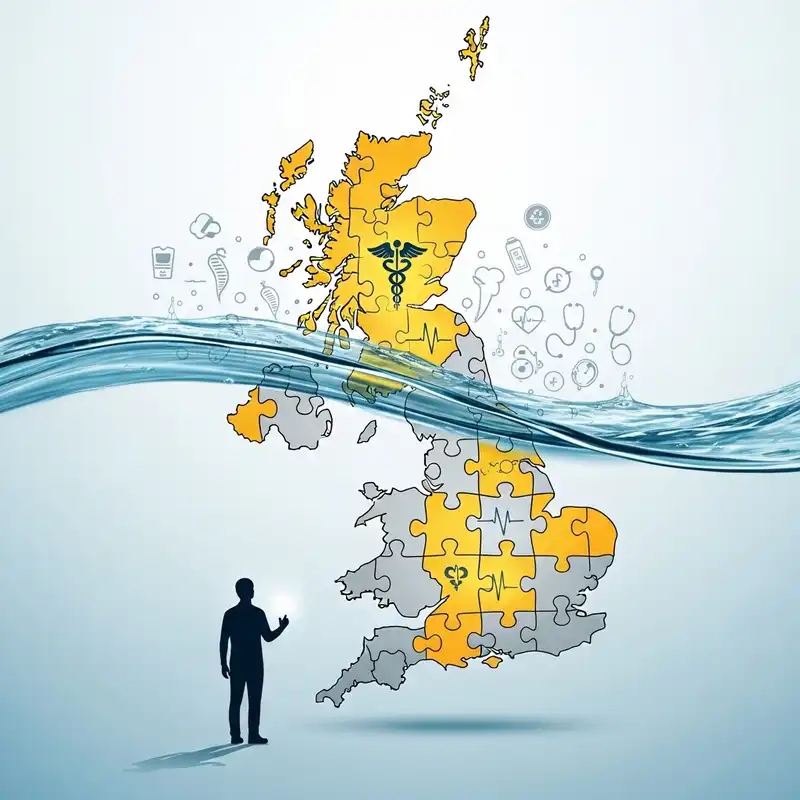
TL;DR
In our relentless pursuit of personal growth, we champion mindfulness, devour self-help books, and optimise our morning routines. We strive to be more productive, more present, and more fulfilled. But what if the greatest barrier to unlocking our true potential isn't a lack of discipline or the wrong mindset?
Key takeaways
- Income Plummets: For many, being unable to work means a drastic drop in income. Statutory Sick Pay (SSP) in the UK for 2025 is just 116.75 per week. Compare that to the average weekly household expenditure, which the ONS reports is over 600. The gap is immense and immediate.
- Expenses Rise: At the same time, costs can increase significantly. These can include travel to and from hospital appointments, prescription charges, private consultations, home modifications, or specialist dietary needs.
- The Emotional Toll: Financial stress is a major contributor to anxiety and depression. Worrying about bills while trying to recover from a serious illness creates a vicious cycle that can hinder both physical and mental healing.
- Clear or pay down your mortgage.
- Cover your salary for a year or two while you recover.
Grow Unstoppable Protect Your Future
In our relentless pursuit of personal growth, we champion mindfulness, devour self-help books, and optimise our morning routines. We strive to be more productive, more present, and more fulfilled. But what if the greatest barrier to unlocking our true potential isn't a lack of discipline or the wrong mindset? What if it’s the silent, creeping anxiety of the unknown?
We live in an era of unprecedented awareness about our health, yet also one of sobering statistics. The most stark of these comes from Cancer Research UK, which projects that 1 in 2 people in the UK will be diagnosed with some form of cancer in their lifetime. Let that sink in. This isn't a remote possibility; it's a statistical coin toss affecting every other person you know. (illustrative estimate)
This reality forms the unseen foundation upon which all our ambitions are built. You can’t truly "live your best life" if a part of your mind is constantly worried about what would happen to you, your family, or your business if illness struck. This is where the conversation must evolve beyond mindfulness. True, unshakable personal growth is built on a bedrock of security. It's about having a robust plan that protects you from life's most challenging storms, freeing up your mental and emotional energy to focus on what truly matters: living, creating, and thriving.
This guide is your blueprint for building that foundation. We will explore how a smart combination of financial protection and proactive health management isn't just a safety net—it's the springboard to your fullest, most unstoppable life.
The Real Cost of Uncertainty: Why Your 'Plan A' Needs a 'Plan B'
We are brilliant at making plans. We plan our careers, our holidays, our finances. This is our 'Plan A'. But Plan A operates on the assumption that things will go smoothly. Our health will hold, our income will remain stable, and our ability to provide for our loved ones will continue uninterrupted.
Unfortunately, life doesn't always stick to the script. An unexpected illness or injury can derail everything in an instant, and the consequences are far more than just physical.
The Financial Shockwave of Illness
When a serious health event occurs, the immediate focus is on treatment and recovery. But a secondary, often more prolonged, crisis quickly follows: the financial fallout.
- Income Plummets: For many, being unable to work means a drastic drop in income. Statutory Sick Pay (SSP) in the UK for 2025 is just £116.75 per week. Compare that to the average weekly household expenditure, which the ONS reports is over £600. The gap is immense and immediate.
- Expenses Rise: At the same time, costs can increase significantly. These can include travel to and from hospital appointments, prescription charges, private consultations, home modifications, or specialist dietary needs.
- The Emotional Toll: Financial stress is a major contributor to anxiety and depression. Worrying about bills while trying to recover from a serious illness creates a vicious cycle that can hinder both physical and mental healing.
Consider this simple breakdown of the financial gap:
| Financial Element | Average UK Reality | With SSP Only | The Monthly Shortfall |
|---|---|---|---|
| Average Monthly Income | £2,500 (approx.) | £505.91 | -£1,994.09 |
| Average Monthly Expenses | £2,400 (approx.) | £2,400 (approx.) | A significant deficit |
| Additional Costs | Minimal | £100 - £500+ | Further increases the deficit |
Source: ONS, Gov.uk SSP rates for 2025. Figures are illustrative.
This isn't about fear-mongering; it's about financial realism. Relying solely on the state or your savings is a high-stakes gamble. A robust 'Plan B' isn't a luxury; it's a fundamental component of modern financial planning.
Your Financial Armour: A Guide to Smart Protection
Think of protection insurance as financial armour. You hope you never need it, but if you do, it can be the difference between a temporary setback and a life-altering crisis. It's designed to pay out when you need it most, providing the funds to cover your mortgage, bills, and living costs, allowing you to focus completely on your recovery.
Let's break down the key types of cover that form this essential shield.
1. Life Insurance: The Cornerstone of Family Protection
Life insurance pays out a tax-free lump sum or a regular income if you pass away during the policy term. It’s the ultimate act of care for those you leave behind.
- Term Life Insurance: This is the most common and affordable type. You choose a sum of money and a period of time (the 'term'), often to coincide with the length of your mortgage or until your children are financially independent. If you die within that term, the policy pays out.
- Family Income Benefit: A variation of term insurance, this doesn't pay a single lump sum. Instead, it pays a regular, tax-free monthly or annual income to your family for the remainder of the policy term. This can be easier to manage than a large lump sum and is often more affordable, as it replaces your lost income in a like-for-like way.
- Whole of Life Insurance: As the name suggests, this policy is guaranteed to pay out whenever you die, as long as you've kept up with the premiums. It's often used for covering funeral costs or for inheritance tax planning.
2. Critical Illness Cover: A Lifeline When You Need It Most
Given that 1 in 2 of us will face a cancer diagnosis, Critical Illness Cover is arguably one of the most vital protections. It pays out a tax-free lump sum if you are diagnosed with one of a list of specified serious conditions. (illustrative estimate)
This money is yours to use as you wish. It could:
- Clear or pay down your mortgage.
- Cover your salary for a year or two while you recover.
- Pay for private medical treatment or specialist care.
- Adapt your home to your new needs.
- Simply remove all financial stress, giving you the peace of mind to heal.
The conditions covered vary between insurers but almost always include the 'big three': cancer, heart attack, and stroke. Most comprehensive policies today cover 50+ conditions, and some even more than 100.
| What Critical Illness Cover Is | What Critical Illness Cover Is Not |
|---|---|
| A lump sum payment on diagnosis. | An income replacement plan. |
| Covers a specific list of illnesses. | A private health insurance policy. |
| Pays out once for a qualifying event. | Cover for minor illnesses or injuries. |
| Designed to handle major financial impact. | A savings or investment plan. |
3. Income Protection: Insuring Your Most Valuable Asset
What is your most valuable asset? It's not your house or your car. It's your ability to earn an income. Income Protection is designed to protect exactly that.
If you're unable to work due to any illness or injury (not just the 'critical' ones), an Income Protection policy will pay you a regular, tax-free monthly income. This continues until you can return to work, the policy term ends (often at your chosen retirement age), or you pass away.
Key features to understand:
- Deferment Period: This is the waiting period between when you stop working and when the policy starts paying out. It can range from 4 weeks to 52 weeks. The longer the deferment period you choose, the lower your premium will be. You can align it with your employer's sick pay scheme or your savings.
- Level of Cover: You can typically insure up to 50-70% of your gross annual income. This is to ensure you have an incentive to return to work when you are able.
For many, Income Protection is the single most important policy they can own. It provides a long-term safety net against almost any health-related event that stops you from earning.
Tailored Protection for Every Walk of Life
Insurance isn't a one-size-fits-all product. Your profession, business structure, and life stage all influence the type of protection that’s right for you.
For the Self-Employed, Freelancers, and Tradespeople
If you work for yourself, you are your own safety net. There's no employer sick pay, no death-in-service benefit, and no one to pick up the slack if you're out of action. This makes personal protection non-negotiable.
- Income Protection is Essential: This is your replacement sick pay scheme. For tradespeople in riskier jobs, it provides peace of mind that an injury on site won't jeopardise your family's finances.
- Personal Sick Pay: Some insurers offer specific short-term income protection policies, sometimes called 'Personal Sick Pay'. These are designed to pay out for a limited period (e.g., 1, 2, or 5 years) and can be a more budget-friendly option for those starting out.
- Critical Illness Cover: A lump sum can provide a vital buffer, allowing you to keep your business afloat or simply take the time you need to recover without dipping into business cash flow.
For Company Directors and Business Owners
As a business leader, you have a dual responsibility: to protect your family and to protect the enterprise you've built. Fortunately, there are highly tax-efficient ways to arrange cover through your limited company.
- Executive Income Protection: This is an Income Protection policy owned and paid for by your company, for your benefit as an employee. The premiums are typically an allowable business expense, making it highly tax-efficient. It can also offer higher levels of cover than a personal plan.
- Key Person Insurance: Who is indispensable to your business? Is it the sales director who brings in all the revenue? The technical founder with all the knowledge? Key Person cover is a policy taken out by the business on the life of a key employee. If that person becomes critically ill or passes away, the policy pays a lump sum directly to the business to cover lost profits, recruit a replacement, or clear debts.
- Relevant Life Cover: This is a company-paid death-in-service benefit for individual employees, including directors. Like Executive Income Protection, the premiums are usually a tax-deductible business expense, and it doesn't count towards the employee's annual or lifetime pension allowances. It's a powerful and cost-effective way to provide life cover.
Here’s a summary of business protection options:
| Protection Type | Who is Covered? | Who Pays? | Who Receives the Benefit? | Primary Purpose |
|---|---|---|---|---|
| Executive Income Protection | A Director / Employee | The Limited Company | The Director / Employee | Replaces personal income tax-efficiently |
| Key Person Insurance | A Vital Employee | The Limited Company | The Limited Company | Protects the business from financial loss |
| Relevant Life Cover | A Director / Employee | The Limited Company | The Employee's Family | Provides a tax-efficient death benefit |
For Those Planning Their Legacy
- Gift Inter Vivos Insurance: Have you gifted a large sum of money or an asset (like a property) to your children? If you pass away within seven years of making that gift, it could be subject to Inheritance Tax (IHT). A Gift Inter Vivos policy is a special type of life insurance designed to pay out a lump sum to cover that potential tax bill, ensuring your loved ones receive the full value of your gift.
Finding the right mix of personal and business protection can feel complex. This is where getting expert advice is invaluable. At WeCovr, we specialise in helping individuals, freelancers, and company directors navigate this landscape. We compare plans from all the UK's leading insurers to create a protection portfolio that’s perfectly tailored to your unique circumstances.
Beyond the Safety Net: Unlocking Peak Performance with Private Health
While protection insurance secures your finances, Private Medical Insurance (PMI) secures your time and your health. The NHS is a national treasure, providing exceptional emergency and critical care. However, for non-urgent conditions, diagnostics, and elective surgeries, waiting lists have become a significant challenge.
According to recent NHS data, millions of people are on waiting lists for consultant-led elective care. This waiting period isn't just an inconvenience; it can mean months of living with pain, discomfort, and uncertainty, impacting your ability to work, parent, and enjoy life.
This is where PMI transforms from a 'nice-to-have' into a powerful tool for personal and professional growth.
The Advantages of Private Medical Insurance:
- Speed of Access: This is the primary benefit. PMI allows you to bypass long NHS waiting lists for consultations, diagnostics (like MRI and CT scans), and treatment.
- Choice and Control: You can often choose the specialist, consultant, and hospital where you receive your treatment, giving you greater control over your healthcare journey.
- Access to Specialist Drugs and Treatments: Some cutting-edge treatments or drugs may not be available on the NHS due to cost or NICE (National Institute for Health and Care Excellence) approval delays. PMI can provide access to these.
- Comfort and Privacy: Treatment is typically provided in a private hospital with your own en-suite room, creating a more comfortable and restful environment for recovery.
For a driven individual, an entrepreneur, or a freelancer, time is your most precious commodity. Being sidelined for six months with a knee injury waiting for surgery isn't just painful; it's six months of lost productivity, lost opportunities, and lost momentum. PMI is an investment in continuity. It gets you diagnosed, treated, and back on your feet faster, so you can get back to building your dreams.
Building Your Unstoppable Foundation: Practical Steps
We've established the 'why'. Now let's focus on the 'how'. Building this foundation of security and health is a proactive process.
1. Conduct a Personal Protection Audit
Take a clear-eyed look at your situation.
- Dependants: Who relies on you financially? (Spouse, children, ageing parents)
- Debts: What are your major liabilities? (Mortgage, car loans, business loans)
- Income: What is your monthly income, and how much would your household need to survive without it?
- Existing Cover: Do you have any protection through your employer? Check the details – it's often less comprehensive than you think and always ends if you leave the job.
- Savings: How long could your savings realistically support you and your family?
2. Embrace Proactive Wellness
Insurance is your reactive plan. Your proactive plan is your lifestyle. Small, consistent habits have a monumental impact on your long-term health, reducing your risk of many of the conditions we've discussed.
- Nourish Your Body: A balanced diet rich in whole foods, fruits, and vegetables is proven to reduce the risk of cancer, heart disease, and type 2 diabetes. It's not about restriction; it's about mindful nourishment. As part of our commitment to our clients' holistic wellbeing, we at WeCovr provide complimentary access to our AI-powered calorie and nutrition tracking app, CalorieHero. It's a simple tool to help you understand your eating habits and make healthier choices, day by day.
- Prioritise Sleep: Sleep is not a luxury; it is a biological necessity. Aim for 7-9 hours of quality sleep per night. It's crucial for cognitive function, immune response, and cellular repair.
- Move Your Body: You don't need to run marathons. The NHS recommends at least 150 minutes of moderate-intensity activity a week. A brisk 30-minute walk five days a week is all it takes to significantly improve your cardiovascular health.
- Manage Stress: This brings us full circle. Financial and health security are the ultimate stress-management tools. When your foundation is secure, you free up mental bandwidth, reducing chronic stress and its harmful physiological effects.
3. Seek Expert Guidance
The world of insurance can be filled with jargon and complexity. Trying to go it alone can be overwhelming. An independent broker works for you, not the insurance company. Our role at WeCovr is to act as your expert guide, translating the complexities into plain English and using our market knowledge to find you the most suitable cover at the most competitive price.
Conclusion: Grow Unstoppable
The pursuit of personal growth is a noble one. But it's a house built on sand if it's not supported by a foundation of real-world security. Mindfulness is powerful, but it won't pay the mortgage if you're too ill to work. A positive mindset is essential, but it's far easier to maintain when you're not consumed by financial anxiety.
In a world where serious illness is a statistical probability, preparing for that eventuality is not negative thinking; it's the ultimate act of self-care and responsibility. It's the action that says you value your life, your family, and your future enough to protect them.
By integrating smart protection and proactive health management into your life, you do more than just build a safety net. You eliminate the deep-seated "what if" anxieties that hold you back. You create the mental and emotional space to take calculated risks, to pursue your passions, and to build your legacy with confidence.
Protect your foundation. Secure your future. And then, go and grow unstoppable.
Is protection insurance expensive?
I'm young and healthy, do I really need this?
What's the difference between Income Protection and Critical Illness Cover?
Can I get cover if I have a pre-existing medical condition?
How does a broker like WeCovr help?
Sources
- Office for National Statistics (ONS): Mortality and population data.
- Association of British Insurers (ABI): Life and protection market publications.
- MoneyHelper (MaPS): Consumer guidance on life insurance.
- NHS: Health information and screening guidance.
Disclaimer: This is general guidance only and does not constitute formal tax or financial advice. Tax treatment depends on individual circumstances, policy terms, and HMRC interpretation, which cannot be guaranteed in advance. Whenever applicable, businesses and individuals should always consult a qualified accountant or tax adviser before arranging such policies.
Measure your family’s protection gap, then get the right life cover quote
Start with the score to see whether your family would face a real financial shortfall before moving on to life cover options.
Check what happens if someone dies too soon
See whether debt, dependants and mortgage risk are covered
Move into tailored life cover options after the score
Get your score
Your next best move
Get your score in minutes, then decide what kind of protection help would be most useful.
Score your household protection
See how well your current setup protects dependants, debt and major commitments.
Find the shortfall
Know whether life cover, critical illness or income protection is the actual missing piece.
Continue to tailored life cover
If life cover is the gap, continue to tailored life cover options.
What you get
A quick view of your current protection position
A clearer idea of where the biggest gaps may be
A direct route to tailored help if you want it