TL;DR
In 2026, UK private medical insurance has evolved from a luxury to an essential safety net due to ongoing healthcare pressures. WeCovr, an experienced broker with over 1,000,000 policies issued, explains how PMI protects individuals and families by providing faster access, where available, to acute care.
Key takeaways
- Standard UK PMI does not cover chronic or pre-existing conditions.
- PMI is designed to provide faster access, where available, to care for acute conditions.
- Long NHS waiting lists have driven mainstream adoption of private cover.
- Underwriting choices dictate how past medical history is treated.
- Using an expert broker ensures a well-matched policy for your needs.
The UK healthcare landscape is experiencing a profound shift. With WeCovr—an experienced broker having helped issue over 1,000,000 policies of various kinds—we explore why private medical insurance is now an essential safeguard. Discover how securing appropriate UK cover provides peace of mind amid rising healthcare challenges.
With NHS waiting lists remaining a challenge in 2026, WeCovr explores why private medical insurance has shifted from an executive perk to an essential safety net
For decades, private medical insurance (PMI) in the United Kingdom was widely regarded as a luxury—a corporate perk reserved for senior executives or an indulgence for the highly affluent. The National Health Service (NHS) provided a comprehensive, reliable safety net from cradle to grave. However, as we navigate through 2026, the structural realities of UK healthcare have fundamentally altered this dynamic.
With NHS elective care waiting lists remaining persistently high and diagnostic delays becoming increasingly common, the UK has quietly transitioned into a two-tier healthcare system. Those who can access private healthcare are doing so to bypass extensive delays, whilst those relying solely on state provision face prolonged waits for routine surgeries, specialist consultations, and vital diagnostic scans.
Consequently, private medical insurance has transitioned from a supplementary luxury to a mainstream necessity. Families, self-employed professionals, and small business owners are now prioritising monthly PMI premiums alongside their mortgage and utility bills. In this comprehensive guide, we dissect the mechanics of modern UK health insurance, explain exactly what it covers, and illustrate why partnering with an expert broking firm like WeCovr can help you navigate this complex market to find an appropriate level of cover.
The Realities of the Two-Tier Healthcare System
The phrase "two-tier healthcare" is often used in political discourse, but for the average UK consumer in 2026, it is a practical reality.
When a patient visits their NHS General Practitioner with a non-emergency ailment—such as a deteriorating hip, a suspicious but non-urgent lump, or severe chronic back pain—the typical pathway involves a referral to a specialist. Currently, the wait from that initial GP referral to the actual specialist consultation, followed by a subsequent wait for an MRI or ultrasound, and a final wait for the surgical intervention, can span many months.
In the private tier, this timeline is drastically compressed. A private patient can often see a specialist within a few days of a GP referral, undergo diagnostic imaging on the same day where available, and schedule surgery within a fortnight.
This stark contrast in access speed is the primary driver behind the surge in mainstream PMI adoption. People are no longer buying health insurance for private en-suite hospital rooms or upgraded food menus; they are purchasing it to buy back their time, preserve their income, and protect their physical mobility.
Understanding the Core Constraint: Acute vs. Chronic Conditions
Before delving into the benefits and structures of private health cover, it is vital to understand the fundamental regulatory and structural boundaries of UK private medical insurance.
Crucial Fact: Standard UK private medical insurance does not cover chronic or pre-existing conditions. PMI is strictly designed to cover acute conditions that arise after your policy start date.
Many consumers enter the PMI market assuming it functions like the NHS, acting as a blanket cover for all medical needs. This is a common and potentially costly misconception. Insurers draw a distinct line between acute and chronic health issues.
Acute Conditions (Covered)
An acute condition is a disease, illness, or injury that is likely to respond quickly to treatment and aims to return you to the state of health you were in immediately before suffering the disease, illness, or injury, or which leads to your full recovery. Examples: A newly torn meniscus requiring surgery, an unexpected hernia, newly diagnosed curable cancers, or a sudden onset of joint pain requiring a joint replacement.
Chronic Conditions (Not Covered)
A chronic condition is a disease, illness, or injury that has one or more of the following characteristics: it needs ongoing or long-term monitoring through consultations, examinations, check-ups, and/or tests; it needs ongoing or long-term control or relief of symptoms; it requires your rehabilitation or for you to be specially trained to cope with it; it continues indefinitely; it has no known cure; or it comes back or is likely to come back. Examples: Type 1 and Type 2 diabetes, asthma, hypertension (high blood pressure), multiple sclerosis, or chronic obstructive pulmonary disease (COPD).
If an acute condition develops into a chronic condition, a PMI policy will typically fund the initial diagnostic phase and the acute stabilisation treatment, but will cease funding once the condition is deemed incurable and requires long-term management. At that point, your care is transferred back to the NHS.
How Private Medical Insurance Works: The Underwriting Process
When you apply for a private medical insurance UK policy, the insurer assesses your medical history to determine what they will and will not cover. This process is known as underwriting. Choosing the right underwriting method is critical to ensuring your policy is a strong fit for your needs.
There are generally two main types of individual underwriting in the UK:
1. Moratorium Underwriting
Moratorium underwriting is the most popular and straightforward way to set up a policy. You do not need to fill out extensive medical questionnaires. Instead, the insurer applies a blanket exclusion on any medical condition you have had symptoms of, sought advice for, or received treatment for in the five years preceding the policy start date.
However, these pre-existing conditions can become eligible for cover in the future. If you complete a continuous two-year period after the policy starts where you remain entirely symptom-free, treatment-free, and advice-free for that specific condition, the insurer will lift the exclusion.
- Pros: Fast setup process; potentially allows cover for older, resolved issues later down the line.
- Cons: Uncertainty at the point of claim, as the insurer will request your medical notes to check the five-year history before authorising treatment.
2. Full Medical Underwriting (FMU)
With Full Medical Underwriting, you are required to disclose your entire medical history upfront through a detailed questionnaire. The insurer reviews this and explicitly states in your policy documents exactly what is excluded from the outset.
- Pros: Absolute clarity. You know precisely what you may be covered for before you ever need to make a claim. The claims process is often faster because the history check has already been completed.
- Cons: Lengthy application process; permanent exclusions are often placed on past conditions, even if they occurred more than five years ago.
Comparison Table: Moratorium vs. Full Medical Underwriting
| Feature | Moratorium Underwriting | Full Medical Underwriting (FMU) |
|---|---|---|
| Application Speed | Very fast (minimal questions) | Slower (requires detailed medical history) |
| Pre-existing Condition Rule | Excludes anything from the past 5 years | Excludes specific conditions permanently |
| Path to Coverage | 2-year clear period after policy starts | Excluded indefinitely (unless appealed later) |
| Claims Speed | Slower (requires historical checking) | Faster (history is already known) |
| Suitability | Those with minor or no recent health issues | Those seeking absolute certainty on cover |
Structuring Your Policy: Finding an Appropriate Level of Cover
Modern PMI is highly modular. You do not have to buy a "one-size-fits-all" package. By tweaking various elements of the policy, you can adjust the monthly premium to suit your budget whilst maintaining a well-matched policy. WeCovr's advisers frequently guide clients through these variables to ensure cost-efficiency.
Core Cover (Inpatient & Day-Patient)
Every PMI policy starts with core cover. This typically applies if you need to be admitted to a hospital (inpatient) or require a minor procedure where you occupy a bed for the day (day-patient); your hospital charges, specialist fees, anaesthetist fees, and diagnostic scans while admitted may be covered. Core cover is the non-negotiable foundation of health insurance.
Outpatient Cover
Outpatient cover dictates how much the insurer may pay for consultations and diagnostics that do not require a hospital bed. This includes seeing a consultant in their clinic, having an initial MRI scan, or undergoing blood tests. You can choose:
- Nil Outpatient Cover: You pay for private consultations out of your own pocket, but surgery may be covered.
- Capped Outpatient Cover: The insurer pays up to a limit (e.g., £1,000 or £1,500 per year) for outpatient appointments and scans.
- Comprehensive/Unlimited Outpatient Cover: All eligible specialist consultations and diagnostic tests are fully funded.
The Excess
Much like car or home insurance, PMI carries an excess—a pre-agreed amount you pay towards your care before the insurer pays the rest. Crucially, in UK health insurance, this excess is usually applied per policy year, not per claim. Opting for a higher excess (e.g., £500 instead of £100) will significantly reduce your monthly premium.
The "Six-Week Rule" Option
If you want private cover for major surgeries but are on a tight budget, the "Six-Week Rule" is a popular adjustment. If you select this option, when you need inpatient treatment, the insurer will check the NHS waiting list in your local area. If the NHS can treat you within six weeks, you must use the NHS. If the NHS wait is longer than six weeks (which is increasingly common in 2026), you are transferred to the private sector immediately. This caveat can reduce premiums by up to 25%.
Hospital Lists
Insurers group private hospitals into tiers or "lists". A standard hospital list covers the vast majority of private hospitals across the UK. However, hospitals in Central London (such as those on Harley Street) are significantly more expensive. If you live outside London and do not intend to travel there for treatment, choosing a "Local" or "Standard" hospital list keeps costs down.
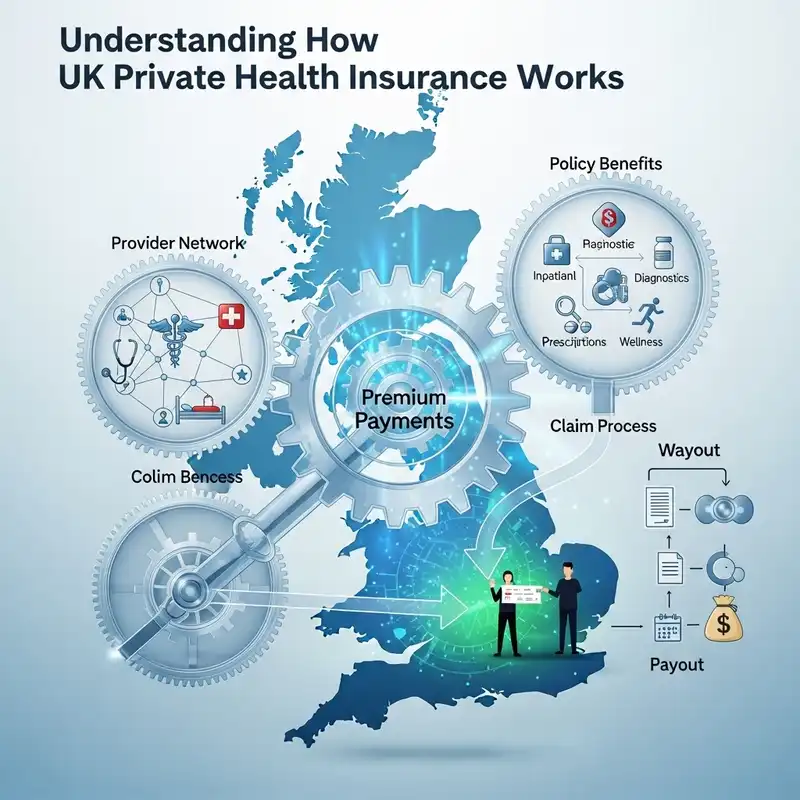
The Step-by-Step Claims Process
To demystify how private medical insurance functions in reality, here is the typical pathway a policyholder takes when an acute health issue arises:
- The Initial Concern: You experience symptoms (e.g., persistent knee pain) and visit a GP. (Note: Many PMI policies now include 24/7 Virtual GP apps, allowing you to bypass the NHS GP waiting room entirely).
- The Open Referral: The GP recommends you see a specialist and provides an "open referral" letter. This letter does not name a specific consultant but rather names the specialty required (e.g., Orthopaedics).
- Pre-Authorisation: Before booking the consultant, you contact your insurer. The insurer assesses the referral against your policy terms (checking underwriting and outpatient limits) and provides an authorisation code.
- The Consultation & Diagnostics: You provide the authorisation code to the private hospital. You see the consultant, and if an MRI is needed, it is often done on the same day where available.
- The Treatment: If surgery is required, the consultant contacts the insurer with a specific procedure code to confirm funding. You are admitted, treated, and discharged.
- Settlement: The private hospital and the consultant bill the insurer directly. You only pay your pre-agreed excess.
Corporate vs. Individual PMI
While individual adoption is rising, Corporate PMI remains a massive sector. Employers are acutely aware that prolonged NHS waits lead to extended employee absences, impacting productivity and revenue. Offering Business Health Insurance is no longer just a recruitment incentive; it is a vital risk management tool for businesses.
For companies, group schemes often offer "Medical History Disregarded" (MHD) underwriting if the group is large enough (typically 20+ employees). Under MHD, even pre-existing conditions may be covered, making it an incredibly valuable employee benefit.
Disclaimer: This is general guidance only and does not constitute formal tax or financial advice. Tax treatment depends on individual circumstances, policy terms, and HMRC interpretation, which cannot be guaranteed in advance. Whenever applicable, businesses and individuals should always consult a qualified accountant or tax adviser before arranging such policies.
Expanding Value: Wellness, Technology and WeCovr Perks
Modern health insurers have evolved beyond merely paying bills for sickness; they actively invest in preventative wellness. Comprehensive policies in 2026 frequently include digital health perks, discounted gym memberships, mental health triage services, and routine health checks.
At WeCovr, we believe in a holistic approach to health and financial wellbeing. We are proud of our high customer satisfaction ratings, driven by our commitment to adding real value for our clients.
When you arrange your PMI through us, you not only secure a suitable option for your circumstances, but WeCovr also provides complimentary access to its AI calorie tracking app, CalorieHero. Preventative health and maintaining a healthy lifestyle are excellent ways to avoid preventable acute conditions down the line. Furthermore, WeCovr provides discounts on other types of cover when customers take PMI or Life insurance through our brokerage, ensuring your entire protection portfolio is structured efficiently.
Common Pitfalls and Client Mistakes
Navigating the private medical insurance UK market without guidance can lead to frustrating scenarios at the point of claim. As an experienced broker, WeCovr frequently helps clients avoid these common pitfalls:
- Misunderstanding Pre-existing Exclusions: Assuming that an old sports injury from three years ago will immediately be covered under a new moratorium policy.
- Ignoring the Excess Structure: Opting for a £1,000 excess to get the lower-cost monthly premium, only to realise they cannot afford the £1,000 upfront payment when a specialist consultation is required.
- Cancelling Cover as You Age: Premiums naturally increase with age because the statistical likelihood of claiming increases. Some individuals cancel their policy in their 60s due to cost, precisely when they are most likely to need a hip replacement or cataract surgery. An expert broker can help adjust the policy (e.g., adding the 6-week rule or capping outpatients) to maintain core cover rather than cancelling entirely.
- Failing to Understand Switching Rules: If you already have a PMI policy and want to switch providers for a better rate, you must use a protocol called Continued Personal Medical Exclusions (CPME). This allows you to carry over your existing underwriting terms so you do not lose cover for conditions that developed while you were insured. Attempting to switch without a broker often results in losing this vital continuous cover.
Why Use an Expert Broker Like WeCovr?
Searching for "private medical insurance UK" yields millions of results, heavily weighted with aggressive marketing terminology. It can be overwhelming to decipher policy wording, understand the nuances of hospital lists, and accurately compare moratorium clauses.
This is where a broker becomes invaluable. WeCovr is an FCA-regulated broking firm — and, where appropriate, our broker partners. We act as an intermediary between you and the insurers. Our services come at no direct cost to you—we are remunerated by the insurer upon the successful placement of a policy.
Using WeCovr offers distinct advantages:
- Market Review: We assess options across major UK providers to present a suitable option for your circumstances.
- Plain English Explanations: We translate complex underwriting terminology into understandable, practical advice.
- Future-Proofing: We structure your policy so that it remains sustainable as you age.
- Claims Support: In the event of a complex claim or an underwriting dispute, you have an expert advocating on your behalf.
- Integrated Protection: We can review your health cover alongside your Life insurance or Income Protection, unlocking multi-policy discounts where applicable.
The Future of UK Private Healthcare
As we progress through 2026, there are no immediate signs that the pressures on the NHS will evaporate. An ageing population, rising operational costs, and post-pandemic backlogs mean that the two-tier reality of UK healthcare is entrenched.
Private medical insurance is the mechanism by which individuals, families, and businesses secure certainty in an uncertain landscape. It ensures that an unexpected acute medical issue results in prompt, comfortable treatment rather than a year of anxious waiting and physical deterioration. By understanding the core principles of PMI—its focus on acute care, the mechanics of underwriting, and the modular nature of policies—you can construct a robust healthcare safety net.
Frequently Asked Questions
Do I need to declare pre-existing conditions when buying UK PMI?
Does private medical insurance cover chronic diseases?
How does the moratorium underwriting work in practice?
Can I switch providers if I already have cover?
Does taking out PMI affect my right to use the NHS?
Sources
- NHS England
- Financial Conduct Authority (FCA)
- HM Revenue & Customs (HMRC)
- Office for National Statistics (ONS)
- National Institute for Health and Care Excellence (NICE)
- Association of British Insurers (ABI)
Important Information and Risks
No advice: This article is for general information only. It is not financial, legal, insurance, or tax advice, and it is not a personal recommendation. WeCovr does not assess your individual circumstances or recommend a specific product through this article.
Policy exclusions and underwriting: Insurance policies, including life insurance, private medical insurance, critical illness cover, and income protection, are subject to insurer underwriting, eligibility, acceptance criteria, terms, conditions, limits, and exclusions. Pre-existing medical conditions may be excluded, restricted, or accepted on special terms unless an insurer confirms otherwise in writing.
Tax treatment: References to tax treatment, HMRC rules, or business reliefs are based on current UK legislation and guidance, which can change. Tax treatment depends on your personal or business circumstances and may differ from examples in this article.
Before you buy: Always read the Insurance Product Information Document (IPID), policy summary, and full policy terms before buying, renewing, changing, or keeping cover. If you are unsure whether a policy is suitable for you, speak to an insurance adviser.
Start with your Protection Score, then decide whether private health cover is the right fit
Check where health access sits in your overall protection picture before deciding whether to compare private health cover.
Spot whether NHS access risk is the real issue
See if PMI is the gap to fix first
Get health insurance help only if it makes sense for you
Get your score
Start with your protection score
Check your current position first, then get health insurance help if you need it.
Check your current resilience
Score your income, health access and family protection position in a few minutes.
See where private cover helps
Understand whether faster diagnosis and treatment is a priority gap.
Continue to tailored PMI help
If health access is the issue, continue to tailored PMI help.
What you get
A quick view of your current protection position
A clearer idea of where the biggest gaps may be
A direct route to tailored help if you want it