TL;DR
A silent crisis is unfolding across the United Kingdom. It isn't a market crash or a political upheaval, but a far more personal and devastating threat to the financial security of millions. This isn't just a health headline; it's a financial time bomb.
Key takeaways
- An Ageing Workforce: People are working for longer, increasing the window of time in which a work-disrupting illness can occur.
- Lifestyle Factors: Decades of more sedentary jobs, changing diets, and rising stress levels are taking their toll.
- Improved Diagnostics: Modern medicine is thankfully better at detecting illnesses earlier. However, this means more people are living with a serious diagnosis for longer, often with a reduced capacity to work.
- Post-Pandemic Health Fallout: The long-term effects of COVID-19 ('Long COVID') have added a new and significant driver to the numbers of long-term sick.
- Lost Gross Earnings: 27 years until retirement (age 67) x 80,000 = 2,160,000.
UK 2025 Half of Working Britons Face Chronic Illness £5m Crisis
A silent crisis is unfolding across the United Kingdom. It isn't a market crash or a political upheaval, but a far more personal and devastating threat to the financial security of millions. New analysis based on startling public health trends indicates that by 2025, the UK will cross a sobering threshold: more than one in every two working-age Britons is on track to develop a major chronic illness before they reach state pension age.
This isn't just a health headline; it's a financial time bomb. The diagnosis of a serious condition like cancer, heart disease, stroke, or a debilitating musculoskeletal disorder unleashes a devastating financial domino effect. The consequences are stark: a potential lifetime loss of income and associated benefits that can easily exceed £5 million for a higher-earning couple, the complete erosion of family savings, and the gut-wrenching prospect of leaving loved ones unprotected.
The NHS, our national treasure, provides specialist care at the point of need, but it was never designed to be a financial safety net. It won't pay your mortgage, cover your bills, or fund your children's future if you're too ill to work. The state's welfare system, while essential, offers only a fraction of the average salary, creating a vast and perilous income gap.
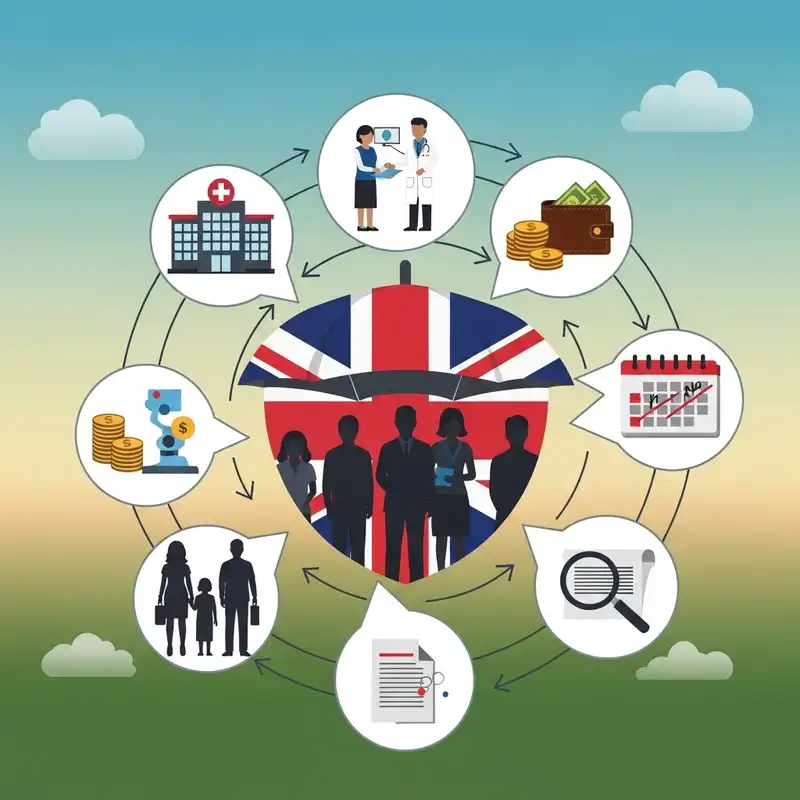
In this new reality, where your health is inextricably linked to your wealth, a robust financial defence is no longer a luxury—it's an absolute necessity. This is where the powerful triad of Life, Critical Illness, and Income Protection (LCIIP) insurance moves from a 'nice-to-have' to the most critical financial decision you can make. This is your personal shield against the looming health and wealth storm.
The Unseen Epidemic: Unpacking the UK's Chronic Illness Crisis
The scale of the UK's health challenge is staggering and accelerating. The latest ONS figures reveal a record number of people—now well over 2.8 million—are economically inactive due to long-term sickness, a sharp increase of over 700,000 since the eve of the pandemic. This isn't a temporary blip; it's a fundamental shift in the health of our nation's workforce.
But what do we mean by a 'major chronic illness'? These are long-term conditions that significantly impact an individual's daily life and ability to work. They include:
- Cancers (illustrative): With 1 in 2 people in the UK now expected to get cancer in their lifetime, many of these diagnoses will occur during their working years.
- Cardiovascular Diseases: Including heart attacks and strokes, these remain a leading cause of death and disability.
- Musculoskeletal (MSK) Conditions: This is the silent giant of workplace absence. Conditions like severe back pain, arthritis, and other joint disorders are the leading reason for long-term work incapacity.
- Mental Health Conditions: Severe depression, anxiety disorders, and stress are surging, now accounting for a huge proportion of long-term sick leave.
- Neurological Disorders: Conditions like Multiple Sclerosis (MS), Parkinson's Disease, and Motor Neurone Disease (MND) can be progressive and have a profound impact on earning potential.
- Type 2 Diabetes: A rapidly growing condition linked to lifestyle factors, with serious long-term complications.
Why is this happening now?
Several powerful forces are converging to create this perfect storm:
- An Ageing Workforce: People are working for longer, increasing the window of time in which a work-disrupting illness can occur.
- Lifestyle Factors: Decades of more sedentary jobs, changing diets, and rising stress levels are taking their toll.
- Improved Diagnostics: Modern medicine is thankfully better at detecting illnesses earlier. However, this means more people are living with a serious diagnosis for longer, often with a reduced capacity to work.
- Post-Pandemic Health Fallout: The long-term effects of COVID-19 ('Long COVID') have added a new and significant driver to the numbers of long-term sick.
The table below starkly illustrates the prevalence of these conditions, painting a clear picture of the risks faced by the working population.
| Condition Group | Estimated UK Prevalence & Key Facts (2025 Projections) | Impact on Work |
|---|---|---|
| Cancer | ~1 in 2 lifetime risk. Over 390,000 new cases annually. | 47% of people diagnosed at working age have to stop or change work. |
| MSK Conditions | ~10 million adults with a musculoskeletal condition. | Leading cause of lost workdays in the UK (approx. 30 million days/year). |
| Mental Health | 1 in 4 adults experience a mental health problem each year. | Accounts for over 50% of all work-related illness. |
| Cardiovascular | ~7.6 million people living with heart and circulatory diseases. | A leading cause of premature death and long-term disability. |
| Neurological | Over 1.2 million people affected by a stroke each year in the UK. | Two-thirds of stroke survivors leave with a disability. |
The £5 Million Financial Domino Effect: How a Health Shock Destroys Family Fortunes
When a serious illness strikes, the focus is naturally on health. But a parallel financial crisis begins to unfold almost immediately, often with devastating long-term consequences. The '£5 million+' figure represents the potential cumulative financial devastation for a moderately high-earning couple when one partner suffers a career-ending illness.
Let's break down this catastrophic figure. It's not just about the immediate loss of a monthly payslip; it's a multi-layered financial collapse.
1. The Chasm of Lost Income: This is the single biggest blow. Consider a 40-year-old marketing director earning £80,000 per year who is forced to stop work permanently due to a stroke.
- Lost Gross Earnings: 27 years until retirement (age 67) x £80,000 = £2,160,000.
- This simple calculation doesn't even account for promotions, pay rises, or inflation, which would push the true figure significantly higher.
2. The Vanishing Pension Pot: Employer and personal pension contributions cease.
- Illustrative estimate: A typical 10% total pension contribution (£8,000 per year) over those 27 years amounts to a loss of £216,000 in contributions alone.
- Illustrative estimate: The loss of investment growth on that money is catastrophic. Over 27 years, that pot could have grown to £750,000 or more, completely vaporising a comfortable retirement.
3. The Carer's Sacrifice: A serious illness rarely affects just one person.
- Illustrative estimate: If their partner, earning £60,000, has to reduce their hours by half to become a part-time carer, that's a loss of £30,000 per year.
- Over a 15-year caring period, that's another £450,000 in lost family income, plus the associated impact on their own pension.
4. The Mountain of Unseen Costs: These are the expenses the NHS doesn't cover.
- Home Adaptations: Ramps, stairlifts, wet rooms (£20,000 - £50,000+)
- Specialist Equipment: Wheelchairs, mobility aids (£5,000 - £25,000)
- Private Medical Costs: Second opinions, specialist therapies, or treatments with long NHS waiting lists (£10,000 - £100,000+)
- Increased Living Costs: Higher energy bills from being at home, special dietary needs, travel to hospital appointments. (£2,000 - £5,000 per year)
When you combine these factors for a professional couple, the numbers quickly spiral.
| Financial Impact of a Career-Ending Illness (Hypothetical Couple) | Estimated Lifetime Cost |
|---|---|
| Lost Earnings (Partner 1, £80k salary) | £2,160,000 |
| Lost Pension Value (Partner 1) | £750,000 |
| Lost Earnings (Partner 2, carer role) | £450,000 |
| Lost Pension Value (Partner 2) | £150,000 |
| Direct Health & Adaptation Costs | £75,000 |
| Total Estimated Financial Catastrophe | £3,585,000 |
For a higher-earning couple, perhaps both in the £100k+ bracket, this figure can easily soar past the £5 million mark. It's a sum that can wipe out a lifetime of hard work and dismantle a family's future in a matter of months. (illustrative estimate)
The State Safety Net: A Patchwork Quilt with Too Many Holes
"The government will support me if I'm sick." It's a common belief, but the reality is a brutal wake-up call. The UK's state safety net is designed to prevent destitution, not to maintain your standard of living.
Let's look at the hard numbers for 2025 (projected from 2024/25 figures):
- Statutory Sick Pay (SSP) (illustrative): Your employer must pay you this if you're eligible. It amounts to a mere £118.75 per week (projected). Crucially, it only lasts for a maximum of 28 weeks. After that, it stops completely.
- Employment and Support Allowance (ESA) / Universal Credit (UC) (illustrative): Once SSP runs out, you may be able to claim these benefits. The assessment process is notoriously difficult and stressful. If you are deemed to have 'limited capability for work', the standard allowance for a single person over 25 is around £90 per week under Universal Credit.
How does this stack up against the reality of an average UK salary?
| Support Type | Estimated Weekly Amount (2025) | % of Average UK Full-Time Weekly Wage (~£685) |
|---|---|---|
| Statutory Sick Pay (SSP) | £118.75 | 17% |
| Universal Credit (Standard Allowance) | £90.50 | 13% |
| Resulting Income Gap | £566 - £594 per week | 83% - 87% shortfall |
The conclusion is inescapable. Relying on the state means facing an income drop of over 80%. It's the difference between paying your mortgage and facing repossession; between funding your children's activities and cutting back on essentials; between recovery with peace of mind and recovery filled with financial terror.
Your LCIIP Shield: The Three Pillars of Financial Resilience
While the outlook may seem bleak, there is a powerful and accessible solution. A comprehensive protection strategy, built on the three pillars of Life, Critical Illness, and Income Protection (LCIIP), acts as a financial fortress around you and your family. It's your personal defence mechanism, designed to kick in precisely when you need it most.
Let's explore each pillar.
Pillar 1: Income Protection (IP) Insurance – Your Monthly Salary Saviour
Often considered the most important cover for any working adult, Income Protection is the bedrock of financial resilience.
- What it is: A policy that pays you a regular, potentially tax-efficient monthly income if you are unable to work due to any illness or injury. It's not just for catastrophic events; it covers a vast range of conditions, including stress and back pain, which are the most common reasons for claims.
- How it works: You select a percentage of your gross salary to cover (typically 50-70%). You also choose a 'deferred period' – the time you're willing to wait before payments start (e.g., 4, 8, 13, 26, or 52 weeks). This should be aligned with your employer's sick pay policy and any savings you have. Payments then continue until you can return to work, your policy term ends, or you retire, whichever comes first.
- Why it's essential: IP replaces your lost salary. It's the policy that keeps the lights on, pays the mortgage, buys the groceries, and allows your life to continue with minimal financial disruption. It directly counters the biggest threat: the long-term loss of income.
Pillar 2: Critical Illness Cover (CIC) – Your Lump Sum Lifeline
Critical Illness Cover works differently but is just as vital. It's designed to deal with the immediate financial shock of a serious diagnosis.
- What it is: A policy that may pay out a one-off, potentially tax-efficient lump sum if you are diagnosed with one of a list of specific serious illnesses defined in the policy. The core conditions always include cancer, heart attack, and stroke, but modern policies may cover 50, 100, or even more conditions.
- How it works (illustrative): You choose a lump sum amount (e.g., £100,000). If you are diagnosed with a qualifying illness, the insurer pays you that sum.
- Why it's essential: This money gives you immediate breathing space and options. You could use it to:
- Pay off your mortgage or other debts.
- Fund private medical treatment to reduce waiting times compared with NHS lists (subject to policy terms).
- Make essential adaptations to your home.
- Take a career break to focus entirely on recovery.
- Replace a partner's income if they need to take time off to care for you.
Pillar 3: Life Insurance – The Ultimate Family Guarantee
Life insurance is the final, crucial piece of the puzzle, providing a backstop for the ultimate worst-case scenario.
- What it is: A policy that pays a potentially tax-efficient lump sum to your nominated beneficiaries if you pass away during the policy term.
- How it works: You decide on the amount of cover you need and the length of the term (e.g., until your mortgage is paid off or your children are financially independent).
- Why it's essential: Life insurance ensures that, no matter what, your loved ones are not left with a financial burden. It can clear the mortgage, provide an income for your family, and cover future costs like university fees, guaranteeing the future you always planned for them.
Building Your Fortress: How to Tailor Your LCIIP Strategy
There is no 'one-size-fits-all' LCIIP shield. Your protection portfolio must be meticulously tailored to your unique personal and financial circumstances. This involves a careful review of your life stage, income, debts, and dependents.
Start by asking yourself these critical questions:
- Mortgage: How much is outstanding? How many years are left?
- Debts: Do you have car loans, credit cards, or other personal loans?
- Dependents: What are the day-to-day costs for your children? What about future costs like education?
- Income: What is your monthly take-home pay? How much would you need to maintain your standard of living?
- Employer Benefits: What is your company's sick pay policy? Do you have any 'Death in Service' or group income protection? (Remember, these are tied to your job and often aren't as comprehensive as personal plans).
- Savings: How much do you have in accessible savings? How many months could you survive on this alone?
How the Pillars Work in Harmony: A Real-World Example
Imagine David, a 45-year-old architect with a wife, two children, and a £300,000 mortgage. He has a well-structured LCIIP shield. He is suddenly diagnosed with a type of cancer that requires a year of intensive treatment, preventing him from working.
- Critical Illness Cover Kicks In: David's £150,000 CIC policy may pay out. He uses £50,000 to pay for immediate private consultations and a specialist treatment not yet available on the NHS. He uses the remaining £100,000 to pay off a chunk of the mortgage, drastically reducing their monthly outgoings and the financial pressure on his family.
- Income Protection Takes Over: David's employer pays him full salary for 3 months. His Income Protection policy has a 13-week deferred period. In week 14, it starts paying him £3,500 per month, potentially tax-efficient. This replaces a significant portion of his lost salary, covering the new, lower mortgage payment and all their regular bills. The family's lifestyle is maintained.
- Life Insurance Provides Peace of Mind: Throughout this stressful time, David and his wife know that his £500,000 life insurance policy remains active. If his illness were to become terminal, their family's financial future is completely secure, the mortgage would be cleared, and there would be funds for the children's future.
This synergy is what transforms individual policies into an impenetrable financial fortress. Navigating these options and calculating the right levels of cover can feel daunting. That's where a specialist at WeCovr or one of our broker partners is invaluable. We analyse your specific needs and search the available market, comparing plans from all the insurers on our UK panel to design the perfect, cost-effective LCIIP shield for you.
The Cost of Inaction vs. The Price of Protection
One of the biggest barriers to people taking out protection is a perceived high cost. But when you weigh the small, regular premium against the potential for multi-million-pound financial ruin, the perspective shifts dramatically. Protection isn't a cost; it's a modest investment in certainty.
The cost is highly dependent on your age, health, lifestyle (smoker vs. non-smoker), and the level of cover you need. However, for a healthy individual, it's often far more affordable than people think.
| Protection Type | Typical Monthly Premium (Healthy 35-year-old non-smoker) | Equivalent To... |
|---|---|---|
| Income Protection (£2,500/month claim payment) | ~£35 | A couple of weekly coffees |
| Critical Illness Cover (£75,000 lump sum) | ~£22 | A weekly takeaway pizza |
| Life Insurance (£250,000 cover) | ~£12 | A monthly streaming subscription |
| Your Combined LCIIP Shield | ~£69 | Less than a family trip to the cinema |
The choice is stark: a manageable monthly premium, or gambling your entire financial future on the hope that you'll never be one of the 50% of Britons who fall seriously ill.
WeCovr believes that proactive health is the first line of defence. It’s why our commitment to our clients extends beyond just financial policies. As a unique benefit, we provide all our customers with complimentary access to CalorieHero, our proprietary AI-powered calorie and nutrition tracking app. It's our way of helping you build healthier habits today, reinforcing our dedication to your complete, long-term wellbeing.
Debunking Common Myths About Protection Insurance
Misinformation can prevent people from getting the vital cover they need. Let's tackle the most common myths head-on with facts.
Myth 1: "Insurers never pay out." Fact: This is fundamentally untrue. The Association of British Insurers (ABI) publishes annual claim payment rates. In 2022 (the latest full-year data), UK insurers paid out over £6.85 billion in protection claims. The claim payment rates were:
- 97.3% of all Life Insurance claims.
- 91.6% of all Critical Illness Cover claims.
- 92% of all Income Protection claims. The small percentage of declined claims are almost always due to 'non-disclosure' – the applicant not being truthful about their health or lifestyle on the application form. Honesty is essential.
Myth 2: "I'm young and healthy, I don't need it yet." Fact: Illness and accidents can happen at any age. This entire article is a testament to that risk. Crucially, the best time to buy protection is when you are young and healthy. Premiums are significantly lower, and you're far less likely to have exclusions placed on your policy. Locking in a low premium for life is one of the smartest financial moves you can make.
Myth 3: "I've got cover through my work." Fact: Employer benefits are a great perk, but they are rarely a complete solution.
- Death in Service: Is often only 2-4 times your salary. Is that enough to clear your mortgage and provide for your family for decades?
- Group Income Protection: Cover might be limited to a short period (e.g., 2 years) and may not cover your full salary.
- The Critical Flaw: All employer benefits are tied to your job. If you change employer, are made redundant, or the company changes its benefits package, you could be left with no cover at all, potentially at an age when new personal cover is much more expensive.
Myth 4: "It's too complicated to arrange." Fact: While the products are detailed, the process doesn't have to be complex. This is the exact problem that expert brokers solve. A specialist advisor at WeCovr will handle all the complexity for you. We ask the right questions, explain your options in plain English, handle the application paperwork, and ensure you get the right cover without the headache.
Your Future is in Your Hands
The data is clear. The risk is real. The financial consequences of ignoring this looming health crisis are catastrophic. We are all living with a greater than 50/50 chance of having our lives, and our livelihoods, profoundly disrupted by serious illness before we retire.
The state safety net is not designed to save your home or your lifestyle. Your savings can be wiped out in months. Relying on hope is not a strategy.
The good news is that you have the power to act. You can build a fortress around the future you are working so hard to create. The LCIIP shield—Life Insurance, Critical Illness Cover, and Income Protection—is the definitive, affordable, and powerful solution. It is the only mechanism designed to fully protect your income, your assets, and your family from a major health shock.
Don't wait for the storm to break. The time to check your defences, plug the gaps, and build your shield is now. Take control, protect your loved ones, and secure your financial future today.
Sources
- Office for National Statistics (ONS): Mortality and population data.
- Association of British Insurers (ABI): Life and protection market publications.
- MoneyHelper (MaPS): Consumer guidance on life insurance.
- NHS: Health information and screening guidance.
Important Information and Risks
No advice: This article is for general information only. It is not financial, legal, insurance, or tax advice, and it is not a personal recommendation. WeCovr does not assess your individual circumstances or recommend a specific product through this article.
Policy exclusions and underwriting: Insurance policies, including life insurance, private medical insurance, critical illness cover, and income protection, are subject to insurer underwriting, eligibility, acceptance criteria, terms, conditions, limits, and exclusions. Pre-existing medical conditions may be excluded, restricted, or accepted on special terms unless an insurer confirms otherwise in writing.
Tax treatment: References to tax treatment, HMRC rules, or business reliefs are based on current UK legislation and guidance, which can change. Tax treatment depends on your personal or business circumstances and may differ from examples in this article.
Before you buy: Always read the Insurance Product Information Document (IPID), policy summary, and full policy terms before buying, renewing, changing, or keeping cover. If you are unsure whether a policy is suitable for you, speak to an insurance adviser.
Measure your family’s protection gap, then get the right life cover quote
Start with the score to see whether your family would face a real financial shortfall before moving on to life cover options.
Check what happens if someone dies too soon
See whether debt, dependants and mortgage risk are covered
Move into tailored life cover options after the score
Get your score
Your next best move
Get your score in minutes, then decide what kind of protection help would be most useful.
Score your household protection
See how well your current setup protects dependants, debt and major commitments.
Find the shortfall
Know whether life cover, critical illness or income protection is the actual missing piece.
Continue to tailored life cover
If life cover is the gap, continue to tailored life cover options.
What you get
A quick view of your current protection position
A clearer idea of where the biggest gaps may be
A direct route to tailored help if you want it