TL;DR
The numbers are in, and they paint a stark picture of the UK's evolving healthcare landscape. A landmark 2025 analysis, drawing on data from the Office for National Statistics (ONS) and the Health Foundation, reveals a seismic shift in how Britons are accessing medical care. An estimated 35% of UK adultsover one in threehave paid out-of-pocket for a private diagnostic test or a specialist consultation in the last 12 months, sidestepping unprecedented NHS waiting lists.
Key takeaways
- The Initial Consultation Fee: The first meeting with a private specialist.
- The Diagnostic Tests: The cost of the MRI, CT, or blood tests they recommend.
- The Procedure Fee: The surgeon's and anaesthetist's fees for the operation.
- The Hospital Fee: A significant cost covering the operating theatre, nursing staff, medication, and overnight stay.
- Follow-up Consultations: Post-operative check-ups with the specialist.
UK Healthcare the Unseen Bill
The numbers are in, and they paint a stark picture of the UK's evolving healthcare landscape. A landmark 2025 analysis, drawing on data from the Office for National Statistics (ONS) and the Health Foundation, reveals a seismic shift in how Britons are accessing medical care. An estimated 35% of UK adults—over one in three—have paid out-of-pocket for a private diagnostic test or a specialist consultation in the last 12 months, sidestepping unprecedented NHS waiting lists.
This reactive spending has created what we're calling "The Unseen Bill"—a colossal £5.5 billion annual burden on household finances. This isn't money for luxury treatments; it's for fundamental services like MRI scans, cardiology appointments, and orthopaedic assessments. Families are dipping into savings, delaying major life events, and even taking on debt to get the answers and care they urgently need.
The cherished National Health Service, while still the bedrock of our emergency and critical care, is straining under the weight of post-pandemic demand and systemic pressures. For millions, the wait for routine diagnostics and elective treatment has become untenable, filled with anxiety and the risk of conditions worsening.
In this new reality, a question once considered by a few is now a pressing concern for the many: Is Private Medical Insurance (PMI) no longer a perk, but an essential component of modern family financial planning? This definitive guide will unpack the crisis, analyse the true cost of 'going private' on a pay-as-you-go basis, and explore how a comprehensive PMI policy can act as your shield—providing a clear, swift, and financially protected pathway to the best possible care.
The Ticking Time Bomb: Unpacking the 2025 NHS Waiting List Crisis
To understand why millions are turning to self-funding, we must first confront the reality of NHS waiting times. While the dedication of NHS staff is unwavering, the system's capacity is struggling to meet demand. The official figures, and the human stories behind them, are deeply concerning.
As of early 2025, the total referral-to-treatment (RTT) waiting list in England remains stubbornly high, with millions of treatment pathways yet to be completed. More worryingly, the number of patients waiting over 52 weeks—a full year—for treatment continues to be a national challenge.
Let's break down the key pressure points:
- Diagnostics: These are the essential first steps to understanding a health problem. Waiting for an MRI, CT scan, or ultrasound can be a period of immense stress. In some regions, the wait for routine scans can stretch for several months, delaying crucial diagnoses for conditions ranging from musculoskeletal injuries to neurological disorders.
- Specialist Consultations: Getting to see a consultant is the gateway to a treatment plan. Yet, waiting times for initial appointments in high-demand specialities like orthopaedics, cardiology, and dermatology often exceed the 18-week target, leaving patients in limbo.
- Elective Surgery: This includes common, quality-of-life-restoring procedures like hip replacements, knee surgery, and cataract removal. The backlog here is immense. The average wait can be many months, during which a patient's mobility, independence, and mental health can significantly decline.
| NHS Service Area | Typical 2024/2025 Waiting Time (Median) | Impact on Patients |
|---|---|---|
| Diagnostic Scans (e.g., MRI) | 8-14 weeks | Prolonged uncertainty; risk of condition worsening. |
| Specialist Consultation (e.g., Orthopaedics) | 18-26 weeks | Delayed treatment plan; ongoing pain and discomfort. |
| Elective Surgery (e.g., Hip Replacement) | 35-50 weeks | Severe impact on quality of life, mobility, and ability to work. |
| Mental Health Services (IAPT) | Varies widely, often 6-18 months for therapy | Deteriorating mental wellbeing; impact on personal and professional life. |
Source: Analysis based on NHS England RTT data and Health Foundation projections for 2025.
This isn't just about numbers on a spreadsheet. It's about a grandparent unable to play with their grandchildren due to debilitating hip pain. It's about a self-employed worker losing income while waiting for a diagnosis for chronic pain. It's about the pervasive anxiety that comes from not knowing what's wrong and when it will be fixed. This is the environment driving the £5.5 billion surge in self-funded care.
The £5.5 Billion Sticking Plaster: How Self-Funding is Draining UK Family Finances
The decision to self-fund is rarely made lightly. It is often a choice born of necessity—a desire to end pain, reduce anxiety, or return to work. However, this ad-hoc approach comes with a significant and often unpredictable price tag. The £5.5 billion figure represents a massive, nationwide financial sticking plaster applied to a systemic issue. (illustrative estimate)
When you "pay as you go" for private healthcare, you are not just paying for a single item. The final bill is an accumulation of separate costs:
- The Initial Consultation Fee: The first meeting with a private specialist.
- The Diagnostic Tests: The cost of the MRI, CT, or blood tests they recommend.
- The Procedure Fee: The surgeon's and anaesthetist's fees for the operation.
- The Hospital Fee: A significant cost covering the operating theatre, nursing staff, medication, and overnight stay.
- Follow-up Consultations: Post-operative check-ups with the specialist.
Each stage comes with its own invoice, and costs can quickly spiral beyond initial estimates, especially if complications arise.
Typical Self-Pay Private Healthcare Costs in the UK (2025)
To illustrate the potential financial exposure, we've compiled a table of typical costs for common private procedures. These are averages and can vary significantly based on the hospital, the consultant's seniority, and your location.
| Procedure or Service | Average Self-Funded Cost | What This Could Represent in Family Savings |
|---|---|---|
| Private GP Appointment | £80 - £150 | A weekly family food shop. |
| Specialist Consultation (e.g., Dermatologist) | £250 - £400 | A new washing machine or a weekend break. |
| MRI Scan (One Part) | £400 - £800 | A significant portion of a monthly mortgage payment. |
| Cataract Surgery (Per Eye) | £2,500 - £4,000 | The deposit for a family car. |
| Knee Arthroscopy (Keyhole Surgery) | £4,500 - £6,000 | A substantial contribution to a home extension. |
| Hip Replacement Surgery | £12,000 - £16,000+ | A significant chunk of a university tuition fund or wedding savings. |
Source: Market analysis of UK private hospital price lists, 2025.
A Real-World Example: David's Knee Pain
David, a 52-year-old self-employed plumber, started experiencing severe knee pain. His GP suspected a torn meniscus and referred him for an NHS MRI scan, with a predicted 12-week wait. Unable to work effectively and in constant discomfort, David decided to go private.
- Initial Orthopaedic Consultation: £300
- Private MRI Scan (arranged within 4 days): £650 (illustrative estimate)
- Follow-up Consultation to discuss results: £200 (illustrative estimate)
- Recommendation: Knee Arthroscopy. The all-inclusive 'package price' quoted was £5,200. (illustrative estimate)
Total Out-of-Pocket Cost: £6,350. (illustrative estimate)
David used a significant portion of his emergency savings, money he had earmarked for a new van. While he was back at work within a few weeks of the surgery, the financial hit was substantial and unexpected. For the cost of his treatment, he could have paid for several years of comprehensive private medical insurance that would have covered the entire pathway.
Private Medical Insurance (PMI): Your Shield Against Uncertainty and Expense
This is where Private Medical Insurance (PMI) transitions from a 'nice-to-have' to a cornerstone of financial security. PMI is a simple concept: you pay a regular monthly or annual premium to an insurer. In return, if you develop a new, eligible medical condition after your policy starts, the insurer covers the costs of private diagnosis and treatment.
It replaces the unpredictable, spiralling costs of self-funding with a fixed, budgeted premium. It's not about skipping the queue; it's about joining a different, faster-moving one that you've paid to access.
The key benefits are clear:
- Speed of Access: Go from GP referral to specialist consultation and diagnostic tests in days, not months.
- Choice and Control: Choose your specialist and hospital from an extensive network approved by your insurer.
- Financial Peace of Mind: Your treatment costs are covered, protecting your savings and investments from sudden, large medical bills.
- Comfort and Privacy: Access to private hospital facilities, often including a private en-suite room for in-patient stays.
- Access to Innovation: Many policies provide cover for the latest treatments and drugs that may not yet be available on the NHS.
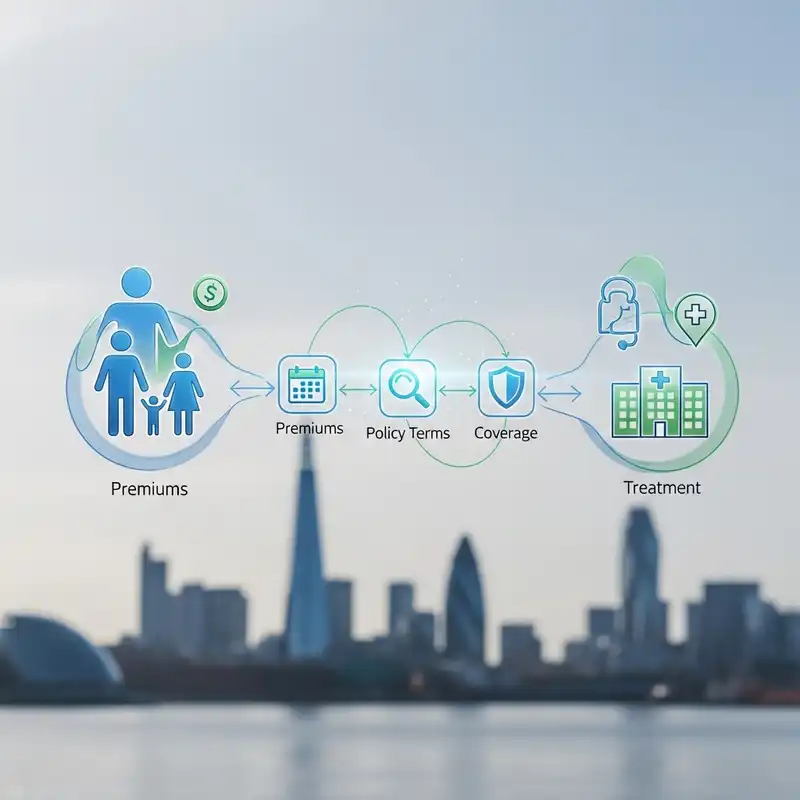
The PMI Process: From GP Visit to Private Treatment in Days, Not Months
Navigating the PMI system is designed to be straightforward and efficient.
- You feel unwell: You visit your NHS GP as normal. This is a crucial first step.
- GP Referral: Your GP diagnoses your symptoms and recommends you see a specialist. They will provide you with an 'open referral' letter. While some insurers now offer a digital GP service, a referral from your own GP is the most common starting point.
- Contact Your Insurer: You call your PMI provider's dedicated claims line. You'll provide your policy number and details from the referral letter.
- Claim Authorisation: The insurer checks that your condition is covered under your policy and authorises the claim, providing you with a pre-authorisation number. They will often give you a list of approved specialists in your area.
- Book Your Appointment: You contact the specialist's secretary or the private hospital, quote your authorisation number, and book an appointment, often within a week.
- Treatment: The specialist oversees your diagnostics and treatment plan. All eligible costs are billed directly to your insurer. You only pay the pre-agreed excess on your policy (if any).
The Golden Rule of PMI: Understanding What is NOT Covered
This is the most important section of this guide. To avoid disappointment and make an informed decision, you must understand the fundamental principle of UK private medical insurance.
PMI is designed to cover acute conditions that arise after you take out your policy.
It is NOT designed to cover:
- Pre-existing Conditions: Any disease, illness, or injury for which you have experienced symptoms, received medication, advice, or treatment before your policy start date.
- Chronic Conditions: Illnesses that are long-term and cannot be fully cured with a single course of treatment. They require ongoing management.
What is a Pre-Existing Condition?
This is typically defined by insurers as any condition for which you've had symptoms or sought advice in the 5 years prior to joining. How insurers deal with this depends on the type of underwriting you choose when you buy your policy.
| Underwriting Type | How It Works | Best For |
|---|---|---|
| Moratorium (Most Common) | You don't declare your medical history upfront. The insurer automatically excludes any condition you've had in the last 5 years. However, if you remain symptom-free and treatment-free for that condition for a continuous 2-year period after your policy starts, the exclusion may be lifted. | Individuals with a clean bill of health who want a quick and simple application process. |
| Full Medical Underwriting (FMU) | You complete a detailed health questionnaire about your medical history. The insurer assesses it and gives you a clear list of what is and isn't covered from day one. These exclusions are often permanent. | Individuals with a complex medical history who want absolute clarity on their cover from the outset. |
What is a Chronic Condition?
The NHS is and will remain the primary provider of care for long-term chronic conditions. PMI is structured to treat and resolve acute issues.
Examples of common chronic conditions not covered by PMI include:
- Diabetes
- High blood pressure (Hypertension)
- Asthma
- Crohn's disease and Ulcerative Colitis
- Arthritis (the long-term management of it)
- Multiple Sclerosis
Think of it this way: if you break your leg (an acute event), PMI can cover the surgery to fix it. However, if you have arthritis in your knee (a chronic condition), PMI will not cover the ongoing management, though it may cover a one-off joint replacement if it's deemed to cure the immediate issue. This distinction is vital.
Decoding Your Policy: A Practical Guide to Choosing the Right PMI Cover
A common misconception is that PMI is a one-size-fits-all product with a prohibitively high price. In reality, modern policies are highly flexible, allowing you to tailor your cover to balance protection with affordability. By adjusting a few key levers, you can design a policy that fits your budget.
Here are the main components you can customise:
| Policy Component | Description | Impact on Premium |
|---|---|---|
| Level of Cover | Comprehensive: Covers in-patient, day-patient, and out-patient care fully. Basic/Intermediate: May only cover in-patient and day-patient care, with limits on out-patient diagnostics and consultations. | Comprehensive is most expensive; basic is most affordable. |
| Excess | The amount you agree to pay towards the first claim you make in a policy year. This can range from £0 to £1,000+. | A higher excess significantly lowers your monthly premium. |
| Hospital List | Insurers have tiered hospital lists. A 'Local' list is cheapest, a 'National' list is standard, and a 'Premium' list including high-end Central London hospitals is the most expensive. | Choosing a more restricted hospital list reduces the cost. |
| Out-patient Limit | You can choose to have unlimited out-patient cover (for scans and consultations) or cap it at a set amount (e.g., £500, £1,000, £1,500). | Capping out-patient cover is a very effective way to lower premiums. |
| Six-Week Option | A clever cost-saving feature. If the NHS can provide the required in-patient treatment within six weeks of it being recommended, you use the NHS. If the wait is longer, your private cover kicks in. | This significantly reduces the premium as it removes the insurer's risk for a large number of elective procedures. |
| Added Benefits | Options like dental, optical, and enhanced mental health cover can be added or removed. | Removing non-essential extras keeps the focus on core medical cover and reduces cost. |
By working with an expert, you can mix and match these options to find the sweet spot between robust protection and a manageable monthly premium.
The Bottom Line: How Much Does Private Health Insurance Actually Cost?
This is the million-dollar—or rather, the fifty-pound—question. The cost of PMI is highly personal and depends on your age, location, the level of cover you choose, and your medical history. However, for many, it is far more affordable than assumed, especially when weighed against the risk of a four or five-figure self-funding bill.
Below are some illustrative monthly premiums for a well-balanced, mid-range policy (e.g., £250 excess, national hospital list, £1,000 out-patient cover).
| Profile | Location: Manchester | Location: London |
|---|---|---|
| 30-year-old Individual | £45 - £60 | £55 - £75 |
| 45-year-old Couple | £110 - £150 | £140 - £190 |
| Family of Four (Parents 40, Kids 10 & 12) | £160 - £220 | £200 - £270 |
Disclaimer: These are guide prices only, correct as of 2025. They are for non-smokers and are subject to underwriting. The only way to get an accurate figure is to get a personalised quote.
When you see that a family could secure comprehensive protection for less than the cost of a high-end mobile phone contract, the value proposition becomes clear. It's about swapping the risk of a £15,000 bill for a hip replacement for a predictable monthly cost. (illustrative estimate)
This is where an independent broker like us at WeCovr becomes invaluable. We compare plans from all leading UK insurers like Aviva, AXA Health, Bupa, and Vitality to find a policy that fits your specific needs and budget, ensuring there are no hidden surprises. Our expertise helps you understand the nuances between policies, saving you both time and money.
The Broker Advantage: Why Navigating the PMI Market Alone is a False Economy
In a complex market, going it alone can be a significant risk. Going direct to a single insurer means you only see their products and their prices. You have no way of knowing if a competitor offers better terms, a more suitable hospital list, or a lower premium for the same level of cover.
Using a specialist, independent broker offers clear advantages:
- Whole-of-Market View: We have access to policies and rates from across the entire UK market, providing a truly impartial comparison.
- Expert Advice: We demystify the jargon. We explain the difference between moratorium and FMU, the impact of a six-week option, and help you find the right excess level for your budget.
- Personalised Recommendation: We take the time to understand your unique circumstances—your age, family structure, budget, and health priorities—before recommending a solution.
- Support at Claim Time: Should you need to use your policy, we can be on hand to offer guidance and assistance, acting as your advocate.
At WeCovr, our service doesn't just stop at finding you a strong fit for your needs. We believe in holistic wellbeing, which is why our clients also receive complimentary access to our proprietary AI-powered calorie tracking app, CalorieHero, to support their health journey. It's a small part of our commitment to going above and beyond for our customers' long-term health.
The Future of UK Healthcare: Embracing a Hybrid Approach
The trends are undeniable. The UK is organically moving towards a hybrid healthcare model. The NHS remains the indispensable foundation for emergency, maternity, and chronic care for all. But for elective treatments and diagnostics, a growing proportion of the population is choosing to create their own solution.
The choice is no longer simply between 'using the NHS' and 'going private'. It is between reactive, expensive, and stressful self-funding, or proactive, budgeted, and reassuring private medical insurance.
Faced with the Unseen Bill of £5.5 billion, which erodes savings and puts family finances at risk, PMI is emerging as the most logical and responsible choice for millions. It is an investment in certainty. It is a shield for your health and your wealth. In the landscape of 2025 and beyond, it may just be the most important financial decision your family makes.
Sources
- NHS England: Waiting times and referral-to-treatment statistics.
- Office for National Statistics (ONS): Health, mortality, and workforce data.
- NICE: Clinical guidance and technology appraisals.
- Care Quality Commission (CQC): Provider quality and inspection reports.
- UK Health Security Agency (UKHSA): Public health surveillance reports.
- Association of British Insurers (ABI): Health and protection market publications.
Disclaimer: This is general guidance only and does not constitute formal tax or financial advice. Tax treatment depends on individual circumstances, policy terms, and HMRC interpretation, which cannot be guaranteed in advance. Whenever applicable, businesses and individuals should always consult a qualified accountant or tax adviser before arranging such policies.
Start with your Protection Score, then decide whether private health cover is the right fit
Check where health access sits in your overall protection picture before deciding whether to compare private health cover.
Spot whether NHS access risk is the real issue
See if PMI is the gap to fix first
Get health insurance help only if it makes sense for you
Get your score
Start with your protection score
Check your current position first, then get health insurance help if you need it.
Check your current resilience
Score your income, health access and family protection position in a few minutes.
See where private cover helps
Understand whether faster diagnosis and treatment is a priority gap.
Continue to tailored PMI help
If health access is the issue, continue to tailored PMI help.
What you get
A quick view of your current protection position
A clearer idea of where the biggest gaps may be
A direct route to tailored help if you want it