TL;DR
Imagine your monthly income vanishes overnight. Not just for a week, but for months, or even years. Your mortgage payment is due, the fridge needs filling, and the energy bills keep climbing.
Key takeaways
- Month 1 (illustrative): David's income plummets from nearly 4,000 a month to just 480. The family's emergency savings of 3,000 are used to cover the mortgage and essential bills. The credit card is used for the weekly food shop. Stress levels begin to rise.
- Month 2: The savings are gone. The mortgage payment is missed for the first time ever, incurring bank charges and a warning letter. The credit card balance swells as more daily expenses are loaded onto it. David's recovery is hampered by constant worry about money.
- Month 3: The family is now in mortgage arrears. The credit card is maxed out. David is forced to borrow money from his elderly parents to avoid defaulting on his car finance. His credit score is in freefall, which will make borrowing more expensive for years to come.
- Aftermath: Even when David returns to work, the damage is done. It will take years to repay the debt accrued and rebuild their savings and credit rating. The emotional toll on him and his family has been immense.
- Immediate Income Shock: Your salary is replaced by a pittance.
UK Sick Pay Gap 2026 £550 Weekly Income Shortfall
UK Sick Pay Gap 2026 £550 Weekly Income Shortfall
Imagine your monthly income vanishes overnight. Not just for a week, but for months, or even years. Your mortgage payment is due, the fridge needs filling, and the energy bills keep climbing. The only financial support you receive is a meagre £120 a week. This isn't a dystopian fantasy; it's the harsh reality facing millions of UK employees in 2025. (illustrative estimate)
New analysis reveals a staggering financial cliff edge. With projected average weekly earnings in the UK hovering around £700 in 2025, the government's Statutory Sick Pay (SSP) of approximately £120 a week creates a breathtaking income gap of over £580. For more than half of all working families, this isn't just an inconvenience; it's a direct path to financial ruin. (illustrative estimate)
The state's safety net is now so threadbare it can barely cushion the fall. Relying on it is like using a plaster to mend a broken leg. In an era of high living costs and dwindling savings, an unexpected illness or injury is one of the single greatest threats to your family's financial stability.
But what if you could build a personal fortress around your finances? A multi-layered defence system designed to protect your income, your assets, and your family's future, no matter what health challenges arise. This is your LCIIP Shield: a powerful combination of Life Insurance, Critical Illness Cover, and Income Protection.
This definitive guide will deconstruct the 2025 income crisis, reveal the true cost of being ill, and show you exactly how to forge a robust LCIIP shield to ensure your family can thrive, not just survive.
The Unseen Financial Cliff Edge: A £580+ Weekly Problem for Millions
For decades, British workers have taken solace in the idea of a "safety net." If you fall ill, the system will catch you. But in 2025, this net is riddled with holes. The primary support mechanism, Statutory Sick Pay (SSP), has failed to keep pace with wages and the cost of living, creating a chasm between what families earn and what they receive when they need it most.
What Exactly is Statutory Sick Pay (SSP)?
SSP is the minimum amount employers in the UK are legally required to pay to eligible employees who are off work due to illness.
To qualify for SSP, an employee must:
- Be classed as an employee and have done some work for their employer.
- Have been ill for at least 4 days in a row (including non-working days).
- Illustrative estimate: Earn an average of at least the Lower Earnings Limit, which for 2025/26 is projected to be around £125 per week.
- Follow their employer's rules for getting sick pay.
The crucial point is the amount. For the 2024/25 tax year, the SSP rate is £116.75 per week. With inflation, this is expected to rise to around £120 per week for 2025/26. It is paid for a maximum of 28 weeks. (illustrative estimate)
The Shocking Maths: The 2026 Income Gap Exposed
Let's put that £120 figure into context. The Office for National Statistics (ONS) reported average weekly earnings were £682 in mid-2024. With modest wage inflation, a figure of £700 is a conservative projection for 2025.
The maths is simple, and it's terrifying.
| Financial Metric | Projected 2025 Figure |
|---|---|
| Average UK Weekly Earnings | £700 |
| Weekly Statutory Sick Pay (SSP) | £120 |
| Weekly Income Shortfall | £580 |
| Percentage of Income Lost | 83% |
Imagine losing 83% of your income instantly. Could you pay your mortgage? Your rent? Your council tax? Your car finance? For the overwhelming majority of people, the answer is a resounding no. A 2024 report from the Money and Pensions Service highlighted that one in four UK adults have less than £100 in savings, leaving them catastrophically exposed.
Who is Most at Risk?
While this affects everyone, some groups are particularly vulnerable:
- The Self-Employed and Gig Economy Workers: These individuals receive zero SSP. For the 4.25 million self-employed people in the UK, a day not worked is a day not paid, regardless of the reason.
- Employees in Retail, Hospitality, and Social Care: These sectors often have a higher proportion of workers on lower incomes and are less likely to offer generous occupational sick pay schemes that top up SSP.
- Younger Workers and Renters: This demographic typically has lower savings and higher proportional outgoings on rent, leaving very little buffer to absorb an income shock.
- Single-Income Households: When the sole breadwinner is incapacitated, the financial impact is immediate and total.
The stark conclusion is that SSP is no longer a safety net; it's a statistical footnote. Relying on it is not a financial plan; it's a gamble with your family's future.
The Domino Effect: How a Short-Term Sickness Can Trigger Long-Term Financial Ruin
An income drop of over £500 a week doesn't just mean tightening your belt. It sets off a chain reaction of financial and personal crises that can be incredibly difficult to stop. (illustrative estimate)
Let's consider a realistic scenario.
Meet David, a 42-year-old IT consultant and father of two. He earns £65,000 a year (approx. £950 per week after tax). He suffers a slipped disc in his back, a common ailment, and needs surgery followed by three months of recovery. His employer only provides SSP after the first week. (illustrative estimate)
- Month 1 (illustrative): David's income plummets from nearly £4,000 a month to just £480. The family's emergency savings of £3,000 are used to cover the mortgage and essential bills. The credit card is used for the weekly food shop. Stress levels begin to rise.
- Month 2: The savings are gone. The mortgage payment is missed for the first time ever, incurring bank charges and a warning letter. The credit card balance swells as more daily expenses are loaded onto it. David's recovery is hampered by constant worry about money.
- Month 3: The family is now in mortgage arrears. The credit card is maxed out. David is forced to borrow money from his elderly parents to avoid defaulting on his car finance. His credit score is in freefall, which will make borrowing more expensive for years to come.
- Aftermath: Even when David returns to work, the damage is done. It will take years to repay the debt accrued and rebuild their savings and credit rating. The emotional toll on him and his family has been immense.
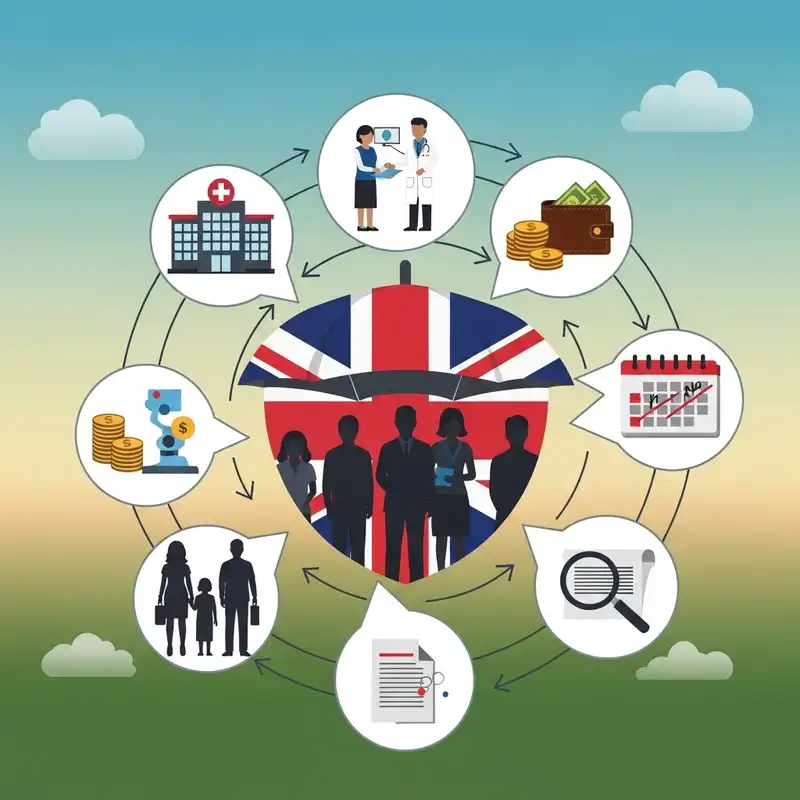
This isn't an exaggeration. It's a textbook example of the domino effect triggered by relying on SSP. The sequence typically looks like this:
- Immediate Income Shock: Your salary is replaced by a pittance.
- Savings Depletion: Your financial buffer is the first to go, usually within weeks.
- Debt Accumulation: Credit cards, overdrafts, and personal loans are used to plug the gap.
- Defaulting on Commitments: Mortgage, rent, and utility payments are missed, damaging your credit history.
- Asset Risk: In prolonged cases, the family home may be at risk of repossession.
- Mental and Physical Health Decline: The immense stress of financial hardship can severely impact mental health and even slow down physical recovery from the initial illness.
According to the debt charity StepChange, a sudden loss of income is one of the leading drivers of problem debt in the UK. Your health and your wealth are inextricably linked. Protecting one means protecting the other.
Forging Your LCIIP Shield: Your Three Lines of Defence
Relying on the state is a losing strategy. The only way to guarantee your financial security is to build your own. An LCIIP Shield combines three distinct but complementary types of insurance, creating a comprehensive fortress around your finances.
- Income Protection (IP): Replaces your monthly income.
- Critical Illness Cover (CIC): Provides a tax-free lump sum for major health crises.
- Life Insurance: Protects your family financially if you pass away.
Let's break down each layer of your shield.
Defence Line 1: Income Protection (IP) – The Monthly Paycheque Replacement
Income Protection is the most direct solution to the SSP income gap. It is arguably the most important insurance you can own after home insurance.
What is it? Income Protection is an insurance policy that pays you a regular, tax-free monthly income if you are unable to work due to any illness or injury. It's designed to replace a significant portion of your lost earnings, allowing you to continue paying your bills and maintaining your lifestyle while you recover.
Key Features Explained:
- Benefit Amount: You can typically insure up to 50-70% of your gross annual salary. This is paid tax-free, so it often equates to a similar amount to your take-home pay.
- Deferred Period: This is the waiting period from when you stop work to when the policy starts paying out. It can range from 4 weeks to 52 weeks. You can align this with any sick pay you receive from your employer. For example, if you get 3 months of full pay, you could choose a 13-week deferred period to reduce your premiums.
- Payment Term: This is how long the policy will pay out for. The most comprehensive plans pay out right up until your chosen retirement age (e.g., 67). Cheaper, short-term options might pay out for a fixed period of 1, 2, or 5 years per claim.
- Definition of Incapacity: This is crucial. The best policies use an 'Own Occupation' definition. This means the policy will pay out if you are unable to do your specific job. Less comprehensive 'Suited Occupation' or 'Any Occupation' definitions may only pay if you are unable to do any job, making it much harder to claim. Always insist on 'Own Occupation' cover.
Let's see how IP stacks up against SSP.
| Feature | Income Protection (A Good Policy) | Statutory Sick Pay (SSP) |
|---|---|---|
| Monthly Payout | £2,500 (based on £50k salary) | ~£520 |
| Payout Duration | Until retirement age (e.g., 67) | Maximum 28 weeks |
| Conditions Covered | Any illness or injury stopping work | Any illness or injury stopping work |
| Tax Status | Tax-Free | Taxable |
| Certainty | Guaranteed contractual payout | Subject to government changes |
The difference is night and day. Income Protection provides a meaningful, long-term income stream that you control, plugging the gap that SSP leaves wide open.
Defence Line 2: Critical Illness Cover (CIC) – The Lump Sum Lifeline
While Income Protection replaces your monthly salary, Critical Illness Cover is designed to deal with the significant, one-off costs of a major health shock.
What is it? Critical Illness Cover pays out a one-time, tax-free lump sum if you are diagnosed with one of a list of specified serious medical conditions defined in the policy.
How does it differ from IP? Think of it this way: IP is for your monthly bills; CIC is for your life-changing problems. IP covers any illness that stops you from working, whereas CIC only covers specific, severe conditions.
What does it cover? Policies typically cover dozens of conditions, but the "big three" that account for the vast majority of claims are:
- Cancer
- Heart Attack
- Stroke
According to Cancer Research UK, there are around 393,000 new cancer cases in the UK every year – that's over 1,000 a day. The British Heart Foundation estimates that more than 100,000 hospital admissions each year are due to heart attacks. The odds are not insignificant.
How can the lump sum be used? The power of a CIC payout is its flexibility. You can use the money for whatever you need most at a time of crisis:
- Pay off your mortgage or other large debts, drastically reducing your monthly outgoings.
- Fund private medical treatment to bypass NHS waiting lists.
- Adapt your home (e.g., wheelchair ramps, walk-in showers).
- Replace a partner's income so they can take time off to care for you.
- Fund a recuperative holiday once treatment is over.
- Simply provide a huge financial cushion to eliminate money worries.
A CIC payout can be the financial equivalent of a full system reboot, giving you the resources and breathing space to focus entirely on your recovery.
Defence Line 3: Life Insurance – The Ultimate Family Safeguard
The first two layers of the shield protect you. This final layer protects your loved ones after you're gone.
What is it? Life Insurance (also known as life assurance) pays out a tax-free lump sum to your chosen beneficiaries if you die during the term of the policy. It is the fundamental building block of financial protection for anyone with dependents.
Why is it essential? Your ability to earn an income is your family's most valuable asset. If that is permanently lost, life insurance steps in to replace it, ensuring your family can maintain their standard of living, stay in their home, and pursue their future dreams.
Choosing the Right Type:
- Level Term Assurance: The payout amount remains fixed throughout the policy term. This is ideal for providing a lump sum for your family to live on or to cover an interest-only mortgage.
- Decreasing Term Assurance: The payout amount reduces over time, broadly in line with a repayment mortgage. As your mortgage debt decreases, so does your cover, making this the most cost-effective way to protect your home.
- Whole of Life Assurance: This policy has no end date and guarantees to pay out whenever you die. It is more expensive and typically used for specific purposes like covering a future Inheritance Tax bill or leaving a guaranteed legacy.
The Golden Rule: Write Your Policy in Trust This is a simple piece of administration that has a monumental impact. Writing your life insurance policy "in trust" means the payout is made directly to your chosen beneficiaries (the trustees) rather than to your legal estate. The benefits are huge:
- Speed: The money bypasses the lengthy and complex probate process, getting to your family in weeks rather than many months or even years.
- Tax Efficiency: The payout is not considered part of your estate and is therefore not subject to Inheritance Tax (IHT). This can save your family a 40% tax bill on the entire sum.
Any good adviser, like our team at WeCovr, will provide and help you complete the trust forms for free as part of the service. It's a non-negotiable part of setting up life insurance correctly.
The LCIIP Shield in Action: Real-Life Scenarios
Let's see how these policies work together in practice.
Scenario 1: Sarah, the 38-year-old Graphic Designer (Self-Employed)
- Situation: Sarah is diagnosed with multiple sclerosis (MS). She can no longer work the long hours her job requires. As she's self-employed, she has no access to SSP or company sick pay.
- Her LCIIP Shield:
- Critical Illness Cover (illustrative): Her £75,000 policy pays out upon diagnosis. She uses this to clear her outstanding car loan and credit card debt, and she puts the rest aside as a financial buffer.
- Income Protection (illustrative): After a 13-week deferred period, her IP policy starts paying her £2,200 per month, tax-free. This covers her mortgage and living costs, allowing her to focus on managing her condition without financial stress.
- Outcome: Sarah's finances are secure. The CIC payout removed her debts, and the IP provides a long-term replacement income, giving her security until she reaches retirement age.
Scenario 2: Tom, the 45-year-old Sales Manager (Employed)
- Situation: Tom has a sudden, major heart attack. He survives but needs a six-month recovery period and is advised to work reduced hours permanently. His employer provides 3 months of full pay, followed by 3 months of half pay, then just SSP.
- His LCIIP Shield:
- Critical Illness Cover (illustrative): His £150,000 policy, taken out to cover his mortgage, pays out. He immediately clears the £130,000 remaining on his home loan. The family's biggest monthly outgoing is now gone.
- Income Protection: He has an IP policy with a 26-week deferred period. After his 6 months of company sick pay ends, his IP policy kicks in. Because he can only work part-time, his income has dropped by 50%. The IP policy pays a partial benefit, topping up his reduced salary and ensuring his take-home pay is almost the same as it was before his heart attack.
- Life Insurance: Tom and his wife have peace of mind knowing that if the worst had happened, their joint decreasing term life insurance would also have cleared the mortgage.
- Outcome: A potentially catastrophic event is managed. The family home is secured, and their long-term income is protected, allowing Tom to return to work in a less stressful capacity.
Scenario 3: The Unprotected Family
- Situation: A 40-year-old electrician has a stroke. He has no personal insurance.
- Outcome (illustrative): He receives SSP (£120/week) for 28 weeks. The family's savings are exhausted in two months. They fall into mortgage arrears. After 28 weeks, the SSP stops, and they have to apply for Universal Credit, a significant drop in income. The stress is immense, and they are eventually forced to sell their family home. This is the devastating reality of the income protection gap.
How Much Cover Do You Actually Need? A Practical Guide
Calculating your needs doesn't have to be complicated. Here’s a straightforward method.
1. For Income Protection:
- Step 1: List your essential monthly outgoings. This includes your mortgage/rent, council tax, utilities, food, transport, insurance premiums, and any debt repayments.
- Step 2: Add a buffer. Add 10-15% for miscellaneous costs and to maintain some quality of life.
- Step 3: Subtract any other income. This could be a partner's income or any state benefits you might be entitled to.
- The Result: This is the monthly benefit you should aim for. Insurers will cap this at 50-70% of your gross salary.
2. For Critical Illness Cover:
Your CIC calculation should focus on clearing large liabilities and creating a capital buffer.
- D: Debts (Your outstanding mortgage + any large loans)
- A: Adaptations (An estimate for potential home/car modifications)
- I: Income (A lump sum to cover 1-2 years of your net salary)
- The Result: D + A + I = Your target CIC amount.
3. For Life Insurance:
Your life insurance should be enough to clear debts and provide an ongoing income for your family.
- D: Debts (Clear the mortgage and all other loans)
- E: Education (Estimate future costs for children's university fees)
- A: Annual Income (Calculate the yearly income your family would need)
- D: Duration (Decide how many years they'd need that income for)
- The Result: Debts + Education + (Annual Income x Duration) = Your target Life Insurance amount.
Here's a quick checklist to help.
| Protection Type | What to Calculate | Example (Family with mortgage & 2 kids) |
|---|---|---|
| Income Protection | Essential monthly outgoings (rent/mortgage, bills, food) | £2,500 per month |
| Critical Illness | Mortgage (£200k) + 2 years' salary (£80k) | £280,000 |
| Life Insurance | Mortgage (£200k) + Uni Fees (£50k) + Family Income (£30k x 15 years) | £700,000 |
These figures can seem large, but a specialist adviser can help you balance the ideal level of cover with a premium that fits your budget.
Navigating the Market: Finding a strong fit for your needs Without the Pitfalls
The protection market can be complex, but avoiding common mistakes is key.
The Cost Factor: Premiums are highly personal and based on your age, health, occupation, smoker status, and the amount/length of cover. However, it's often more affordable than people think. A healthy 35-year-old non-smoker could secure £2,000 a month of long-term income protection for around £35-£45 a month – less than a daily coffee. (illustrative estimate)
The "It Won't Happen to Me" Myth: The statistics prove otherwise. According to the Association of British Insurers (ABI), protection insurers paid out a staggering £7 billion in 2023. That’s over £19 million every single day to families hit by illness, injury, or bereavement. The industry paid 97.5% of all claims, demonstrating that these policies work when you need them.
Disclosure is Everything: When you apply for insurance, you must be completely honest about your medical history, lifestyle, and occupation. Non-disclosure of a material fact (e.g., failing to mention you smoke or had a previous health issue) is the number one reason a legitimate claim might be rejected. It is never worth the risk.
Why Use an Expert Broker like WeCovr?
Trying to navigate this market alone can be a false economy. An independent broker adds value in several ways:
- Whole-of-Market Access: We are not tied to a single insurer. We compare policies and prices from all the UK's leading providers like Aviva, Legal & General, Zurich, Royal London, and more to find the best fit for you.
- Expert Guidance: We understand the nuances between policies – from the crucial 'own occupation' definition in IP to the number of conditions covered by a CIC plan. We translate the jargon so you can make an informed choice.
- Application Support: We help you complete the application forms correctly, ensuring full and proper disclosure to give you peace of mind that your policy is secure.
- Trust Writing Service: We help you place your life insurance in trust, a vital step that is often overlooked when buying direct.
Beyond the Policy: The Added Value That Makes a Difference
Modern insurance policies are no longer just about the financial payout. They have evolved to become holistic support systems, often including a suite of valuable benefits at no extra cost:
- 24/7 Virtual GP: Get a GP appointment via phone or video call, often within hours.
- Mental Health Support: Access to a set number of counselling and therapy sessions.
- Second Medical Opinion: Have your diagnosis and treatment plan reviewed by a world-leading expert.
- Physiotherapy & Rehabilitation: Get support to help you recover and get back to work faster.
These services can be invaluable, providing practical support during a difficult time.
At WeCovr, we believe in supporting our clients' overall health, which is why we go a step further. Alongside finding you the perfect protection plan from the UK's top insurers, we provide all our customers with complimentary access to CalorieHero, our exclusive AI-powered calorie and nutrition tracking app. It's our way of helping you stay proactive about your health long before you might ever need to claim.
Conclusion: Your Financial Future is a Choice, Not a Chance
The financial landscape for UK workers in 2025 is precarious. The state's safety net has been eroded to the point of being almost non-existent, leaving a £580+ weekly income gap for the average employee who falls ill. Relying on Statutory Sick Pay is a gamble you cannot afford to take.
An unexpected illness or injury is a matter of chance, but protecting your family from the financial fallout is a choice.
The LCIIP Shield – a considered combination of Income Protection, Critical Illness Cover, and Life Insurance – is the only reliable way to build a fortress around your finances.
- Income Protection replaces your monthly paycheque.
- Critical Illness Cover clears your debts and provides a capital buffer.
- Life Insurance secures your family's future if you're no longer there.
Don't wait for a health crisis to expose your financial vulnerabilities. The time to act is now, while you are healthy and the cover is affordable. Building your financial shield today is the greatest investment you can make in your family's tomorrow.
Contact a specialist adviser at WeCovr today for a no-obligation review of your circumstances. We can help you build a personalised LCIIP shield that fits your life and your budget, giving you and your family the protection and peace of mind you deserve.
Sources
- Office for National Statistics (ONS): Mortality and population data.
- Association of British Insurers (ABI): Life and protection market publications.
- MoneyHelper (MaPS): Consumer guidance on life insurance.
- NHS: Health information and screening guidance.
Disclaimer: This is general guidance only and does not constitute formal tax or financial advice. Tax treatment depends on individual circumstances, policy terms, and HMRC interpretation, which cannot be guaranteed in advance. Whenever applicable, businesses and individuals should always consult a qualified accountant or tax adviser before arranging such policies.
Measure your family’s protection gap, then get the right life cover quote
Start with the score to see whether your family would face a real financial shortfall before moving on to life cover options.
Check what happens if someone dies too soon
See whether debt, dependants and mortgage risk are covered
Move into tailored life cover options after the score
Get your score
Your next best move
Get your score in minutes, then decide what kind of protection help would be most useful.
Score your household protection
See how well your current setup protects dependants, debt and major commitments.
Find the shortfall
Know whether life cover, critical illness or income protection is the actual missing piece.
Continue to tailored life cover
If life cover is the gap, continue to tailored life cover options.
What you get
A quick view of your current protection position
A clearer idea of where the biggest gaps may be
A direct route to tailored help if you want it