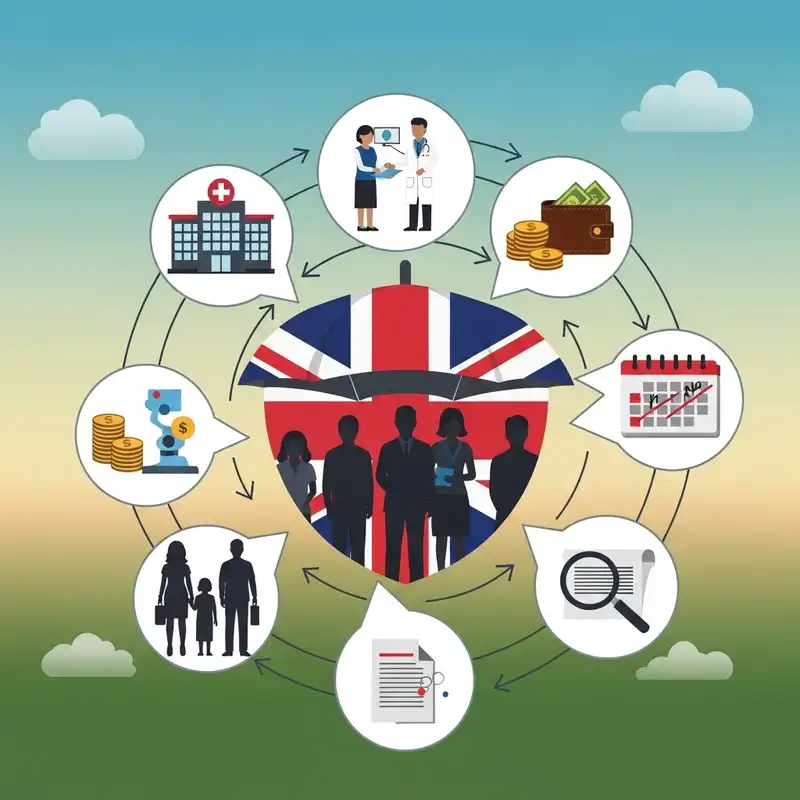
TL;DR
The foundations of financial security for millions of UK households are more fragile than ever before. A seismic shift in the nation's health is unfolding, and the aftershocks are set to derail careers, savings, and family futures on an unprecedented scale. New analysis, based on emerging 2025 data trends from sources including the Office for National Statistics (ONS) and NHS Digital, paints a stark picture.
Key takeaways
- An Ageing Workforce: Britons are working longer than ever, with the state pension age continuing to rise. This extends the period during which a health condition can strike while a person is still reliant on their employment income. An illness that might have occurred in early retirement 20 years ago is now happening to someone in their mid-60s who is still working.
- The Rise of Lifestyle-Related Diseases: Decades of increasingly sedentary lifestyles, processed diets, and high-stress work environments are taking their toll. Conditions like Type 2 diabetes, high blood pressure, and certain cancers are becoming more common at younger ages.
- The Mental Health Crisis: The modern workplace, with its "always-on" culture, has seen a dramatic rise in work-related stress, burnout, and anxiety. The ONS consistently reports stress, depression, or anxiety as one of the leading causes of long-term sickness absence, a trend that accelerated post-pandemic.
- NHS Pressures: Our NHS is a source of national pride, but it is under immense strain. Record-high waiting lists for consultations, diagnoses, and treatments, like those reported by NHS England, mean that recovery periods are often extended. A treatable condition can become a long-term work absence simply due to delays in accessing care. This prolongs financial uncertainty and stress for millions.
- They are means-tested: If you have a partner who works, or if you have modest savings (typically over 6,000, with support stopping entirely at 16,000), your eligibility for support will be reduced or eliminated. The system is designed to penalise those who have been prudent and saved.
UK Work Health Shock
The foundations of financial security for millions of UK households are more fragile than ever before. A seismic shift in the nation's health is unfolding, and the aftershocks are set to derail careers, savings, and family futures on an unprecedented scale.
New analysis, based on emerging 2025 data trends from sources including the Office for National Statistics (ONS) and NHS Digital, paints a stark picture. More than half of all working-age Britons (over 1 in 2) are now projected to experience a significant health event—such as cancer, a heart attack, stroke, or severe mental illness—that forces them out of work for six months or longer before they reach state pension age.
This isn't a rare misfortune; it's becoming a statistical probability.
The financial consequences are nothing short of catastrophic. For many, this "work health shock" won't just mean a few months of tight budgeting. It will trigger a domino effect of financial devastation, potentially wiping out over £4.0 million in lifetime financial potential through lost earnings, squandered pension growth, and depleted family assets.
This isn't scaremongering. This is the new reality. The question is no longer if a health storm will hit, but when—and whether you have the right shield to protect you and your loved ones. This definitive guide will unpack the data, reveal the true cost of being unprepared, and introduce the one solution that can stand between your family and financial ruin: The Life, Critical Illness, and Income Protection (LCIIP) shield.
Deconstructing the 2026 Work Health Shock: The Alarming New Reality
The headline statistic is startling, but understanding the forces behind it is crucial. This isn't a single number from a single report; it's the culmination of several converging trends that are reshaping the landscape of work and health in the UK.
According to the latest ONS data, the number of people out of work due to long-term sickness has hit a record high, soaring past 2.8 million in early 2025. This isn't a temporary blip; it's a sustained upward trend. When we cross-reference this with data on the incidence of major illnesses, a clear and worrying projection emerges.
What Constitutes a "Major Health Event"?
These are not minor ailments. We are talking about life-altering conditions that form the main drivers of long-term work absence:
- Cancer (illustrative): Around 1 in 2 people in the UK will develop some form of cancer during their lifetime (Source: Cancer Research UK). With earlier diagnosis and better treatments, more people are living with cancer, but this often involves long and gruelling treatment periods requiring significant time off work.
- Cardiovascular Disease: Heart attacks and strokes remain leading causes of death and disability. The British Heart Foundation reports over 100,000 hospital admissions for heart attacks in the UK each year. Recovery can take many months, and a full return to a previous role is not always possible.
- Mental Health Conditions: This is the fastest-growing category for work absence. Conditions like severe depression, anxiety, and PTSD are now a primary reason for long-term sickness, affecting an estimated 1 in 4 adults each year (Source: Mind).
- Musculoskeletal (MSK) Issues: Conditions affecting the back, neck, and joints are a huge driver of long-term absence, particularly in a population that is working later into life.
The £4.0 Million+ Lifetime Financial Catastrophe: Unpacking the True Cost
The figure of a "£4.0 million+ lifetime financial catastrophe" can seem abstract. Let's break down how a serious health event can obliterate a family's financial future, especially for a mid-career higher earner. (illustrative estimate)
Consider a 40-year-old professional earning £80,000 per year with a promising career trajectory. A sudden stroke forces them to leave their high-pressure job permanently. (illustrative estimate)
| Financial Impact Component | Calculation & Explanation | Potential Lifetime Loss |
|---|---|---|
| Direct Lost Salary | £80,000/year for 27 years (to age 67). This is the most immediate impact. | £2,160,000 |
| Lost Promotions & Pay Rises | Assuming a conservative 2% average annual pay rise over their remaining career. | £850,000+ |
| Lost Pension Contributions | Loss of both employee (5%) and employer (3%) contributions on the £80k+ salary. | £172,800 (Capital) |
| Lost Pension Growth | The catastrophic loss of 27 years of compound investment growth on those contributions. | £500,000+ |
| Depletion of Savings | Family savings and investments are drained to cover the income gap and extra costs. | £150,000 |
| Partner's Lost Income | A spouse or partner may need to reduce hours or leave work to become a carer. | £300,000+ |
| Additional Costs | Home modifications, private therapies, increased bills, prescription charges. | £50,000+ |
| Total Lifetime Financial Impact | The sum of lost potential and incurred costs. | £4,182,800+ |
As the table shows, the true financial disaster isn't just the loss of a monthly paycheque. It's the complete and utter destruction of a family's long-term financial plan, including retirement, investments, and the ability to support their children's futures.
Why Is This Happening? The Driving Forces Behind the UK's Worsening Health Outlook
This worrying trend is not accidental. It's fueled by a combination of demographic, lifestyle, and societal pressures.
- An Ageing Workforce: Britons are working longer than ever, with the state pension age continuing to rise. This extends the period during which a health condition can strike while a person is still reliant on their employment income. An illness that might have occurred in early retirement 20 years ago is now happening to someone in their mid-60s who is still working.
- The Rise of Lifestyle-Related Diseases: Decades of increasingly sedentary lifestyles, processed diets, and high-stress work environments are taking their toll. Conditions like Type 2 diabetes, high blood pressure, and certain cancers are becoming more common at younger ages.
- The Mental Health Crisis: The modern workplace, with its "always-on" culture, has seen a dramatic rise in work-related stress, burnout, and anxiety. The ONS consistently reports stress, depression, or anxiety as one of the leading causes of long-term sickness absence, a trend that accelerated post-pandemic.
- NHS Pressures: Our NHS is a source of national pride, but it is under immense strain. Record-high waiting lists for consultations, diagnoses, and treatments, like those reported by NHS England, mean that recovery periods are often extended. A treatable condition can become a long-term work absence simply due to delays in accessing care. This prolongs financial uncertainty and stress for millions.
The Fragile Safety Net: Can You Rely on Statutory Sick Pay and State Benefits?
Many people believe a "safety net" exists to catch them. They assume their employer or the government will provide for them if they fall seriously ill. This is a dangerously misplaced assumption.
Statutory Sick Pay (SSP)
Your first line of defence is Statutory Sick Pay. However, it is fundamentally inadequate for any long-term absence.
- The Amount (illustrative): As of 2025, SSP is a mere £116.75 per week.
- The Duration: It is only payable for a maximum of 28 weeks. After that, it stops completely.
Let's put that into perspective.
| Income / Outgoings | Average Weekly Amount (UK) |
|---|---|
| Average Weekly Pay (Full-Time) | £682 |
| Statutory Sick Pay (SSP) | £116.75 |
| The Weekly Income Gap on SSP | -£565.25 |
| Average Family Household Costs | £671 |
Relying on SSP is not a plan; it's a guaranteed path to financial distress within weeks. It doesn't cover the mortgage, the bills, or the food shop. After 28 weeks, even this meagre support vanishes.
State Benefits (Employment and Support Allowance / Universal Credit)
Once SSP runs out, you would move onto the state benefits system, likely applying for Universal Credit or the 'New Style' Employment and Support Allowance (ESA).
- They are means-tested: If you have a partner who works, or if you have modest savings (typically over £6,000, with support stopping entirely at £16,000), your eligibility for support will be reduced or eliminated. The system is designed to penalise those who have been prudent and saved.
- The income is minimal: Even if you do qualify, the amount provided is designed for basic subsistence, not to maintain your home, lifestyle, or financial commitments.
- The process is stressful: The application and assessment process for these benefits can be lengthy, complex, and incredibly stressful at a time when you should be focusing solely on your health.
The conclusion is unavoidable: the state safety net is not designed to protect your lifestyle. It is designed to prevent destitution, and only just.
Your LCIIP Shield: The Definitive Guide to Personal Protection Insurance
If the state and your employer cannot adequately protect you, you must protect yourself. This is where the LCIIP shield comes in. It is a personal financial fortress built from three core components: Life Insurance, Critical Illness Cover, and Income Protection.
Each element serves a unique and vital purpose, working together to provide comprehensive protection against life's biggest uncertainties.
Part 1: Income Protection (IP) – Your Monthly Salary Lifeline
If you were to choose only one policy to protect your financial wellbeing, it would be Income Protection. It is the bedrock of any sound financial plan.
- What it is: An insurance policy that pays you a regular, tax-free monthly income if you are unable to work due to any illness or injury.
- How it works: You choose a percentage of your salary to cover (typically 50-70% of your gross income). You also select a "deferment period" – the time you wait before the payments start. This is usually set to align with your employer's sick pay period (e.g., 3 or 6 months). If you are signed off work by a doctor past this period, the policy starts paying you each month.
- Why it's the cornerstone: It directly replaces your lost salary. This allows you to continue paying your mortgage, rent, bills, and everyday living costs. It removes the immediate financial pressure, allowing you to focus 100% on your recovery, no matter how long it takes. Policies can be set up to pay out for a few years or, ideally, right up until your planned retirement age.
Part 2: Critical Illness Cover (CIC) – The Financial First Responder
While IP replaces your income, Critical Illness Cover provides a powerful financial boost to handle the immediate and significant costs of a major illness.
- What it is: A policy that pays out a one-off, tax-free lump sum on the diagnosis of a specific, serious condition listed in the policy.
- How it works: Insurers will have a list of conditions they cover – core conditions like cancer, heart attack, and stroke are almost always included, but the breadth and definitions of other conditions can vary significantly between providers. If you are diagnosed with one of these qualifying conditions, the policy pays out the full sum assured.
- How it's used: The lump sum is yours to use as you see fit. The freedom this provides is immense. You could:
- Pay off your mortgage or other major debts.
- Fund private medical treatment to speed up recovery.
- Adapt your home (e.g., install a ramp or stairlift).
- Provide a financial cushion for a partner to take time off work.
- Simply replace savings that have been used up.
Part 3: Life Insurance – The Ultimate Family Safeguard
Life Insurance addresses the ultimate "what if," ensuring your loved ones are protected financially if you are no longer around.
- What it is: A policy that pays out a lump sum to your named beneficiaries upon your death.
- How it works (illustrative): You choose a level of cover and a term (e.g., £250,000 over 25 years to cover a mortgage). If you pass away within that term, the policy pays out.
- Why it's essential: It is the final, undeniable act of protection for your family. The payout can clear debts, cover funeral costs, provide an inheritance, and ensure your family can remain in their home and maintain their standard of living during the most difficult of times.
LCIIP Components at a Glance
| Protection Type | What It Is | How It Pays | Primary Purpose |
|---|---|---|---|
| Income Protection (IP) | Replaces lost earnings due to illness/injury. | Tax-free monthly income. | Pay ongoing bills and maintain lifestyle. |
| Critical Illness Cover (CIC) | Protects against the impact of serious illness. | Tax-free lump sum. | Clear debts, fund treatment, adapt home. |
| Life Insurance | Provides for your family after you die. | Tax-free lump sum. | Clear mortgage, provide inheritance, secure future. |
Building Your Fortress: How to Choose the Right Protection
Putting together the right LCIIP shield is a personal process. The right cover for a single 25-year-old renter is very different from that needed by a 45-year-old parent with a mortgage and two children.
Key Considerations for Your Plan:
-
How much cover do you need?
- Life Insurance: A common rule of thumb is 10 times your annual salary, or enough to clear your mortgage and other major debts.
- Critical Illness Cover: This should be enough to clear major debts and/or provide an income for 1-2 years to allow for recovery.
- Income Protection: Aim to cover your essential monthly outgoings: mortgage/rent, bills, food, travel, etc.
-
How long should the policy term be?
- Your protection should typically last until your biggest financial responsibilities end. This could be when your mortgage is paid off, your children become financially independent, or you reach retirement age.
-
What deferment period is right for your IP?
- Check your contract of employment. If your employer provides 6 months of full sick pay, you can choose a 6-month deferment period on your IP policy, which will make your premiums significantly cheaper. If you only get SSP, a shorter deferment period (e.g., 4 or 13 weeks) is essential.
The Critical Role of an Expert Broker
Navigating the protection insurance market alone can be a minefield. The terminology is complex, and the differences between policies can be subtle but significant—especially with Critical Illness Cover, where the definition of a condition can be the difference between a claim being paid or declined.
This is why working with an expert independent broker is not just a good idea; it's essential.
A specialist broker like WeCovr works for you, not the insurance companies. We survey the entire market, comparing policies from all the UK's leading insurers to find the most suitable and comprehensive cover for your unique circumstances and budget. We handle the complex application forms and ensure your disclosure is accurate, giving you the peace of mind that your policy is built on solid foundations.
Furthermore, at WeCovr, we believe in proactive health as well as reactive protection. That's why our clients get complimentary access to our exclusive AI-powered calorie tracking app, CalorieHero. It's our way of going the extra mile, helping you stay on top of your wellness goals—because the best claim is the one you never have to make.
Real-Life Scenarios: The LCIIP Shield in Action
The true power of protection insurance is best illustrated through real-world examples.
Case Study 1: Sarah, 35, Marketing Manager
Sarah is a single homeowner earning £45,000. She has a £200,000 mortgage. She is diagnosed with breast cancer. (illustrative estimate)
| Without Protection | With an LCIIP Shield |
|---|---|
| Relies on SSP (£116.75/week) after her 1-month full sick pay ends. | Her CIC policy pays out a £75,000 tax-free lump sum. |
| Her savings are gone in 3 months. | She uses £20,000 to clear her car loan and credit cards, and keeps the rest as a buffer. |
| She falls behind on her mortgage payments, causing immense stress. | After her 3-month deferment period, her IP policy kicks in, paying her £2,200/month tax-free. |
| The financial anxiety severely impacts her mental health and recovery. | All her bills are covered. She can afford supportive therapies and focuses entirely on getting better. |
| Outcome: Financial crisis, long-term debt, and compromised recovery. | Outcome: Financial stability, peace of mind, and a successful recovery. |
Case Study 2: David, 48, Electrician & Father of Two
David is self-employed, earning around £50,000. He suffers a serious back injury falling from a ladder and can no longer perform manual work. (illustrative estimate)
| Without Protection | With an LCIIP Shield |
|---|---|
| His income stops immediately. There is no sick pay for the self-employed. | His IP policy has a 4-week deferment period. It starts paying him £2,500/month tax-free. |
| He is forced to apply for Universal Credit but qualifies for very little as his wife works part-time. | The monthly income ensures the mortgage is paid and the children's activities can continue. |
| The family burns through their life savings in 6 months. | The pressure is off. David has the financial security and time to retrain for a new career in project management. |
| He is forced to take a low-wage job out of desperation, impacting his mental and physical health. | His IP policy is an 'own occupation' policy, meaning it pays out because he cannot do his specific job. |
| Outcome: Career destroyed, family savings wiped out, future uncertain. | Outcome: Family life is undisrupted, and he successfully transitions to a new, sustainable career. |
Common Myths and Objections Debunked
Despite the clear need, many people hesitate to get cover, often due to persistent myths.
| Myth | Reality |
|---|---|
| "It's too expensive." | For a healthy 30-year-old, comprehensive cover can cost less than a daily coffee or a few streaming subscriptions. The real question is: can you afford not to have it? The cost of a £30/month policy is insignificant compared to the loss of a £3,000/month salary. |
| "Insurers never pay out." | This is false. The Association of British Insurers (ABI) consistently reports that around 98% of all protection claims are paid, amounting to billions of pounds each year. The tiny fraction that are declined are almost always due to customers failing to disclose important medical information on their application. |
| "It won't happen to me." | The data is clear: over 1 in 2 of us will face a long-term health absence. You insure your car and your house without a second thought for events that are far less likely to occur. Protecting your income—your most valuable asset—is even more critical. |
| "I have cover through work." | While a good starting point, employer-provided 'Death in Service' or group income protection is often basic and, crucially, it is not portable. The moment you leave your job, you lose your cover, and getting new personal cover when you are older will be more expensive. |
Your Next Step: Taking Control of Your Financial Future Today
The 2025 Work Health Shock is not a distant threat; it's a clear and present danger to the financial stability of working Britons. Relying on luck, the state, or basic employer provisions is no longer a viable strategy.
Taking control is a straightforward process, but it requires action.
- Assess Your Position: Take 30 minutes to review your finances. What are your essential monthly outgoings? What sick pay does your employer offer? How long would your savings last? This will give you a clear picture of your vulnerability.
- Don't Delay: The younger and healthier you are when you apply for protection, the cheaper your premiums will be for the entire life of the policy. Every year you wait, the cost increases and the risk of developing a health condition that makes you uninsurable grows.
- Seek Expert, Independent Advice: This is the most important step. Don't navigate this complex landscape alone. The expert advisors at WeCovr provide a free, no-obligation service to assess your unique needs. We compare plans from all the UK's leading insurers to find you the right level of protection at the most competitive price, ensuring your family's future is secure against any storm.
A Life, Critical Illness, and Income Protection shield is not an 'extra' expense in your monthly budget. It is the fundamental investment you make in yourself and your family. It is the bedrock upon which your home, your lifestyle, and your future are built. Without it, everything you've worked for is exposed to life's inevitable storms. Secure your foundation today.
Sources
- Office for National Statistics (ONS): Mortality and population data.
- Association of British Insurers (ABI): Life and protection market publications.
- MoneyHelper (MaPS): Consumer guidance on life insurance.
- NHS: Health information and screening guidance.
Disclaimer: This is general guidance only and does not constitute formal tax or financial advice. Tax treatment depends on individual circumstances, policy terms, and HMRC interpretation, which cannot be guaranteed in advance. Whenever applicable, businesses and individuals should always consult a qualified accountant or tax adviser before arranging such policies.
Measure your family’s protection gap, then get the right life cover quote
Start with the score to see whether your family would face a real financial shortfall before moving on to life cover options.
Check what happens if someone dies too soon
See whether debt, dependants and mortgage risk are covered
Move into tailored life cover options after the score
Get your score
Your next best move
Get your score in minutes, then decide what kind of protection help would be most useful.
Score your household protection
See how well your current setup protects dependants, debt and major commitments.
Find the shortfall
Know whether life cover, critical illness or income protection is the actual missing piece.
Continue to tailored life cover
If life cover is the gap, continue to tailored life cover options.
What you get
A quick view of your current protection position
A clearer idea of where the biggest gaps may be
A direct route to tailored help if you want it