
TL;DR
Our latest analysis of official NHS data reveals the ten most severe bottlenecks among England's acute trusts. Watch how extreme delays in Essex, Derbyshire, Norfolk, Northamptonshire, Hull, Hertfordshire, Buckinghamshire, and London have created a new 'League of Shame' for routine healthcare.
Key takeaways
- Zero out of 23 NHS specialties are currently meeting the 18-week standard nationally.
- Mid & South Essex is now the 'Waiting List Capital' of England, holding the three longest waits in the country.
- The longest single wait in the country is 67.2 weeks for Orthopaedics.
- Routine surgeries like hernia repairs and tooth extractions are taking well over a year in specific postcodes.
- Check your local hospital's performance using WeCovr's free interactive dashboard.
The government’s flagship deadline to stabilize the NHS is looming in March 2026, but a deep dive into the latest official data reveals that specific local hospitals are failing at an alarming rate.
Following the release of the January 2026 NHS Referral to Treatment (RTT) figures, the data team at WeCovr analysed the 92nd-percentile wait times across all 150 English hospital trusts.
What we found was a booming "52-Week Club"—dozens of local service lines where patients are being forced to wait well over a year for routine, yet vital, care.
The Race to the Bottom: Visualising the "League of Shame"
To highlight where the system is breaking down the fastest, we tracked the absolute longest waiting lists in the country over the last 18 months.
Watch the chart below to see how a handful of trusts have surged to create the most severe bottlenecks in the UK.
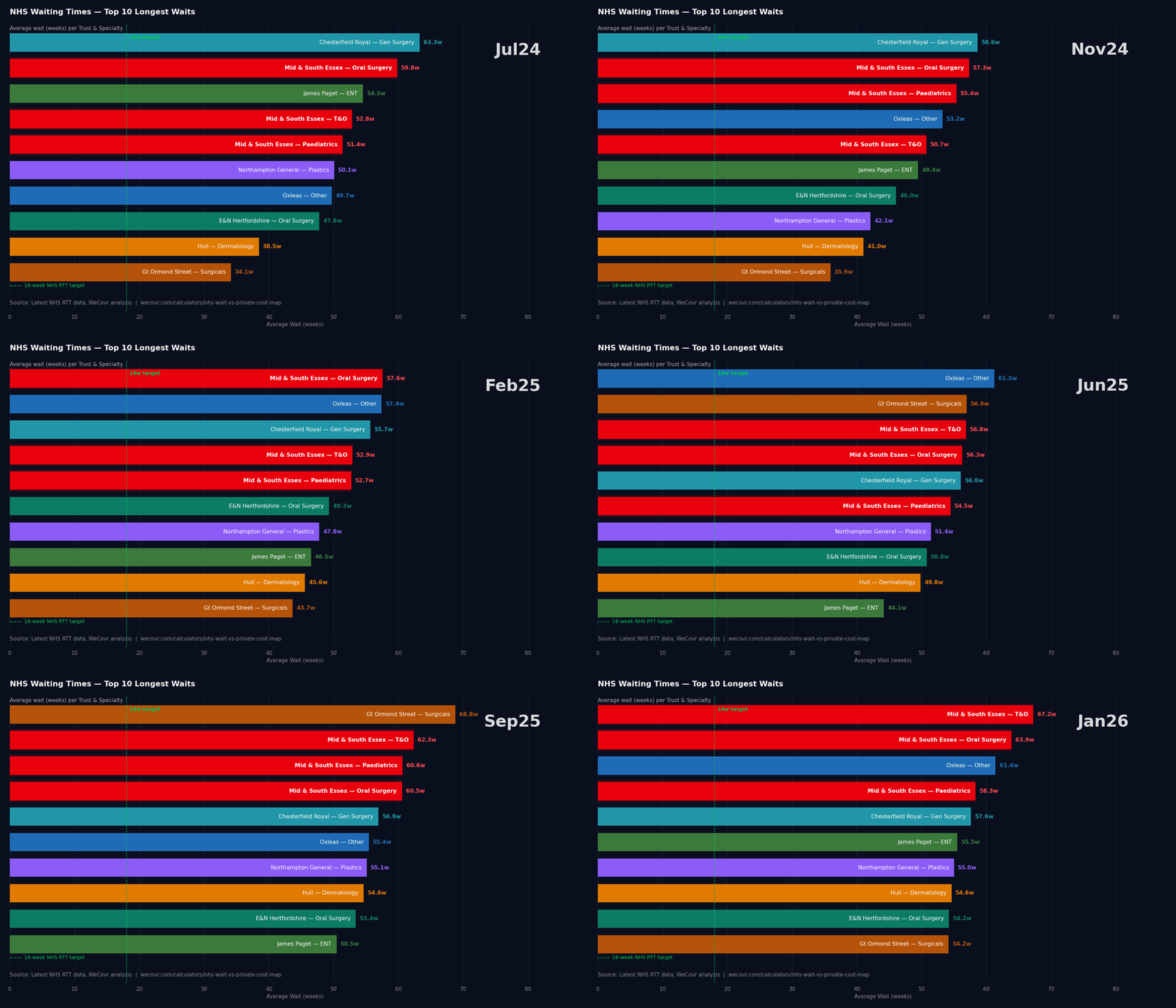
The 10 Longest Waits in England Right Now
As of January 2026, among acute trusts only, these are the longest delays in the nation. Where the NHS dataset uses a broad label such as "Other - Surgicals," we have kept that wording because it is the official RTT category name:
- 🔴 Mid & South Essex (Trauma & Orthopaedics): 67.2 Weeks
- The Reality: Patients here are waiting roughly 15 months for hip and knee replacements.
- 🔴 Mid & South Essex (Oral Surgery): 63.9 Weeks
- The Reality: The collapse of NHS dentistry is spilling into hospitals, leaving patients waiting over a year for complex tooth extractions and jaw surgery.
- 🔴 Mid & South Essex (Paediatrics): 58.3 Weeks
- The Reality: Children in the Essex commuter belt are waiting over a year for specialised medical attention, a significant share of a young child's life.
- 🔴 Chesterfield Royal Hospital (General Surgery): 57.6 Weeks
- The Reality: The worst wait outside the South East for routine procedures like gallbladder removal and hernia repairs.
- 🔴 James Paget University Hospitals (Ear, Nose & Throat): 55.5 Weeks
- The Reality: ENT patients in Norfolk are waiting over a year for procedures like tonsillectomies and sinus surgery that are considered routine.
- 🔴 Northampton General Hospital (Plastic Surgery): 55.0 Weeks
- The Reality: Another plastic surgery unit has drifted into year-long waits, showing this is not a one-off local issue.
- 🔴 Hull University Teaching Hospitals (Dermatology): 54.6 Weeks
- The Reality: Patients with persistent skin conditions are facing extraordinary waits for specialist diagnosis and treatment in East Yorkshire.
- 🔴 East & North Hertfordshire Teaching (Oral Surgery): 54.2 Weeks
- The Reality: Oral surgery delays are not confined to Essex. Patients in Hertfordshire are also facing waits of more than a year for hospital-based dental and jaw procedures.
- 🔴 Great Ormond Street Hospital for Children (Other - Surgicals): 54.2 Weeks
- The Reality: This official NHS reporting category covers a grouped surgical pathway, and the delay shows that even one of England's best-known specialist children's hospitals is dealing with severe backlog pressure in this service line.
- 🔴 Buckinghamshire Healthcare (Neurology): 53.8 Weeks * The Reality: Patients waiting for neurological assessment and treatment in Buckinghamshire are facing delays that stretch well beyond a year.
The Alternative to Waiting
When local hospitals reach these levels of systemic failure, the concept of a "free" health service begins to cost patients dearly in terms of lost income, chronic pain, and mental distress.
You cannot assume a hospital is good for everything. A trust might be world-class at cardiac care, but failing completely in orthopaedics. It is vital to know exactly what you are facing before you join a list.
WeCovr has built an interactive search tool that allows you to bypass the confusing NHS spreadsheets. Simply select your local trust and your required treatment, and see exactly how long the backlog is—and how much it would cost to bypass it privately.
👉 Search your hospital on the WeCovr NHS Wait vs Private Cost Map
If you want to protect yourself and your family from these extreme local bottlenecks for any future health issues, comparing Private Medical Insurance is the most effective first step.
Sources
- WeCovr Analysis of NHS England Referral to Treatment (RTT) Data (Jan 2026 release).
Disclaimer: This is general guidance only and does not constitute formal tax or financial advice. Tax treatment depends on individual circumstances, policy terms, and HMRC interpretation, which cannot be guaranteed in advance. Whenever applicable, businesses and individuals should always consult a qualified accountant or tax adviser before arranging such policies.
Start with your Protection Score, then decide whether private health cover is the right fit
Check where health access sits in your overall protection picture before deciding whether to compare private health cover.
Spot whether NHS access risk is the real issue
See if PMI is the gap to fix first
Get health insurance help only if it makes sense for you
Get your score
Start with your protection score
Check your current position first, then get health insurance help if you need it.
Check your current resilience
Score your income, health access and family protection position in a few minutes.
See where private cover helps
Understand whether faster diagnosis and treatment is a priority gap.
Continue to tailored PMI help
If health access is the issue, continue to tailored PMI help.
What you get
A quick view of your current protection position
A clearer idea of where the biggest gaps may be
A direct route to tailored help if you want it