TL;DR
Comprehensive guide to UK and European tax rules, residence tests, double taxation, and legal optimisation strategies covering all 27 EU countries plus EEA states for UK citizens relocating to Europe.
Key takeaways
- Traditional destinations like Spain, France, or Germany
- Emerging digital nomad hubs like Estonia, Portugal, or Croatia
- Low-tax havens like Cyprus, Malta, or Monaco
- High-quality Nordic countries like Denmark, Sweden, or Norway
- Eastern European opportunities like Bulgaria, Romania, or Czech Republic
Moving to Europe from UK Complete Guide
Comprehensive guide to UK and European tax rules, residence tests, double taxation, and legal optimisation strategies covering all 27 EU countries plus EEA states for UK citizens relocating to Europe.
Table of Contents
- Executive Summary
- UK Foundations Before You Move
- Living Arrangements & Tax Exposure
- Legal Tax-Optimisation Strategies
- Complete EU Countries Analysis
- EEA Countries Deep Dive
- Other European Opportunities
- Digital Nomad Paradise: Country Rankings
- Cross-Country Comparisons
- Healthcare & Insurance Abroad
- Compliance & Risk
- Step-by-Step Planning Checklist
- Frequently Asked Questions
- Call-to-Action
- Sources & Citations
Executive Summary
Who This Guide Is For
This guide is designed for UK citizens—including employees, contractors, company founders, high-net-worth individuals (HNWIs), remote workers, and retirees—who are planning a permanent or long-term move to any country within the European Union (EU), European Economic Area (EEA), or Switzerland. It is intended for the diligent planner who seeks a comprehensive understanding of the tax, residency, and healthcare implications before engaging professional advisors. Whether you're considering:
- Traditional destinations like Spain, France, or Germany
- Emerging digital nomad hubs like Estonia, Portugal, or Croatia
- Low-tax havens like Cyprus, Malta, or Monaco
- High-quality Nordic countries like Denmark, Sweden, or Norway
- Eastern European opportunities like Bulgaria, Romania, or Czech Republic
This guide provides the detailed analysis you need to make informed decisions.
Key Decisions That Matter
Your tax liability and overall financial position when moving from the UK to Europe will depend on five critical factors:
- Timing of departure - When you leave can trigger or defer significant tax liabilities
- Country choice - Each European nation has vastly different tax regimes and special incentives
- Work structure - Whether you remain employed, become self-employed, or establish a business
- Property decisions - Buy vs rent impacts wealth taxes, transaction costs, and flexibility
- Healthcare arrangements - International private medical insurance becomes crucial for comprehensive coverage
Top Tax Optimisation Opportunities by Region
Western Europe (Traditional Destinations):
- Spain: Beckham Law (24% flat rate for 6 years)
- Portugal: NHR 2.0/ITS (20% professional income rate)
- Italy: HNW Flat Tax (€200,000 annual payment)
- Netherlands: 30% Ruling (30% potentially tax-efficient allowance)
Eastern Europe (Emerging Opportunities):
- Bulgaria: 10% flat tax (lowest in EU)
- Estonia: Deferred corporate taxation system
- Cyprus: Non-dom status (0% on foreign income for 17 years)
- Malta: Non-dom remittance basis (unlimited duration)
Nordic Region (High Quality/High Tax):
- Denmark: Comprehensive social system (55.9% top rate)
- Sweden: Excellent infrastructure (57% top rate)
- Norway: Oil wealth benefits (47.4% top rate)
Digital Nomad Havens:
- Estonia: E-residency program and digital-first infrastructure
- Portugal: D7 visa and favorable tax treatment
- Croatia: Digital nomad visa with moderate taxation
- Czech Republic: Low cost of living with reasonable taxes
Compliance Disclaimer
Important: This guide provides general information only and does not constitute tax, legal, or financial advice. Tax rules change frequently, and individual circumstances vary significantly. You must seek personalised advice from qualified professionals in both the UK and your destination country before making any decisions. The authors and publishers accept no responsibility for any losses arising from the use of this information.
UK Foundations Before You Move
Understanding the UK Statutory Residence Test (SRT)
The Statutory Residence Test determines your UK tax residency status through a systematic approach involving three tests applied in sequence:
Automatic Overseas Test
You're automatically non-resident if you meet any of these conditions:
- Present in the UK for fewer than 16 days in the tax year (or 46 days if you were non-resident in the previous three years)
- Working full-time overseas with UK presence limited to fewer than 91 days and no more than 30 work days in the UK
- Dying in the year having been non-resident in the previous tax year and present for fewer than 46 days
Automatic UK Resident Test
You're automatically UK resident if:
- Present in the UK for 183 days or more in the tax year
- Your only home is in the UK (available for at least 91 days and you're present on at least 30 days)
- Working full-time in the UK (unless significant overseas work time applies)
Sufficient Ties Test
If neither automatic test applies, your residency depends on UK ties combined with days spent in the UK:
UK Ties include:
- Family tie - spouse/civil partner or minor children resident in the UK
- Accommodation tie - accessible accommodation in the UK
- Work tie - substantive work in the UK (more than 3 hours on more than 40 days)
- 90-day tie - spent 90+ days in the UK in either of the previous two tax years
- Country tie - UK is the country where you spend the most time
Day Thresholds by Ties:
- Previously resident: 16-45 days (4+ ties), 46-90 days (3+ ties), 91-120 days (2+ ties), 121-182 days (1+ tie)
- Not previously resident: 46-90 days (4+ ties), 91-120 days (3+ ties), 121-182 days (2+ ties)
Domicile vs Residence: The 2026 Revolution
Major Change Alert: From 6 April 2026, the UK abolished the concept of domicile for tax purposes, replacing it with a residence-based system. This represents the most significant change to UK international tax rules in decades.
Post-2026 Residence-Based System
Foreign Income and Gains (FIG) Regime:
- New UK residents get 100% relief on foreign income and gains for first 4 years
- Must not have been UK resident in any of the 10 consecutive years before arrival
- Overseas Workday Relief retained for qualifying assignments
Inheritance Tax Changes:
- Long-term residents (10+ years) face UK inheritance tax on worldwide assets
- Temporary repatriation facility allows former remittance basis users to bring offshore funds to UK at reduced tax rates
UK Departure Checklist: Forms, Deadlines, and Pitfalls
Your departure from the UK triggers several administrative requirements with significant penalty risks for non-compliance:
Form P85: Leaving the UK
When to use P85:
- You're leaving the UK permanently or indefinitely
- You'll work abroad full-time for at least one tax year
- You're not required to file a Self Assessment return
What the P85 achieves:
- Claims tax refund on employment income for departure year
- Updates your contact details with HMRC
- May trigger NT (no tax) coding for continuing UK employment
Complete EU Countries Analysis
Western European Powerhouses
Spain: Beyond the Beckham Law
Residency Rules:
- Automatic residency: 183+ days in any calendar year
- Centre of vital interests: Family or main economic activities in Spain
- 2026 updates: Enhanced enforcement of "sporadic absence" rules
Tax Structure:
- Personal Income Tax: 19% to 47% (plus regional variations up to 3.5%)
- Beckham Law: 24% flat rate for qualifying expatriates (6 years maximum)
- Wealth Tax: 0.2-3.5% (varies by autonomous community)
- Property Tax: 0.4-1.1% of cadastral value
Special Considerations for 2026:
- Solidarity Contribution: Additional levy on global income exceeding €600,000
- Split-year treatment: Tax residency begins from arrival date, not calendar year beginning
- Digital Nomad Visa: New visa category allowing remote work for non-Spanish employers
France: Navigating Complex Fiscal Residency
Residency Determination - Four-Point Test:
- Family home (foyer) in France or principal place of stay
- Professional activity in France (unless ancillary)
- Centre of economic interests in France
- 183+ days in France per year
Tax Landscape 2026:
- Income Tax: 0% to 45% progressive rates
- Social Charges: 17.2% on investment income for residents
- Wealth Tax (IFI): 0.5-1.5% on real estate wealth over €1.3m
- Capital Gains: 19% + 17.2% social charges = 36.2% total
Germany: The Economic Engine
Dual Residence Framework:
- Domicile (Wohnsitz): Place available for regular use
- Habitual Abode: Physical presence over 183 days
Tax Advantages:
- No tax on private capital gains for passive investors
- Cryptocurrency gains potentially tax-efficient after 1-year holding period
- Real estate gains potentially tax-efficient after 10-year holding for private use
Italy: The €200,000 Flat Tax Revolution
2026 Updates:
- Flat tax increased to €200,000 annually (from €100,000)
- Family members can join for additional €25,000 per person
- 15-year duration with no minimum income requirement
Northern European Excellence
Denmark: The Nordic Model
Tax Structure:
- Top Rate: 55.9% (including municipal and labour market taxes)
- Comprehensive Benefits: Free healthcare, education, generous parental leave
- Quality of Life: Consistently ranked among world's happiest countries
Sweden: Innovation Hub
Tax Framework:
- Top Rate: 57% (including municipal taxes)
- Special Considerations: 3-year exemption for certain foreign employees
- Innovation Incentives: Strong support for tech and startups
Finland: The Foreign Expert Programme
Special Regime:
- Foreign Expert Tax: 32% flat rate on Finnish salary income
- Standard Rates: 0% to 44.25% progressive
- Residency: Physical presence over 6 months or permanent home
Eastern European Opportunities
Estonia: The Digital Pioneer
Revolutionary Tax System:
- Corporate Tax: Only on distributed profits (22% rate)
- Personal Tax: 22% flat rate (increased from 20% in 2026)
- E-Residency: Fully digital company management
Digital Nomad Benefits:
- Visa Available: 12-month renewable
- Tax Rate: 20% for qualifying nomads
- Infrastructure: World-class digital government services
Bulgaria: The EU's Tax Haven
Competitive Advantages:
- Corporate Tax: 10% flat rate (lowest in EU)
- Personal Tax: 10% flat rate
- Social Security: 27.1% total burden
- EU Benefits: Full access to single market
Czech Republic: Central European Hub
Residency Rules:
- 183+ days in calendar year, OR
- Permanent home in Czech Republic
Tax Benefits:
- Reasonable rates: 15% to 23% personal income tax
- Low costs: Excellent value for money
- Strategic location: Heart of Europe
Hungary: The Flat Tax Leader
Tax Structure:
- Personal Income Tax: 15% flat rate (one of EU's lowest)
- Residency: Hungarian citizenship, EEA nationals with 183+ days, or vital interests
Poland: The Economic Powerhouse
Growing Opportunities:
- Personal Tax: 17% to 32% rates
- Digital Nomad Visa: Available with competitive requirements
- Economic Growth: One of EU's fastest-growing economies
Croatia: Adriatic Paradise
Residency Framework:
- Real estate ownership: 183+ days over 2 consecutive calendar years
- Physical presence: 183+ days alternative
- Tax Rates: 15% to 30% (with municipal variations)
Southern European Gems
Cyprus: The 17-Year Non-Dom Paradise
Exceptional Benefits:
- 0% tax on dividends, interest, capital gains (except Cyprus real estate)
- 60-day rule: Minimum physical presence
- 17-year duration for non-domiciled status
Malta: Unlimited Non-Dom Benefits
Remittance Basis System:
- No tax on foreign income kept offshore
- 15% tax on foreign income remitted to Malta
- €5,000 minimum annual tax (if foreign income >€35,000)
- No time limit on benefits
Slovenia: Recent Reforms
Digital Nomad Focus:
- New visa programme launched in 2026
- Recent tax reforms attract EU tech startups
- Reduced bureaucracy and streamlined compliance
Greece: The Pensioner Paradise Extended
Special Programmes:
- 7% flat tax on foreign-source income for 15 years
- Golden Visa: €250,000+ real estate investment
- Quality of life: Mediterranean lifestyle with low costs
Atlantic European Destinations
Portugal: Post-NHR Era
NHR 2.0/ITS Programme:
- 20% tax rate on qualifying Portuguese professional income
- 10-year duration with stricter eligibility
- Professional requirement: Must qualify as highly skilled
Ireland: The Corporate Haven
Advantages:
- Corporate tax: 12.5% on trading income
- 280-day rule: Unique two-year residency test
- English-speaking: No language barrier for UK relocators
Baltic Innovation Hub
Latvia: Progressive Yet Competitive
Tax Structure 2026:
- 25.5% for income up to €105,300
- 33% for income above €105,300
- Additional 3% on income exceeding €200,000
Lithuania: The Baltic Tiger
Competitive Framework:
- 15% on income up to €253,065.60
- 20% on income exceeding threshold
- Digital nomad friendly with growing tech sector
Romania: The Micro-Enterprise Haven
Special Programmes:
- Micro-enterprise tax: 1-3% for qualifying businesses
- Standard corporate: 16% flat rate
- Growing economy with EU benefits
Slovakia: Central European Value
Tax Benefits:
- Progressive rates: Competitive with regional neighbours
- EU access: Full single market participation
- Strategic location: Gateway to Eastern and Western Europe
EEA Countries Deep Dive
Norway: Oil-Funded Excellence
Tax Structure:
- Top Rate: 47.4% (including municipal taxes)
- Wealth Tax: 1% on net wealth over NOK 20 million
- 2026 Changes: Amendments to exit tax rules
Quality of Life:
- Oil Fund Benefits: Sovereign wealth fund supports social programs
- High Living Standards: Among world's highest GDP per capita
- Natural Beauty: Fjords, northern lights, midnight sun
Iceland: Nordic Island Paradise
Tax Framework:
- Progressive rates: Up to 46.24%
- Unique Benefits: Geothermal energy, pristine environment
- Strategic Location: Gateway between Europe and North America
Liechtenstein: The Alpine Financial Centre
Exclusive Benefits:
- Lump Sum Taxation: Available for qualifying individuals
- Banking Secrecy: Strong financial privacy protections
- Low Taxes: Competitive rates for high-net-worth individuals
- EU Access: EEA membership provides single market access
Other European Opportunities
Monaco: The Ultimate Tax Haven
Zero Tax Paradise:
- Personal Income Tax: 0% for residents
- Capital Gains: 0% on most investments
- Inheritance Tax: 0% for direct line succession
Requirements:
- Physical Presence: 183+ days annually
- Financial Proof: €500,000+ bank deposit
- Property Investment: Purchase or rental (average €2M+ for purchase)
Important Caveat: French nationals remain subject to French income tax even with Monaco residency
Switzerland: Precision Tax Planning
Lump Sum Taxation:
- Cantonal Variations: Each canton sets own terms
- Living Expenses Method: Tax on 5x annual living costs
- Minimum Requirements: Typically €200,000+ annually
- No Employment: Cannot work in Switzerland under this regime
Andorra: The Pyrenees Paradise
Low Tax Haven:
- Maximum 10% personal income tax
- No wealth, gift, or inheritance tax
- 90+ days physical presence required
- Investment Options: €600,000 passive residence or €50,000 active business
Digital Nomad Paradise: Country Rankings
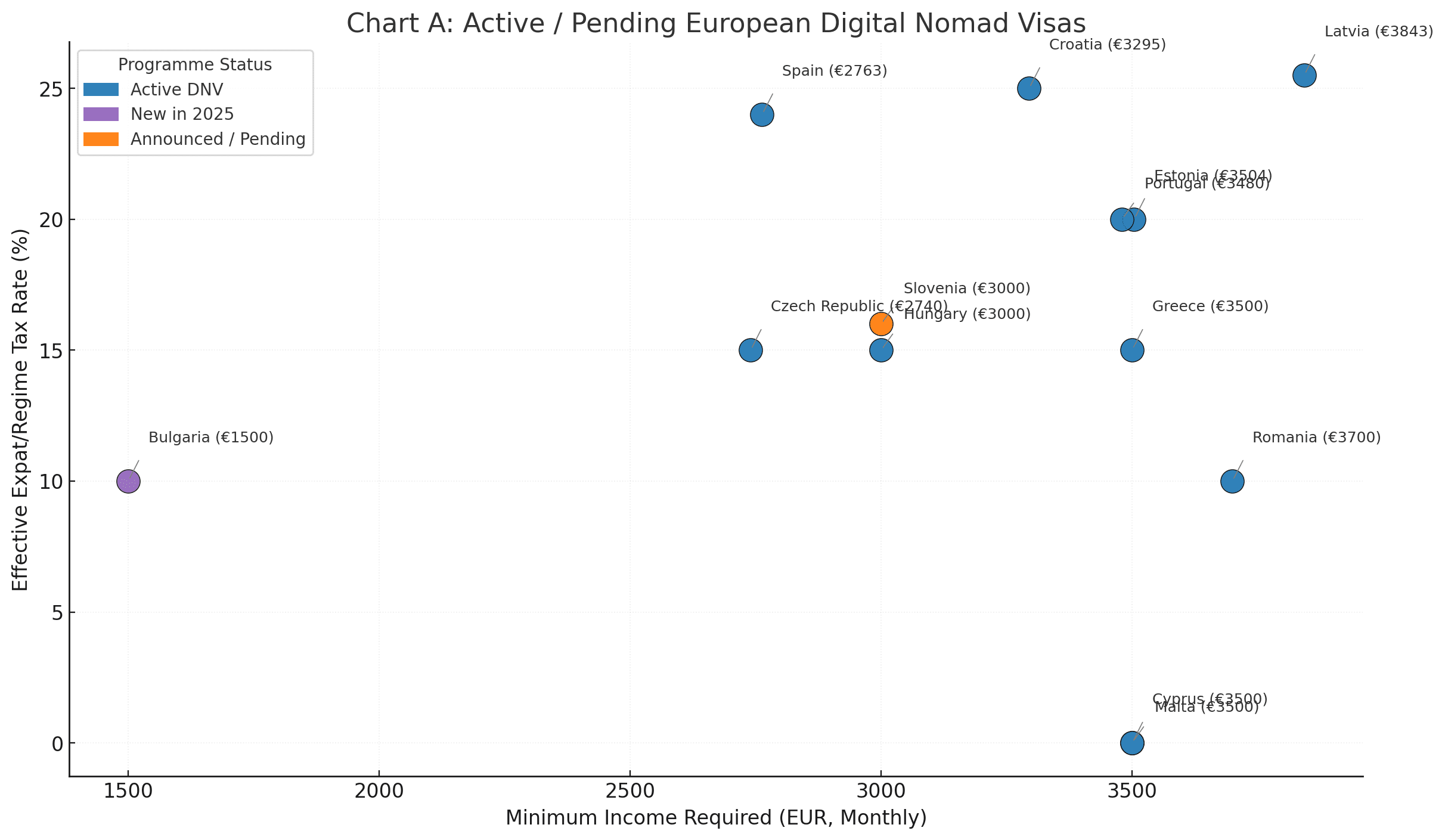
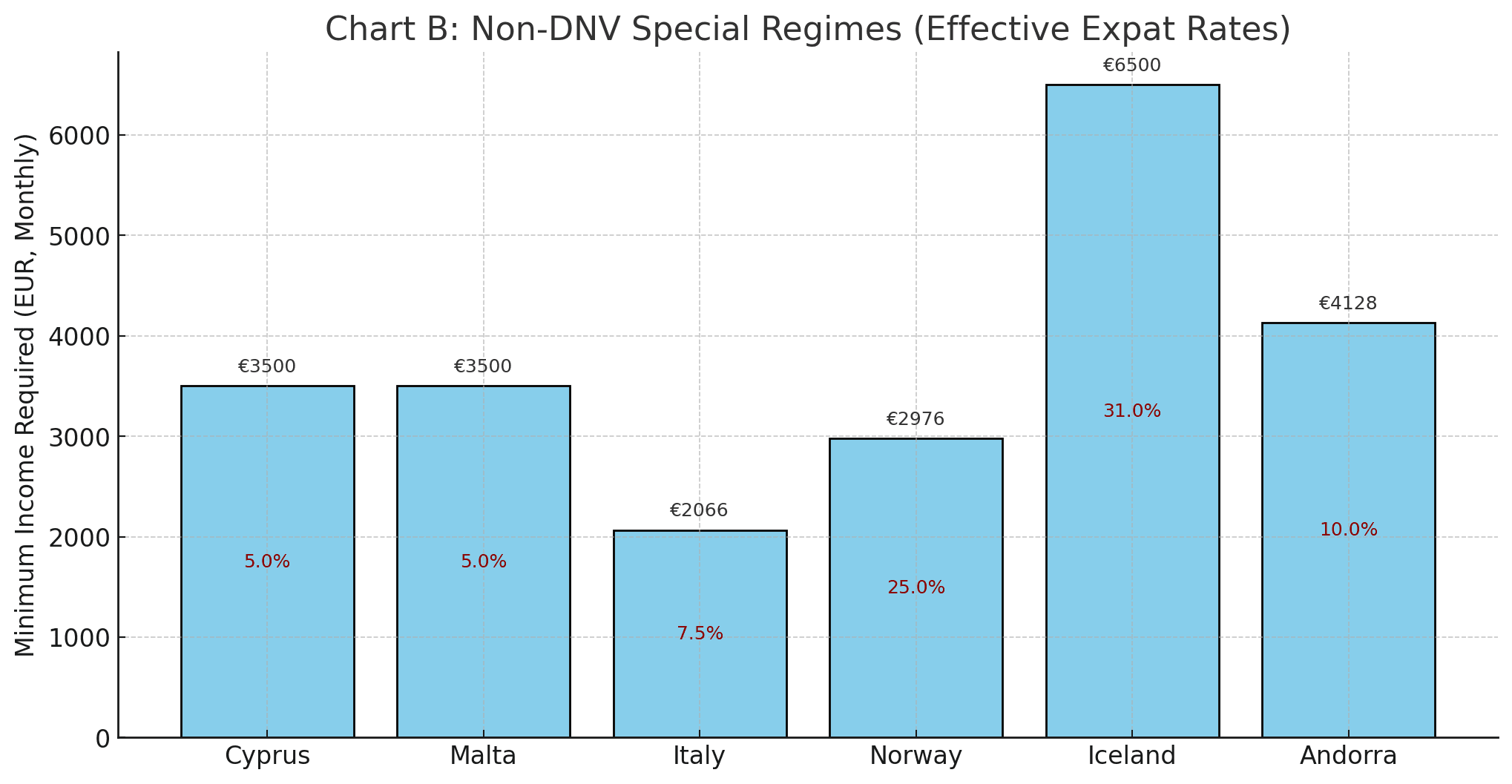
European Digital Nomad Visas & Special Regimes (2026)
| Country | Category | Programme Status | Min. Income Required (EUR/month) | Effective Tax Rate (%) |
|---|---|---|---|---|
| Spain | Digital Nomad Visa | Active | 2763 | 24 |
| Portugal | Digital Nomad Visa | Active | 3480 | 20 |
| Croatia | Digital Nomad Visa | Active | 3295 | 25 |
| Greece | Digital Nomad Visa | Active | 3500 | 15 |
| Estonia | Digital Nomad Visa | Active | 3504 | 20 |
| Cyprus | Digital Nomad Visa | Active | 3500 | 5 |
| Malta | Digital Nomad Visa | Active | 3500 | 5 |
| Czech Republic | Digital Nomad Visa | Active | 2740 | 15 |
| Hungary | Digital Nomad Visa | Active | 3000 | 15 |
| Latvia | Digital Nomad Visa | Active | 3843 | 25.5 |
| Romania | Digital Nomad Visa | Active | 3700 | 10 |
| Slovenia | Digital Nomad Visa | Active | 3000 | 16 |
| Bulgaria | Digital Nomad Visa | Active | 1500 | 10 |
| Lithuania | Digital Nomad Visa | No | 3000 | 15 |
| Poland | Digital Nomad Visa | No | 3000 | 17 |
| Italy | Special Regime (Non-DNV) | Impatriate Reg. | 2066 | 5–10 |
| Cyprus | Special Regime (Non-DNV) | Non-Dom | 3500 | 5 |
| Malta | Special Regime (Non-DNV) | Non-Dom | 3500 | 5 |
| Andorra | Special Regime (Non-DNV) | Low Tax Residence | 3333 | 10 |
| Norway | Special Regime (Non-DNV) | No DNV | 2976 | 25 |
| Iceland | Special Regime (Non-DNV) | No DNV | 6500 | 31 |
Top Digital Nomad Destinations
Tier 1: Premium Options
- Estonia - €3,500 income requirement, 20% tax rate, very easy application
- Cyprus - €3,500 income requirement, 0% tax on foreign income, easy application
- Malta - €2,700 income requirement, 0% tax on foreign income, easy application
- Portugal - €2,800 income requirement, 20% tax rate under ITS, easy application
Tier 2: Balanced Value
- Czech Republic - €2,500 income requirement, 15% tax rate, easy application
- Hungary - €2,000 income requirement, 15% tax rate, easy application
- Croatia - €2,300 income requirement, 25% tax rate, moderate application
- Latvia - €2,500 income requirement, 25.5% tax rate, easy application
Tier 3: Budget-Friendly
- Bulgaria - €1,500 income requirement, 10% tax rate, very easy application
- Lithuania - €3,000 income requirement, 15% tax rate, easy application
- Slovenia - €3,000 income requirement, 16% tax rate, moderate application
- Poland - €3,000 income requirement, 17% tax rate, easy application
Digital Nomad Tax Considerations
Key Factors to Consider:
- Permanent Establishment Risk: Working 30+ days may create tax obligations for your employer
- Social Security Coordination: A1 certificates for EU work assignments
- Day Counting: Different countries have different presence rules
- Double Taxation: Treaty tie-breaker rules when dual resident
Cross-Country Comparisons
Complete European Tax Rate Analysis
Complete European Tax Rates Comparison
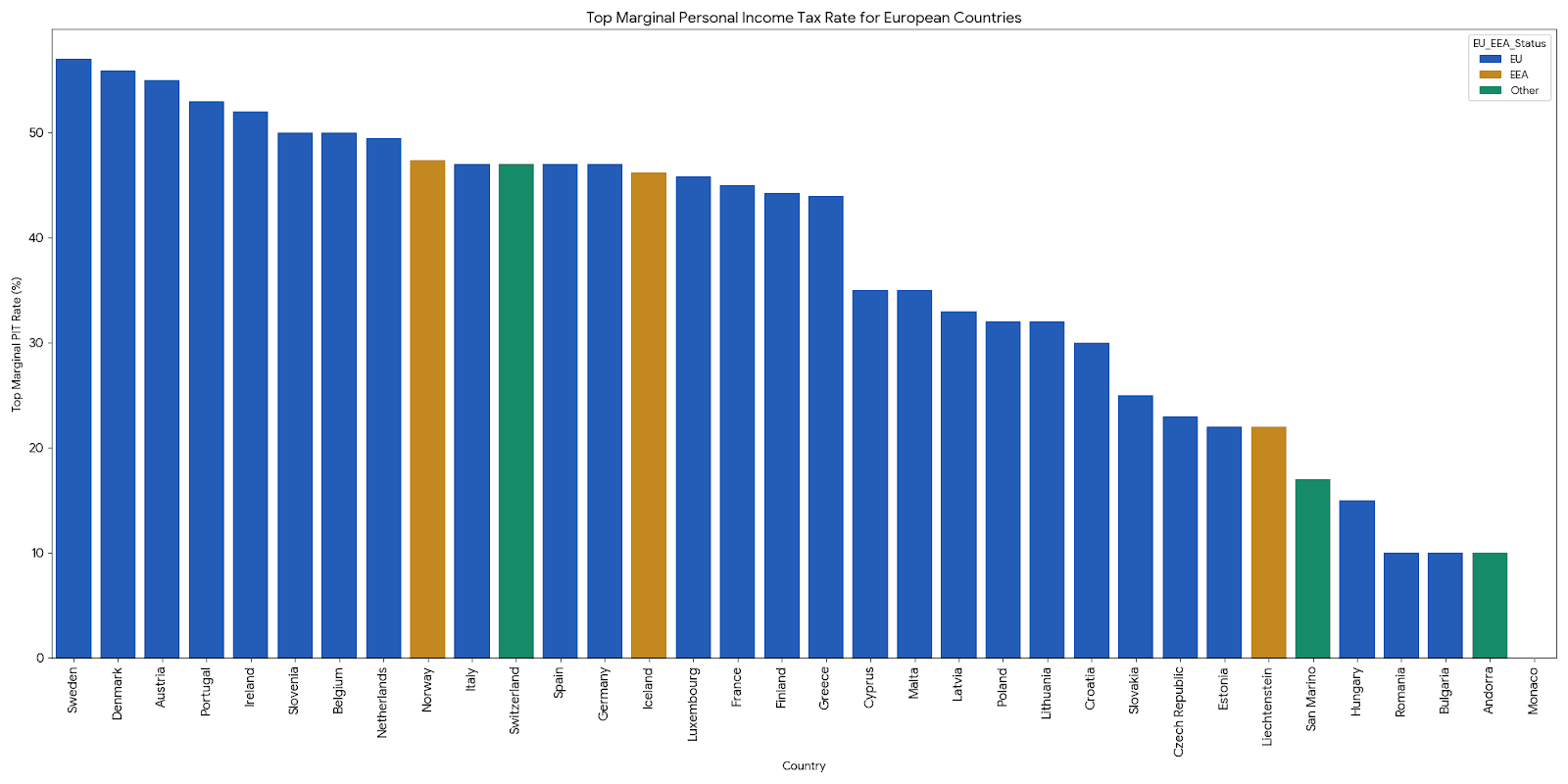
Master Comparison Table - All European Countries
| Country | EU/EEA Status | Top PIT Rate | Dividend Rate | CGT Rate | Wealth Tax | Property Purchase | Annual Property Tax |
|---|---|---|---|---|---|---|---|
| Western Europe | |||||||
| Austria | EU | 55.0% | 27.5% | 27.5% | No | 9.5% | 0.5% |
| Belgium | EU | 50.0% | 30.0% | 33.0% | No | 12.0% | 1.25% |
| France | EU | 45.0% | 30.0% | 30.0% | Yes | 8.0% | 1.5% |
| Germany | EU | 47.0% | 26.4% | 26.4% | No | 10.5% | 0.6% |
| Luxembourg | EU | 45.8% | 15.0% | 0.0% | No | 7.5% | 0.6% |
| Netherlands | EU | 49.5% | 26.9% | 31.0% | No | 6.0% | 0.8% |
| Switzerland | Other | 47.0% | 35.0% | 0.0% | Cantonal | 4.0% | 0.3% |
| Southern Europe | |||||||
| Cyprus | EU | 35.0% | 0.0% | 0.0% | No | 8.0% | 0.6% |
| Greece | EU | 44.0% | 15.0% | 15.0% | No | 9.0% | 0.8% |
| Italy | EU | 47.0% | 26.0% | 26.0% | No | 9.0% | 0.9% |
| Malta | EU | 35.0% | 0.0% | 0.0% | No | 5.0% | 0.55% |
| Portugal | EU | 53.0% | 28.0% | 28.0% | No | 7.0% | 0.5% |
| Slovenia | EU | 50.0% | 25.0% | 25.0% | No | 2.0% | 0.6% |
| Spain | EU | 47.0% | 26.0% | 23.0% | Yes | 10.0% | 1.1% |
| Eastern Europe | |||||||
| Bulgaria | EU | 10.0% | 5.0% | 10.0% | No | 3.0% | 0.15% |
| Croatia | EU | 30.0% | 12.0% | 12.0% | No | 5.0% | 0.6% |
| Czech Republic | EU | 23.0% | 23.0% | 23.0% | No | 9.0% | 1.0% |
| Estonia | EU | 22.0% | 22.0% | 22.0% | No | 2.0% | 0.1% |
| Hungary | EU | 15.0% | 15.0% | 15.0% | No | 11.0% | 1.0% |
| Latvia | EU | 33.0% | 25.5% | 25.5% | No | 2.0% | 0.2% |
| Lithuania | EU | 32.0% | 15.0% | 15.0% | No | 0.5% | 0.5% |
| Poland | EU | 32.0% | 19.0% | 19.0% | No | 2.0% | 0.8% |
| Romania | EU | 10.0% | 5.0% | 10.0% | No | 1.5% | 0.1% |
| Slovakia | EU | 25.0% | 25.0% | 25.0% | No | 4.0% | 0.25% |
| Nordic Countries | |||||||
| Denmark | EU | 55.9% | 42.0% | 42.0% | No | 4.0% | 1.0% |
| Finland | EU | 44.25% | 30.0% | 30.0% | No | 4.0% | 0.6% |
| Sweden | EU | 57.0% | 30.0% | 30.0% | No | 4.5% | 0.75% |
| Iceland | EEA | 46.24% | 22.0% | 22.0% | Yes | 3.0% | 1.3% |
| Norway | EEA | 47.4% | 31.7% | 31.7% | Yes | 3.5% | 0.7% |
| Special Jurisdictions | |||||||
| Liechtenstein | EEA | 22.0% | 4.0% | 0.0% | No | 1.0% | 0.05% |
| Monaco | Other | 0.0% | 0.0% | 0.0% | No | 5.0% | 0.0% |
| Andorra | Other | 10.0% | 0.0% | 0.0% | No | 4.5% | 0.0% |
| Ireland | EU | 52.0% | 51.0% | 33.0% | No | 7.0% | 0.2% |
Sources: National tax authorities, KPMG, PwC, EY, Deloitte 2026 editions - Last checked August 2026
Property Investment Analysis by Region
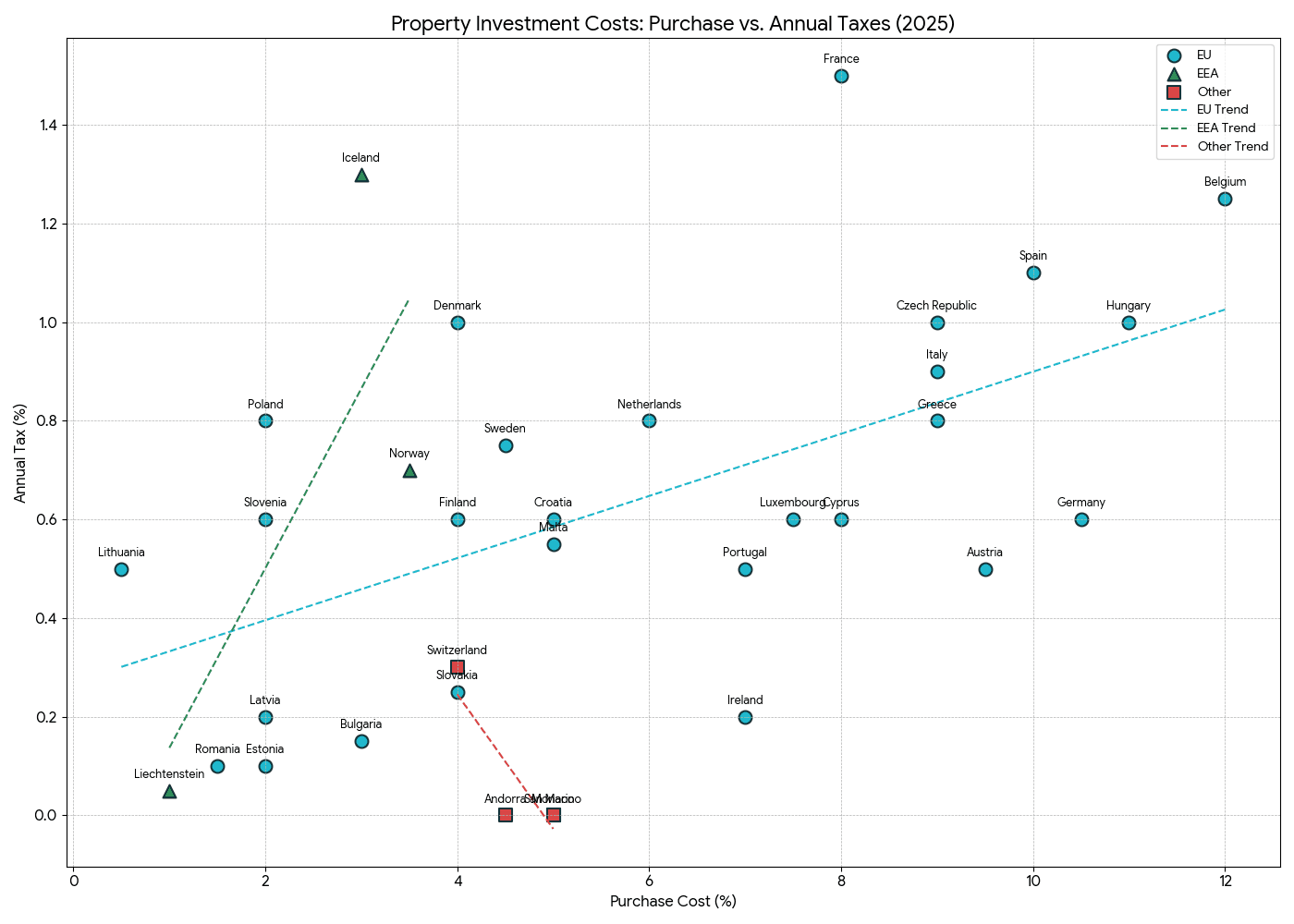
Key Insights by Region:
Most Expensive Markets:
- Belgium: 12% purchase + 1.25% annual = highest total cost
- Hungary: 11% purchase costs despite low income taxes
- Germany: 10.5% purchase costs but strong rental yields
Good Value Markets:
- Lithuania: 0.5% purchase + 0.5% annual = lowest total cost in EU
- Estonia: 2% purchase + 0.1% annual = excellent for tech workers
- Romania: 1.5% purchase + 0.1% annual = exceptional value
Tax Haven Advantages:
- Monaco: No annual property taxes
- Andorra: No annual property taxes
- Cyprus: 0% CGT (except local real estate) + reasonable costs
Healthcare & Insurance Abroad
Understanding Your Coverage Options in All European Countries
When relocating from the UK to any European destination, your healthcare coverage becomes significantly more complex, especially when considering the differences between EU, EEA, and non-EU countries.
EHIC/GHIC Coverage Across Europe
Full Coverage Countries (EU + EEA):
- All 27 EU countries: Austria, Belgium, Bulgaria, Croatia, Cyprus, Czech Republic, Denmark, Estonia, Finland, France, Germany, Greece, Hungary, Ireland, Italy, Latvia, Lithuania, Luxembourg, Malta, Netherlands, Poland, Portugal, Romania, Slovakia, Slovenia, Spain, Sweden
- EEA countries: Iceland, Liechtenstein, Norway
- Additional: Switzerland (through separate agreement)
Limited/No Coverage:
- Monaco: No EHIC/GHIC coverage (private insurance required)
- Andorra: No EHIC/GHIC coverage (private insurance required)
- San Marino: Limited reciprocal arrangements
International Private Medical Insurance (IPMI)
IPMI becomes essential when living in any European country long-term, providing comprehensive coverage that EHIC/GHIC cannot match.
Why IPMI Matters:
- Comprehensive coverage: Routine care, specialists, dental, optical
- Choice of providers: Access to private healthcare systems
- Multi-country living: Essential for digital nomads
- Emergency evacuation: Return to UK or appropriate medical facility
- Pre-existing conditions: Coverage after underwriting period
Specialist WeCovr specialists or broker partners can arrange international PMI to keep you covered when living abroad, including multi-country living arrangements across the EU and EEA.
Healthcare Quality by Region
Nordic Excellence (Universal Systems):
- Denmark, Sweden, Finland: World-class universal healthcare
- Norway, Iceland: Comprehensive coverage with minimal wait times
Western European Standards:
- Germany, France, Netherlands: Mixed public-private systems with high quality
- Switzerland: Private insurance mandatory but specialist care
- Austria: Strong public system with private options
Southern European Mixed Systems:
- Spain, Italy: Good public systems, private supplements common
- Portugal, Greece: Basic public coverage, private recommended
- Cyprus, Malta: Developing systems, international insurance advisable
Eastern European Developing Systems:
- Czech Republic, Estonia: Rapidly improving, EU standards
- Poland, Hungary: Basic public, private supplementation recommended
- Bulgaria, Romania: Limited public systems, private insurance essential
Special Jurisdictions:
- Monaco: Premium private healthcare required
- Liechtenstein: Swiss-standard system
- Andorra: Mixed system with French/Spanish coordination
Compliance & Risk
Multi-Country Compliance Challenges
When considering any European destination, several compliance risks become particularly important:
Permanent Establishment Risks by Country Type
High-Risk Countries (Strict PE Rules):
- Germany: Aggressive interpretation of management and control
- France: Complex rules around centre of economic interests
- Netherlands: Strict substance requirements
- Belgium: Enhanced beneficial ownership reporting
Moderate-Risk Countries:
- Spain, Italy, Portugal: Standard EU approaches with some flexibility
- Austria, Luxembourg: Business-friendly but EU-compliant
- Nordic countries: Clear rules, predictable application
Lower-Risk Countries:
- Estonia: Digital-first approach, clear guidelines
- Cyprus, Malta: International business friendly
- Czech Republic, Poland: Pragmatic application
- Bulgaria, Romania: Developing enforcement
Record-Keeping Requirements
Essential for All European Destinations:
- Travel records: Entry/exit stamps, flight bookings, accommodation receipts
- Residence evidence: Rental agreements, utility bills, bank statements
- Professional ties: Employment contracts, business registrations
- Social connections: School enrollments, healthcare registrations, club memberships
When to Engage Professional Advisers
Country-Specific Specialist Requirements
Complex Tax Systems (Require Local Experts):
- Germany: Transfer pricing, CFC rules, trade tax variations
- France: Wealth tax, social charges, complex residency rules
- Netherlands: Box system, 30% ruling eligibility
- Switzerland: Cantonal variations, lump sum taxation
Moderate Complexity (Regional Expertise Sufficient):
- Spain, Portugal, Italy: Well-established expat advisory industry
- Nordic countries: Clear rules but high rates require optimisation
- Eastern EU countries: Growing expertise, EU compliance
Straightforward Systems (Basic Advice Often Sufficient):
- Cyprus, Malta: Non-dom regimes well-established
- Estonia: Digital processes, clear guidelines
- Bulgaria: Simple flat tax system
- Czech Republic: Standard EU approaches
Step-by-Step Planning Checklist
Universal Pre-Move Checklist (All European Destinations)
90-180 Days Before Departure
UK Tax Position Review:
- Assess SRT position for all potential destinations
- Review 2026 domicile changes and their impact
- Plan asset disposal timing around departure
- Consider pension arrangements and QROPS transfers
- Review trust structures if applicable
Destination Research:
- Compare tax rates across shortlisted countries
- Research special regimes available to newcomers
- Understand visa/residency requirements for non-EU nationals
- Assess healthcare systems and insurance needs
- Evaluate education systems if children involved
30-90 Days Before Departure
Administrative Preparation:
- Complete P85 if applicable
- Notify HMRC of departure
- Arrange international banking facilities
- Research local tax registration requirements
- Plan healthcare transition and arrange IPMI
Upon Arrival (All Countries)
Universal Registration Steps:
- Register with local authorities (timeframes vary by country)
- Apply for tax identification number
- Open local bank account
- Register with healthcare system
- Begin residence evidence collection
Country-Specific Variations
EU Countries (Freedom of Movement)
- No visa required for UK citizens (may need residence registration)
- 3-6 months to register residence in most countries
- Automatic healthcare access in most systems after registration
EEA Countries (Norway, Iceland, Liechtenstein)
- Residence permits may be required for UK citizens post-Brexit
- Work permits necessary for employment
- Separate healthcare arrangements needed
Other European Countries
- Specific visa requirements (Monaco, Switzerland, Andorra)
- Investment thresholds may apply
- Private insurance typically mandatory
Frequently Asked Questions
Country-Specific Questions
Q1: Which European country has the lowest taxes overall?
A: The answer depends on your income type and amount:
Lowest Personal Income Tax:
- Monaco: 0% (but expensive residency requirements)
- Bulgaria and Romania: 10% flat rate (EU countries)
- Andorra: Maximum 10% (non-EU)
- Hungary: 15% flat rate
Lowest Capital Gains Tax:
- Cyprus, Malta, Monaco, Andorra: 0% on foreign assets
- Switzerland: 0% for private investors
- Luxembourg: 0% after 6-month holding period
Lowest Overall Tax Burden (including social security):
- Cyprus: With non-dom status
- Estonia: For retained business profits
- Bulgaria: 10% income + 27.1% social security
- Monaco: 0% income tax but high living costs
Q2: Can I maintain EU benefits if I move to a non-EU European country?
A: It depends on the specific country:
EEA Countries (Norway, Iceland, Liechtenstein):
- Most EU benefits maintained through EEA Agreement
- Freedom of movement for goods, services, people, capital
- Single market access for businesses
- EHIC coverage continues
Switzerland:
- Bilateral agreements provide some EU-like benefits
- Freedom of movement for persons (with limitations)
- No customs union membership
Other Countries (Monaco, Andorra, San Marino):
- No EU benefits - treated as third countries
- Separate agreements may exist for specific areas
- Higher barriers for business and personal mobility
Q3: What about the best countries for digital nomads?
A: Based on our analysis, the top tiers are:
Tier 1 (Best Overall):
- Estonia: €3,500 income requirement, 20% tax, excellent digital infrastructure
- Cyprus: €3,500 income requirement, 0% foreign tax, Mediterranean lifestyle
- Portugal: €2,800 income requirement, 20% tax under ITS, great quality of life
Tier 2 (Great Value):
- Czech Republic: €2,500 income requirement, 15% tax, Central European base
- Hungary: €2,000 income requirement, 15% tax, Budapest hub
- Malta: €2,700 income requirement, 0% foreign tax, English-speaking
Tier 3 (Budget Options):
- Bulgaria: €1,500 income requirement, 10% tax, very low costs
- Croatia: €2,300 income requirement, 25% tax, beautiful coastline
- Romania: Growing tech scene, reasonable requirements
Q4: How do property investment costs compare across Europe?
A: Our comprehensive analysis shows:
Highest Purchase Costs:
- Belgium: 12% upfront costs
- Hungary: 11% upfront costs
- Germany: 10.5% upfront costs
Lowest Purchase Costs:
- Lithuania: 0.5% upfront costs
- Romania: 1.5% upfront costs
- Estonia: 2.0% upfront costs
Highest Annual Taxes:
- France: 1.5% annual property tax
- Iceland: 1.3% annual property tax
- Belgium: 1.25% annual property tax
Lowest Annual Taxes:
- Estonia: 0.1% annual property tax
- Romania, Bulgaria: 0.1-0.15% annual property tax
- Monaco, Andorra: 0% annual property tax
Q5: What are the healthcare implications of moving to different European regions?
A: Healthcare quality and access varies significantly:
Excellent Universal Systems:
- Nordic countries: World-class, tax-funded systems
- Germany, France, Netherlands: Mixed systems with high quality
- Austria: Strong public system
Good Systems with Private Supplements:
- Spain, Italy: Decent public, private recommended
- Czech Republic, Estonia: Rapidly improving EU-standard systems
Systems Requiring Private Insurance:
- Eastern Europe (Bulgaria, Romania): Basic public systems
- Cyprus, Malta: Developing systems
- Monaco, Switzerland: Private insurance mandatory
IPMI Recommendations:
- Essential for multi-country living
- Recommended for Eastern Europe
- Advisable as supplement in Southern Europe
- Optional but valuable in Nordic/Western Europe
For comprehensive healthcare coverage across all European destinations, speak with WeCovr to compare international PMI options for your specific needs.
Brexit-Related Questions
Q6: How has Brexit affected my options for moving to Europe?
A: Brexit significantly changed UK citizens' status:
EU Countries:
- No longer EU citizens - now "third country nationals"
- Visa-free visits: Up to 90 days in 180-day period
- Residence permits: Required for longer stays
- Work permits: Necessary for employment (with exceptions for some countries)
EEA Countries:
- Separate agreements negotiated post-Brexit
- Generally favorable treatment for UK citizens
- Work rights often more restricted than pre-Brexit
Impact on Taxes:
- Double taxation treaties remain in force
- No change to tax residency rules
- Some countries offer special visas for UK citizens
Q7: Which countries are most welcoming to UK citizens post-Brexit?
A: Several countries actively court UK relocators:
Most Welcoming:
- Portugal: D7 visa for remote workers and retirees
- Spain: Various visa categories, large UK expat community
- Netherlands: Continues to welcome skilled UK workers
- Cyprus, Malta: Non-dom programmes attractive to UK tax planning
Moderately Welcoming:
- Germany, France: Standard EU immigration rules
- Italy: Golden visa and flat tax programs
- Eastern Europe: Generally pragmatic approach
Special Arrangements:
- Ireland: Common Travel Area maintains special relationship
- Gibraltar: Unique arrangements due to sovereignty issues
Call-to-Action
Moving from the UK to any European destination involves navigating complex tax, legal, and healthcare considerations across 34 different countries, each with unique rules, opportunities, and challenges. This comprehensive guide covers every EU and EEA country plus key European destinations, but successful international relocation requires personalised professional advice tailored to your specific circumstances and chosen destination.
Professional Tax and Legal Advice
Given the complexity of cross-border taxation across multiple jurisdictions and the significant penalties for non-compliance, we strongly recommend engaging qualified advisers in both the UK and your destination country. The investment in professional advice typically saves multiples of its cost through tax optimisation and penalty avoidance, especially when navigating the different systems across 34 countries.
International Healthcare Coverage
Whether you're moving to the tax-efficient environments of Cyprus and Malta, the digital nomad havens of Estonia and Portugal, the traditional powerhouses of Germany and France, or exploring opportunities in emerging markets like Bulgaria and Romania, comprehensive healthcare coverage is essential.
For complete healthcare coverage across all European destinations, including multi-country living arrangements and access to private healthcare standards throughout Europe, speak with WeCovr to compare international PMI options for your move. Their FCA-authorized experts understand the nuances of healthcare systems across all EU and EEA countries and can ensure you have appropriate protection before departing the UK.
Taking the Next Steps
Your journey from UK to European residence should be planned carefully with professional guidance, whether you're attracted to:
- The sophistication of Monaco and Switzerland
- The innovation of Estonia and Finland
- The lifestyle of Spain and Portugal
- The opportunities of Eastern Europe
- The quality of Nordic countries
- The tax efficiency of Cyprus and Malta
Proper planning ensures you maximize the benefits while minimizing the risks and costs of your international move across any of the European destinations covered in this guide.
Disclaimer: This guide contains general information only and should not be relied upon as tax, legal, or financial advice. Tax laws change frequently, and individual circumstances vary across 34 different European jurisdictions. Always consult qualified professionals in both the UK and your chosen destination before making any decisions. The authors accept no responsibility for any losses arising from the use of this information.
Sources
- NHS England: Waiting times and referral-to-treatment statistics.
- Office for National Statistics (ONS): Health, mortality, and workforce data.
- NICE: Clinical guidance and technology appraisals.
- Care Quality Commission (CQC): Provider quality and inspection reports.
- UK Health Security Agency (UKHSA): Public health surveillance reports.
- Association of British Insurers (ABI): Health and protection market publications.
Important Information and Risks
No advice: This article is for general information only. It is not financial, legal, insurance, or tax advice, and it is not a personal recommendation. WeCovr does not assess your individual circumstances or recommend a specific product through this article.
Policy exclusions and underwriting: Insurance policies, including life insurance, private medical insurance, critical illness cover, and income protection, are subject to insurer underwriting, eligibility, acceptance criteria, terms, conditions, limits, and exclusions. Pre-existing medical conditions may be excluded, restricted, or accepted on special terms unless an insurer confirms otherwise in writing.
Tax treatment: References to tax treatment, HMRC rules, or business reliefs are based on current UK legislation and guidance, which can change. Tax treatment depends on your personal or business circumstances and may differ from examples in this article.
Before you buy: Always read the Insurance Product Information Document (IPID), policy summary, and full policy terms before buying, renewing, changing, or keeping cover. If you are unsure whether a policy is suitable for you, speak to an insurance adviser.
Compare private health insurance quotes from leading UK insurers
Answer a few quick questions and a specialist from WeCovr or one of its broker partners will help you compare cover from insurers such as Bupa, AXA, Aviva and Vitality. No obligation.
Takes about 2-3 minutes
Compare cover from leading UK insurers
No obligation to buy
Get a quote
Get a private health insurance quote
Answer a few questions, then a specialist helps you compare cover and prices.
Tell us who needs cover
Just you, a partner, your family or your staff.
Compare your options
A specialist compares cover and prices from leading UK insurers.
Decide in your own time
There is no obligation to buy.
What you get
A specialist from WeCovr or one of its broker partners
Options compared across leading UK insurers
No obligation to buy